A long straight wire carries an electric current of $2\,A$. The magnetic induction at a perpendicular distance of $5\,m$ from the wire is
Easy
Download our app for free and get started
(b) $B = {10^{ - 7}}\frac{{2i}}{r} = {10^{ - 7}} \times \frac{{2 \times 2}}{5} = 8 \times {10^{ - 8}}\,T$

Download our appand get started for free
Experience the future of education. Simply download our apps or reach out to us for more information. Let's shape the future of learning together!No signup needed.*
Similar Questions
- 1An electron is moving along positive $x$-axis.Auniform electric field exists towards negative $y$-axis. What should be the direction of magnetic field of suitable magnitude so that net force of electron is zeroView Solution
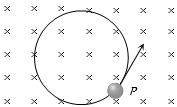
- 2A particle having a charge of $10.0\,\mu C$ and mass $1\,\mu g$ moves in a circle of radius $10\,cm$ under the influence of a magnetic field of induction $0.1\,T$. When the particle is at a point $P$, a uniform electric field is switched on so that the particle starts moving along the tangent with a uniform velocity. The electric field is......$V/m$View Solution
- 3In the following hexagons, made up of two different material $P$ and $Q,$ current enters and leaves from points $X$ and $Y$ respectively. In which case the magnetic field at its centre is not zero.View Solution
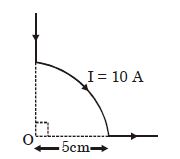
- 4Find out magnetic field at point $O$ ?View Solution
- 5A current of $I$ $ampere$ is passed through a straight wire of length $2.0$ $metres$. The magnetic field at a point in air at a distance of $3$ $metres$ from either end of wire and lying on the axis of wire will beView Solution
- 6The deflection in moving coil galvanometer falls from $25$ divisions to $5$ division when a shunt of $24\ \Omega$ is applied. The resistance of galvanometer coil will be :View Solution
- 7An electron of mass $m$ and charge $q$ is travelling with a speed $v$ along a circular path of radius $r$ at right angles to a uniform of magnetic field $B$. If speed of the electron is doubled and the magnetic field is halved, then resulting path would have a radius ofView Solution
- 8A moving coil galvanometer has $50$ turns and each turn has an area $2 \times 10^{-4} m ^2$. The magnetic field produced by the magnet inside the galvanometer is $0.02 T$. The torsional constant of the suspension wire is $10^{-4} N m rad ^{-1}$. When a current flows through the galvanometer, a full scale deflection occurs if the coil rotates by $0.2$ rad. The resistance of the coil of the galvanometer is $50 \Omega$. This galvanometer is to be converted into an ammeter capable of measuring current in the range $0-1.0 A$. For this purpose, a shunt resistance is to be added in parallel to the galvanometer. The value of this shunt resistance, in ohms, is. . . . . .View Solution
- 9The radius of a circular ring of wire is $R$ and it carries a current of $I\,ampere$. At its centre a smaller ring of radius $r$ with current $i$ and $N\, turns$ is placed. Assuming that the planes of two rings are perpendicular to each other and the magnetic induction produced at the centre of bigger ring is constant, then the torque acting on smaller ring will beView Solution
- 10An electron with kinetic energy $5 \mathrm{eV}$ enters a region of uniform magnetic field of $3 \mu \mathrm{T}$ perpendicular to its direction. An electric field $\mathrm{E}$ is applied perpendicular to the direction of velocity and magnetic field. The value of $\mathrm{E}$, so that electron moves along the same path, is . . . . . $\mathrm{NC}^{-1}$.View Solution
(Given, mass of electron $=9 \times 10^{-31} \mathrm{~kg}$, electric charge $=1.6 \times 10^{-19} \mathrm{C}$ )