A current of $I$ $ampere$ is passed through a straight wire of length $2.0$ $metres$. The magnetic field at a point in air at a distance of $3$ $metres$ from either end of wire and lying on the axis of wire will be
Easy


Download our appand get started for free
Experience the future of education. Simply download our apps or reach out to us for more information. Let's shape the future of learning together!No signup needed.*
Similar Questions
- 1Two long and parallel straight wires $A$ and $B$ carrying currents of $8.0\; A$ and $5.0\; A$ in the same direction are separated by a distance of $4.0\; cm$. Estimate the force on a $10\; cm$ section of wire $A.$View Solution
- 2The magnetic induction due to an infinitely long straight wire carrying a current $i$ at a distance $r$ from wire is given byView Solution
- 3If two protons are moving with speed $v=4.5 \times 10^{5} \,m / s$ parallel to each other then the ratio of electrostatic and magnetic force between themView Solution
- 4The resistance of a galvanometer is $50\, ohm$ and the maximum current which can be passed through it is $0.002\, A$. What resistance must be connected to it in order to convert it into an ammeter of range $0 -0.5\, A$ ?....$ohm$View Solution
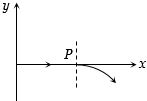
- 5For a positively charged particle moving in a $x-y$ plane initially along the $x$-axis, there is a sudden change in its path due to the presence of electric and/or magnetic fields beyond $P$. The curved path is shown in the $x-y$ plane and is found to be non-circular. Which one of the following combinations is possibleView Solution
- 6View SolutionThe resultant magnetic moment of neon atom will be
- 7In a certain region static electric and magnetic fields exist. The magnetic field is given by $\vec B = {B_0}\left( {\hat i + 2\hat j - 4\hat k} \right)$. If a test charge moving with a velocity $\vec v = {v_0}\left( {3\hat i - \hat j + 2\hat k} \right)$ experiences no force in that region, then the electric field in the region, in $SI\, units$, isView Solution
- 8View SolutionTwo infinitely long parallel wires carry equal current in same direction. The magnetic field at a mid point in between the two wires is
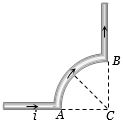
- 9A wire carrying current $i$ is shaped as shown. Section $AB$ is a quarter circle of radius $r$. The magnetic field is directedView Solution
- 10The coil in a moving coil galvanometer experiences torque proportional to current passes through it. If a steady current $i$ is passed through it the steady deflection of the coil is found to be $90^o$ . Now the steady current is switched off and a charge $q$ is suddenly passed through coil. If the coil has $N$ turns of area $A$ and its moment of inertia is $I$ about the axis it is going to rotate then the maximum angle through which it deflects upon passing charge $q$ isView Solution