MCQ
A long, straight wire of radius $R$ carries a current distributed uniformly over its cross section. $T$ he magnitude of the magnetic field is:
  • A
    Maximum at the axis of the wire.
  • B
    Minimum at the axis of the wire.
  • C
    Maximum at the surface of the wire.
  •  Both $B$ and $C$

Answer

Correct option: D.
 Both $B$ and $C$
A long, straight wire of radius $R$ is carrying current $i,$ which is uniformly distributed over its cross section. According to Ampere's law,
$\oint\overrightarrow{\text{B}}.\text{d}\overrightarrow{\text{l}}=\mu_0\text{i}_\text{inside}$
At surface,
$\text{B}\times2\pi\text{R}=\mu_0\text{i}$
$\Rightarrow\text{B}_\text{surface}=\frac{\mu_0\text{i}}{2\pi\text{R}}$
Inside, $\text{B}\times2\pi\text{r}=\mu_0\text{i}$ for $\text{r}<\text{R}$
Here $i$, is the current enclosed by the amperian loop drawn inside the wire.
$B_{inside}$ will be proportional to the distance from the axis.
On the axis
$B = 0$
The magnetic fields from points on the cross section will point in opposite directions and will cancel each other at the centre.
Outside, $\text{B}\times2\pi\text{r}=\mu_0\text{i}$
$\Rightarrow\text{B}_\text{outside}=\frac{\mu_0\text{i}}{2\pi\text{r}},\ \text{r}>\text{R}$
Therefore, the magnitude of the magnetic field is maximum at the surface of the wire and minimum at the axis of the wire.

Need a full question paper?

Generate a complete, print-ready paper with questions like this in minutes — across 16+ boards, with answer keys.

Start Generating Free

Similar questions

A monatomic gas at pressure $P_1$ and volume $V_1$ is compressed adiabatically to ${\frac{1}{8}}^{th}$ of its original volume. What is the final pressure of the gas is ........ $P_1$?
If the density of the earth is doubled keeping its radius constant then acceleration due to gravity will be........ $m/{s^2}$ . $(g = 9.8\,m/{s^2})$
Three particles, located initially on the vertices of an equilateral triangle of side $L,$ start moving with a constant tangential acceleration towards each other in a cyclic manner, forming spiral loci that coverage at the centroid of the triangle. The length of one such spiral locus will be
A missile is fired for maximum range with an initial velocity of $20\; m/s$. If $g = 10 \;m/s^2$ , the range of the missile is ...... $m$
The transverse displacement of a string clamped at its both ends is given by 

$y\left( {x,t} \right) = 2\,\sin \,\left( {\frac{{2\pi }}{3}x} \right)\,\cos \,\left( {100\,\pi t} \right)$ 

where $x$ and $y$ are in $cm$ and $t$ is in $s$. Which of the following statements is correct ?

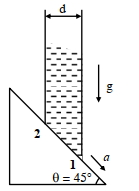
A cylindrical tube, with its base as shown in the figure, is filled with water. It is moving down with a constant acceleration $a$ along a fixed inclined plane with angle $\theta=45^{\circ} . P_1$ and $P_2$ are pressures at points 1 and 2 , respectively, located at the base of the tube. Let $\beta=\left(P_1-P_2\right) /(\rho g d)$, where $\rho$ is density of water, $d$ is the inner diameter of the tube and $g$ is the acceleration due to gravity. Which of the following statement($s$) is(are) correct?

$(A)$ $\beta=0$ when $a= g / \sqrt{2}$

$(B)$ $\beta>0$ when $a= g / \sqrt{2}$

$(C)$ $\beta=\frac{\sqrt{2}-1}{\sqrt{2}}$ when $a= g / 2$

$(D)$ $\beta=\frac{1}{\sqrt{2}}$ when $a= g / 2$

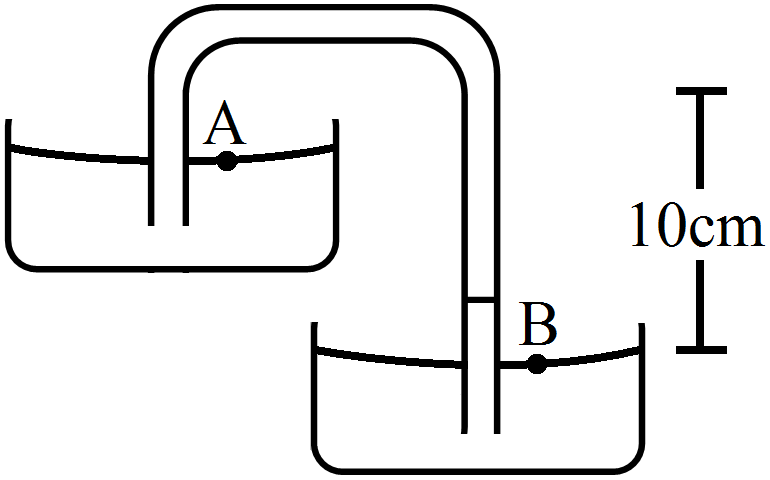
Figure shows a siphon. The liquid shown is water. The pressure difference $P_a P_A$ between the points $A$ and $B$ is the reading will be:
What could be a correct expression for the speed of ocean waves in terms of its wavelength $\lambda $ , the depth $h$ of the ocean, the density $\rho $ of sea water, and the acceleration of free fall $g$ ?
A uniform tube of length $60.5\,cm$ is held vertically with its lower end dipped in water. A sound source of frequency $500\,Hz$ sends sound waves into the tube. When the length of tube above water is $16\,cm$ and again when it is $50\,cm,$ the tube resonates with the source of sound. Two lowest frequencies (in $Hz$), to which tube will resonate when it is taken out of water, are (approximately).
A body of $5 \,kg$ is moving with a velocity of $20 \,m/s$. If a force of $100\,N$ is applied on it for $10\,s$ in the same direction as its velocity, what will now be the velocity of the body.........$m/s$