MCQ
A uniform tube of length $60.5\,cm$ is held vertically with its lower end dipped in water. A sound source of frequency $500\,Hz$ sends sound waves into the tube. When the length of tube above water is $16\,cm$ and again when it is $50\,cm,$ the tube resonates with the source of sound. Two lowest frequencies (in $Hz$), to which tube will resonate when it is taken out of water, are (approximately).
  • A
    $281,562$
  • B
    $281,843$
  • C
    $276,552$
  • $272,544$

Answer

Correct option: D.
$272,544$
d
Two lowest frequencies to which tube will resonates are $272\,Hz$ and  $544\,Hz$

Need a full question paper?

Generate a complete, print-ready paper with questions like this in minutes — across 16+ boards, with answer keys.

Start Generating Free

Similar questions

In which of the following cases is the contact force between $A$ and $B$ maximum $(m_A = m_B = 1 kg)$
A charged particle moves in a gravity$-$free space without change in velocity. Which of the following is are possible:
  1. $\text{E}=0,\ \text{B}=0$
  2. $\text{E}=0,\ \text{B}\not=0$
  3. $\text{E}\not=0,\ \text{B}=0$
  4. $\text{E}\not=0,\ \text{B}\not=0$
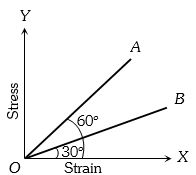
The stress versus strain graphs for wires of two materials $A$ and $B$ are as shown in the figure. If ${Y_A}$ and ${Y_B}$ are the Young ‘s modulii of the materials, then
For a gas, the difference between the two specific heats is $4150\, J\, kg^{-1}\, K^{-1}$ and the ratio of the two specific heats is $1.4$. What is the specific heat of the gas at constant volume in units of $J\, kg^{-1}\, K^{-1}$ ?
An ideal gas is in thermodynamic equilibrium. The number of degrees of freedom of a molecule of the gas in $n$. The internal energy of one mole of the gas is $U_n$ and the speed of sound in the gas is $v_n$. At a fixed temperature and pressure, which of the following is the correct option?
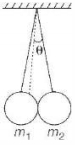
Two spherical objects each of radii $R$ and masses $m_1$ and $m_2$ are suspended using two strings of equal length $L$ as shown in the figure $(R << L)$. The angle $\theta$ which mass $m_2$ makes with the vertical is approximately
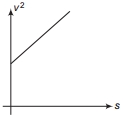
$v^2$ versus $s$-graph of a particle moving in a straight line is as shown in figure. From the graph some conclusions are drawn. State which statement is wrong?
What happens to the centripetal acceleration of a revolving body if you double the orbital speed $v$ and half the angular velocity $\omega $
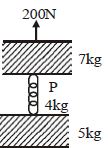
Two blocks of  $7\,\,kg$ and $5\,\,kg$  are connected by a heavy rope of mass $4\,\,kg.$ An upward force of $200\,N$  is applied as shown in the diagram. The tension at the top of heavy rope at point $P$  is ....... $N$ $(g = 10\,\,m/s^2)$
A body starts from rest from the origin with an acceleration of $6 \;m / s^2$ along the $x$-axis and $8\; m / s^2$ along the $y$-axis. Its distance from the origin after $4\; seconds$ will be