MCQ
A loop is moulded by a constant length current carrying wire and placed in external magnetic field, then torque acts on it does not depends upon

$(a)$ Shape of loop

$(b)$ Area of loop.

$(c)$ Current in loop

$(d)$ External magnetic field.


  • A
    Only $a$
  • B
    $a, b$
  • C
    $b, c$
  • None

Answer

Correct option: D.
None
d

Need a full question paper?

Generate a complete, print-ready paper with questions like this in minutes — across 16+ boards, with answer keys.

Start Generating Free

Similar questions

If a charged spherical conductor of radius 10 cm has potential V at a point distant 5 cm from its centre, then the potential at a point distant 15 cm from the centre will be 
Two radioactive materials $X_1$ and $X_2$ have decay constant $5\lambda$ and $\lambda$ respectively intially they have the saame number of nuclei, then the ratio of the number of nuclei of $X_1$ to that $X_2$ will be $\frac{1}{e}$ after a time
Assertion : The permeability of a ferromagnetic material is independent of the magnetic field.
Reason : Permeability of a material is a constant quantity.
Two lenses of power +12 and – 2 diopters are placed in contact. What will the focal length of combination
The minimum intensity of light to be detected by human eye is ${10^{ - 10}}W/{m^2}$. The number of photons of wavelength $5.6 \times {10^{ - 7}}m$ entering the eye, with pupil area ${10^{ - 6}}{m^2}$, per second for vision will be nearly
Two non-conducting solid spheres of radii $R$ and $2 \ R$, having uniform volume charge densities $\rho_1$ and $\rho_2$ respectively, touch each other. The net electric field at a distance $2 \ R$ from the centre of the smaller sphere, along the line joining the centres of the spheres, is zero. The ratio $\frac{\rho_1}{\rho_2}$ can be ;

$(A)$ $-4$ $(B)$ $-\frac{32}{25}$ $(C)$ $\frac{32}{25}$ $(D)$ $4$

The speed of light in media $M_1$ and $M_2$ are $1.5 \times 10^8\,\, m/s$ and $2.0 \times 10^8\,\, m/s$ respectively. A ray of light enters from medium $M_1$ to $M_2$ at an incidence angle $i.$ If the ray suffers total internal reflection, the value of $i$ is
An electron rotates in a circle around a nucleus having positive charge $\mathrm{Ze}$. Correct relation between total energy ( $E$ ) of electron to its potential energy $(U)$ is:
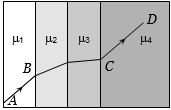
A ray of light passes through four transparent media with refractive indices ${\mu _1},{\mu _2},{\mu _3}$ and ${\mu _4}$ as shown in the figure. The surfaces of all media are parallel. If the emergent ray $CD$ is parallel to the incident ray $AB,$ we must have
Assertion $(A):$ A spherical equipotential surface is not possible for a point charge.

Reason $(R):$ A spherical equipotential surface is possible inside a spherical capacitor.