MCQ
A magnetic dipole in a constant magnetic field has 
  • A
    maximum potential energy when the torque is maximum
  • B
    zero potential energy when the torque is minimum
  • zero potential energy when the torque is maximum
  • D
    minimum potential energy when the torque is maximum.
Answer

Correct option: C.
zero potential energy when the torque is maximum
c
Potential energy of dipole,

$U =  - pE\,\cos \,\theta $

Torque experienced by dipole

$\tau  = pE\,\sin \,\theta $

Torque will be maximum $({\tau _{\max }})$ when $\theta  = {90^o}$

then potential energy $U = 0$

Need a full question paper?

Generate a complete, print-ready paper with questions like this in minutes — across 16+ boards, with answer keys.

Start Generating Free

Similar questions

One mole of an ideal gas at an initial temperature of $T\, K$ does $6\, R\, joules$ of work adiabatically. If the ratio of specific heats of this gas at constant pressure and at constant volume is $\frac{5}{3}$ , the final temperature of gas will be
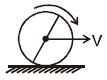
$A$ ring of mass $m$ is rolling without slipping with linear velocity $v$ as shown is figure. $A$ rod of identical mass is fixed along one of its diameter. The total kinetic energy of the system is :-
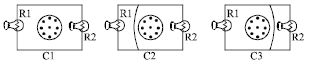
A solenoid is oriented end-on so that its opening is perpendicular to the circuit containing the two light bulbs as drawn in figure $C_1.$ For figure $C_2$ and $C_3,$ a shorting wire of negligible resistance is added as shown. Assume that the magnetic field from the solenoid, shown coming out of the plane of the page, decreases uniformly with time at the same rate for each circuit. Rank the circuits for the brightness of the bulb labeled $R_1$ from brightest to dimmest.
Suppose that the speed of sound in air at a given temperature is $400 m/sec$. An engine blows a whistle at $1200 Hz$ frequency. It is approaching an observer at the speed of $100 m/sec$. What is the apparent frequency as heard by the observer .... $Hz$
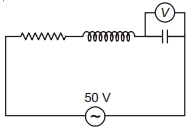
If reading of voltmeter $V$ shown in the figure at resonance is $200 \,V$, then the quality factor of the circuit is
A steady current $I$ is set up in a wire whose cross-sectional area decreases in the direction of the flow of the current. Then, as we examine the narrowing region,
Given below are two statements: one is labelled a

Assertion $(A)$ and the other is labelled as Reason$(R)$

$Assertion$ $(A)$ : Work done by electric field on moving a positive charge on an equipotential surface is always zero.

$Reason$ $(R)$ : Electric lines of forces are always perpendicular to equipotential surfaces.

In the light of the above statements, choose the most appropriate answer from the options given below 

A crystal diode is a
If a gas is heated at constant pressure, its isothermal compressibility
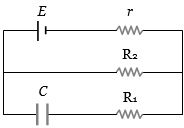
In the given figure each plate of capacitance $C$ has partial value of charge