Question
 A magnetic field can be produced by moving, charges or electric currents. The basic equation governing the magnetic field due to a current distribution is the Biot-Savart law. Finding the magnetic field resulting from a current distribution involves the vector product, and is inherently a calculas problem when the distance from the current to the field point is continuously changing. According to this law, the magnetic field at a point due to a current element of length $\text{d}\vec{\text{I}}$ carrying current I, at a distance r from the element is $\text{dB}=\frac{\mu_0}{4\pi}\frac{\text{I}(\text{d}{\vec{\text{I}}\times\vec{\text{r}}})}{\text{r}^3}$Biot-Savart law has certain similarities as well as difference with Coloumb's law for electrostatic field e.g., there is an angle dependence in Biot-Savart law which is not present in electrostatic case.
  1. The direction of magnetic field $\text{d}\vec{\text{B}}$ due to a current element $\text{Id}\vec{\text{l}}$ at a point of distance $\vec{\text{r}}$ from it, when a current I passes through a long conductor is in the direction
  1. Of position vector $\vec{\text{r}}$ of the point.
  2. Of current element $\text{Id}\vec{\text{l}}$
  3. Perpendicular to both $\text{d}\vec{\text{l}}$ and $\vec{\text{r}}$
  4. Perpendicular to $\text{d}\vec{\text{l}}$ only.
  1. The magnetic field due to a current in a straight wire segment of length Lat a point on its perpendicular bisector at a distance r (r >> L)
  1. Decreases as $\frac{1}{\text{r}}$
  2. Decreases as $\frac{1}{\text{r}^2}$
  3. Decreases as $\frac{1}{\text{r}^3}$
  4. approaches a finite limit as $\text{r}\rightarrow\infty$
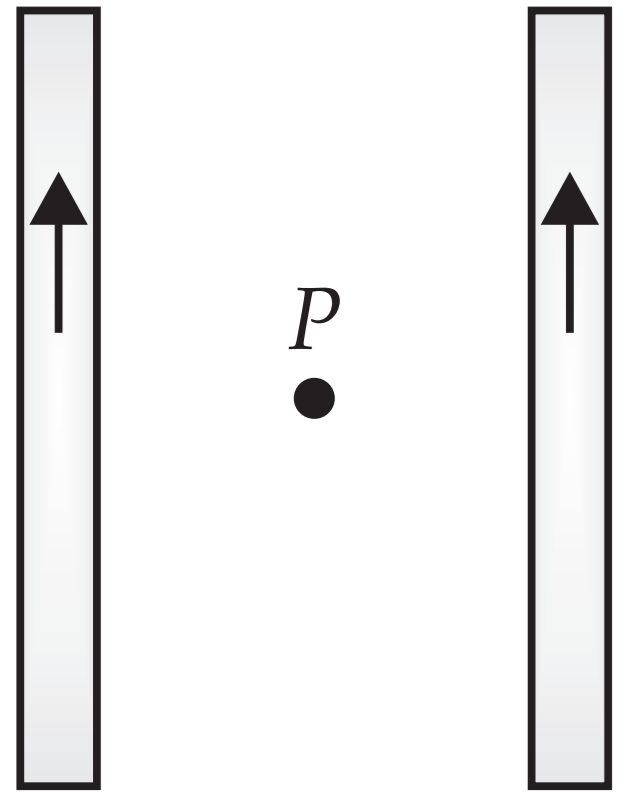
  1. Two long straight wires are set parallel to each other. Each carries a current i in the same direction and the separation between them is 2r. The intensity of the magnetic field midway between them is:
  1. $\mu_0\frac{\text{i}}{\text{r}}$
  2. $4\mu_0\frac{\text{i}}{\text{r}}$
  3. $\text{Zero}$
  4. $\mu_0\frac{\text{i}}{\text{4r}}$
  1. A long straight wire carries a current along the z-axis for any two points in the x - y plane. Which of the following is always false?
  1. The magnetic fields are equal.
  2. The directions of the magnetic fields are the same.
  3. The magnitudes of the magnetic fields are equal.
  4. The field at one point is opposite to that at the other point.
  1. Biot-Savart law can be expressed alternatively as:
  1. Coulomb's Law.
  2. Ampere's circuital law.
  3. Ohm's Law.
  4. Gauss's Law. 

Answer

  1. (c) Perpendicular to both $\text{d}\vec{\text{l}}$ and $\vec{\text{r}}$
Explanation:
According to Biot-Savart's law, the magnetic induction due to a current element is given by,
$\text{d}\vec{\text{B}}=\frac{\mu_0}{4\pi}\frac{\text{Id}\vec{\text{l}\times\text{r}}}{\text{r}^3}$
This is perpendicular to both $\text{d}\vec{\text{l}}$ and $\vec{\text{r}}.$
  1. (b) Decreases as
Explanation:
From Biot-savart's law, $\text{dB}=\frac{\mu_0}{4\pi}\frac{\text{Idl}}{\text{r}^2}\text{i.e. dB}\propto\frac{1}{\text{r}^2}$
  1. (c) $\text{Zero}$
Explanation:
$\text{B}=\frac{\mu_0}{2\pi}.\frac{\text{i}}{\text{r}}-\frac{\mu_0}{2\pi}.\frac{\text{i}}{\text{r}}=0$
  1. (a) The magnetic fields are equal.
  1. (b) Ampere's circuital law.
Explanation:
Biot-Savart law can be expressed alternatively as Ampere circuital law.

Need a full question paper?

Generate a complete, print-ready paper with questions like this in minutes — across 16+ boards, with answer keys.

Start Generating Free

Similar questions

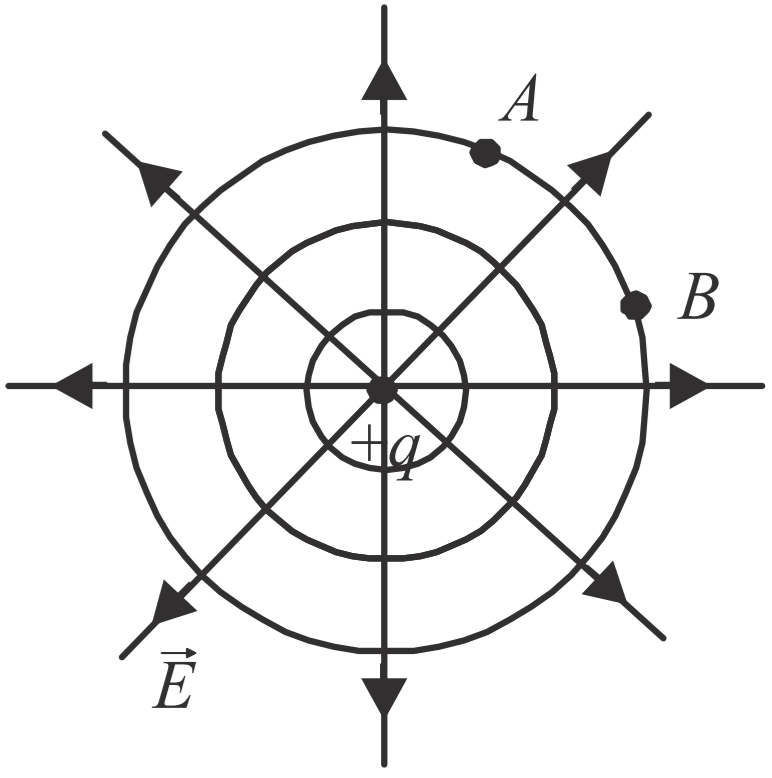
For the various charge systems, we represent equipotential surfaces by curves and line of force by full line curves. Between any two adjacent equipotential surfaces, we assume a constant potential difference the equipotential surfaces of a single point charge are concentric spherical shells with their centres at the point charge. As the tines of force point radially outwards, so they are perpendicular to the equipotential surfaces at all points.
  1. Identify the wrong statement.
  1. Equipotential surface due to a single point charge is spherical.
  2. Equipotential surface can be constructed for dipoles too.
  3. The electric field is normal to the equipotential surface through the point.
  4. The work done to move a test charge on the equipotential surface is positive.
  1. Nature of equipotential surface for a point charge is:
  1. Ellipsoid with charge at foci.
  2. Sphere with charge at the centre of the sphere.
  3. Sphere with charge on the surface of the sphere.
  4. Plane with charge on the surface.
  1. A spherical equipotential surface is not possible:
  1. Inside a uniformly charged sphere.
  2. For a dipole.
  3. Inside a spherical condenser.
  4. For a point charge.
  1. The work done in carrying a charge $q$ once round a circle of radius a with a charge $Q$ at its centre is:
  1. $\frac{\text{qQ}}{4\pi\epsilon_0\text{a}}$
  2. $\frac{\text{qQ}}{4\pi\epsilon_0\text{a}^2}$
  3. $\frac{\text{q}}{4\pi\epsilon_0\text{a}}$
  4. $\text{Zero}$
  1. The work done to move a unit charge along an equipotential surface from $P$ to $Q:$
  1. Must be defined as $-\int\limits_{\text{P}}^{\text{Q}}\vec{\text{E}}\cdot\text{d}\vec{\text{l}}.$
  2. Is zero.
  3. Can have a non$-$zero value.
  4. Both $(a)$ and $(b)$ are correct.
An electromagnetic wave transports linear momentum as it travels through space. If an electromagnetic wave transfers a total energy $U$ to a surface in time $t,$ then total linear momentum delivered to the surface is $\text{p}=\frac{\text{U}}{\text{c}}.$ When an electromagnetic wave falls on a surface, it exerts pressure on the surface. ln $1903,$ the American scientists Nichols and Hull succeeded in measuring radiation pressures of visible light where other had failed, by making a detailed empirical analysis of the ubiquitous gas heating and ballistic effects.
  1. The pressure exerted by an electromagnetic wave of intensity $I (Wm^{-2})$ on a non$-$reflecting surface is $(c$ is the velocity of light$).$ 
  1. $\text{Ic}$
  2. $\text{Ic}^2$
  3. $\frac{\text{I}}{\text{c}}$
  4. $\frac{\text{I}}{\text{c}^2}$
  1. Light with an energy flux of $18\frac{\text{W}}{\text{cm}^2}$ falls on a non$-$reflecting surface at normal incidence. The pressure exerted on the surface is:
  1. $3\frac{\text{N}}{\text{m}^2}$
  2. $2\times10^{-4}\frac{\text{N}}{\text{m}^2}$
  3. $6\frac{\text{N}}{\text{m}^2}$
  4. $6\times10^{-4}\frac{\text{N}}{\text{m}^2}$
  1. Radiation of intensity $0.5Wm^{-2}$ are striking a metal plate. The pressure on the plate is:
  1. $0.166 \times 10^{-8}Nm^{-2}$
  2. $0.212 \times 10^{-8}Nm^{-2}​​​​​​​$
  3. $0.132 \times 10^{-8}Nm^{-2}​​​​​​​$
  4. $0.083 \times 10^{-8}Nm^{-2}​​​​​​​$
  1. A point source of electromagnetic radiation has an average power out$-$put of $1500W.$ The maximum value of electric field at a distance of 3m from this source $($in $Vm^{-1})$ is:
  1. $500$
  2. $100$
  3. $\frac{500}{3}$
  4. $\frac{250}{3}$
  1. The radiation pressure of the visible light is of the order of,
  1. $10^{-2}\frac{\text{N}}{\text{m}^2}$
  2. $10^{-4}\frac{\text{N}}{\text{m}}$
  3. $10^{-6}\frac{\text{N}}{\text{m}^2}$
  4. $10^{-8}\text{N}$
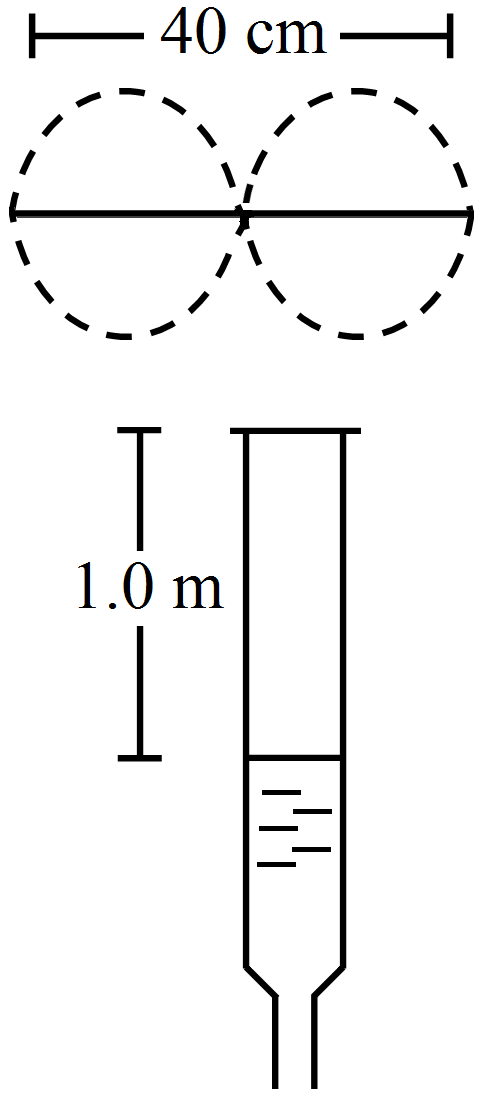
Consider the situation shown in figure. The wire which has a mass of $4.00g$ oscillates in its second harmonic and sets the air column in the tube into vibrations in its fundamental mode. Assuming that the speed of sound in air is $340m/s$, find the tension in the wire.
A moving-coil galvanometer has a 50-turn coil of size 2cm × 2cm. It is suspended between the magnetic poles producing a magnetic field of 0.5T. Find the torque on the coil due to the magnetic field when a current of 20mA passes through it. 
The magnetic moment of the assumed dipole at the earth's centre is $8.0 \times 10^{22}A-m^2$​​​​​​​. Calculate the magnetic field $B$ at the geomagnetic poles of the earth. Radius of the earth is 6400km.
Motion of Charge in Magnetic Field
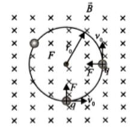
An electron with speed $V_0$ << c moves in a circle of radius $r _{\circ}$ in a uniform magnetic field. This electron is able to traverse a circular path as the magnetic force acting on the electron is perpendicular to both $V_0$ and B ,as shown in the figure. This force continuously deflects the particle sideways without changing its speed and the particle will move along a circle perpendicular to the field. The time required for one revolution of the electron is $T _{ o }$.

Image

(i) If the speed of the electron is now doubled to 2vo. The radius of the circle will change to
(A) $4 r_0$ (B) $2 r_0$ (C) $r _{ o }$ (D) $r _0 / 2$

(ii) If v = 2vo, then the time required for one revolution of the electron (To ) will change to
(A) $4 T_0$ (B) $2 T_{ O }$ (C) $T _{ o }$ (D) $T _{ d } / 2$
(iii) A charged particles is projected in a magnetic field . The acceleration of the particle is found to be. Find the value of x.
(A) $4 ms^{-2}$ (B) $-4 ms^{-2}$ (C) $-2 ms^{-2}$ (D) $2 ms^{-2}$

(iv) If the given electron has a velocity not perpendicular to B, then trajectory of the electron is
(A) straight line (B) circular (C) helical (D) zig-zag

OR

If this electron of charge (e) is moving parallel to uniform magnetic field with constant velocity v, the force acting on the electron is
(A) Bev (B) Be/v (C) B/ev (D) Zero
Derive the formula for the magnetic field produced at a point on the axis of a current carrying circular loop.
Point charge q is placed (i)at the mid-point of the core of a cube of side a meter (ii)centrally on a plane of a cube of side a meter. Calculate the total flux associated with the cube. Also find out how many surfaces of the cube will be the total flux associated?
When white radiation is passed through a sample of hydrogen gas at room temperature, absorption lines are observed in Lyman series only. Explain.
Explain diffraction by a single slit and write down the conditions for central maximum, secondary maxima and minima.