Rajasthan BoardEnglish MediumSTD 12 SciencePhysicsWAVE OPTICS4 Marks
Question
Explain diffraction by a single slit and write down the conditions for central maximum, secondary maxima and minima.
✓
Answer
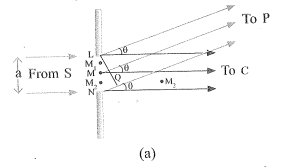
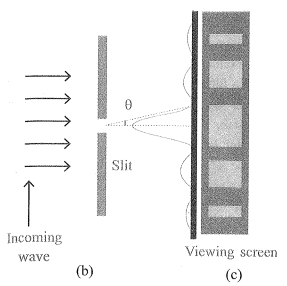
→ When the double slit in Young's experiment is replaced by a single narrow slit (illuminated by a monochromatic source), a broad pattern with a central bright region is seen. → On both the sides, there are alternate dark and bright regions, the intensity becoming weaker away from the centre. (Fig. (b)) →Fig (a) shows a parallel beam of light falling normally, on a single slit LN of width $a$. The diffracted light goes on to meet a screeen. The midpoint of the slit is M . →A straight line through M perpendicular to the slit plane meets the screen at $c$. →We want the intensity at any point P on the screen. As before, straight lines joining P to different points $L, M, N$, etc. can be treated as parallel, making an angle $\theta$ with the normal MC. →Here, the basic idea is to divide the slit into much smaller parts and add their contributions at P with the proper phase difference. →We are treating different parts of the wavefront at the slit as secondary sources. Because the incoming wavefront is parallel to the plane of the slit, these sources are in phase.
Need a full question paper?
Generate a complete, print-ready paper with questions like this in minutes — across 16+ boards, with answer keys.