Question
A magnetic field can be produced by moving, charges or electric currents. The basic equation governing the magnetic field due to a current distribution is the Biot-Savart law. Finding the magnetic field resulting from a current distribution involves the vector product, and is inherently a calculas problem when the distance from the current to the field point is continuously changing. According to this law, the magnetic field at a point due to a current element of length $\text{d}\vec{\text{I}}$ carrying current I, at a distance r from the element is $\text{dB}=\frac{\mu_0}{4\pi}\frac{\text{I}(\text{d}{\vec{\text{I}}\times\vec{\text{r}}})}{\text{r}^3}$Biot-Savart law has certain similarities as well as difference with Coloumb's law for electrostatic field e.g., there is an angle dependence in Biot-Savart law which is not present in electrostatic case.
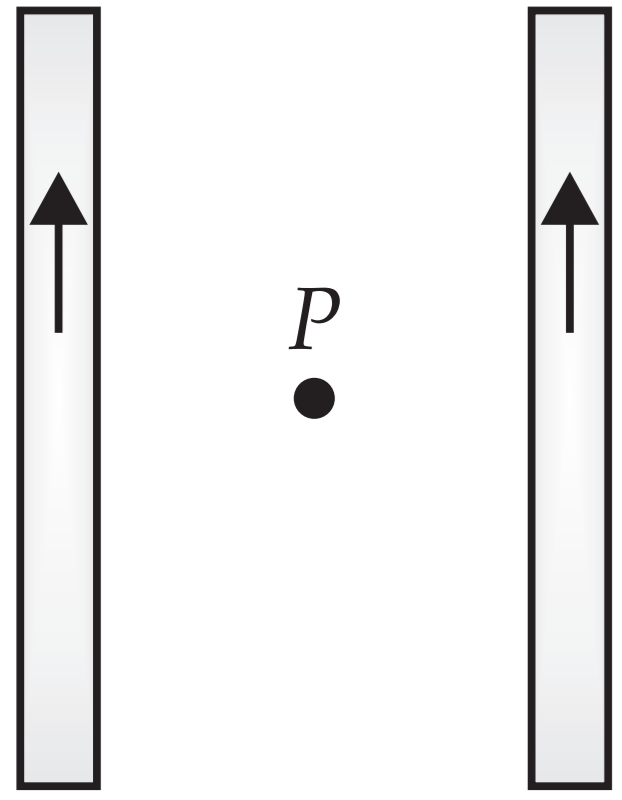
  1. The direction of magnetic field $\text{d}\vec{\text{B}}$ due to a current element $\text{Id}\vec{\text{l}}$ at a point of distance $\vec{\text{r}}$ from it, when a current I passes through a long conductor is in the direction
  1. Of position vector $\vec{\text{r}}$ of the point.
  2. Of current element $\text{Id}\vec{\text{l}}$
  3. Perpendicular to both $\text{d}\vec{\text{l}}$ and $\vec{\text{r}}$
  4. Perpendicular to $\text{d}\vec{\text{l}}$ only.
  1. The magnetic field due to a current in a straight wire segment of length Lat a point on its perpendicular bisector at a distance r (r >> L)
  1. Decreases as $\frac{1}{\text{r}}$
  2. Decreases as $\frac{1}{\text{r}^2}$
  3. Decreases as $\frac{1}{\text{r}^3}$
  4. approaches a finite limit as $\text{r}\rightarrow\infty$
  1. Two long straight wires are set parallel to each other. Each carries a current i in the same direction and the separation between them is 2r. The intensity of the magnetic field midway between them is:
  1. $\mu_0\frac{\text{i}}{\text{r}}$
  2. $4\mu_0\frac{\text{i}}{\text{r}}$
  3. $\text{Zero}$
  4. $\mu_0\frac{\text{i}}{\text{4r}}$
  1. A long straight wire carries a current along the z-axis for any two points in the x - y plane. Which of the following is always false?
  1. The magnetic fields are equal.
  2. The directions of the magnetic fields are the same.
  3. The magnitudes of the magnetic fields are equal.
  4. The field at one point is opposite to that at the other point.
  1. Biot-Savart law can be expressed alternatively as:
  1. Coulomb's Law.
  2. Ampere's circuital law.
  3. Ohm's Law.
  4. Gauss's Law.

Answer

  1. (c) Perpendicular to both $\text{d}\vec{\text{l}}$ and $\vec{\text{r}}$
Explanation:

According to Biot-Savart's law, the magnetic induction due to a current element is given by,

$\text{d}\vec{\text{B}}=\frac{\mu_0}{4\pi}\frac{\text{Id}\vec{\text{l}\times\text{r}}}{\text{r}^3}$

This is perpendicular to both $\text{d}\vec{\text{l}}$ and $\vec{\text{r}}.$
  1. (b) Decreases as
Explanation:

From Biot-savart's law, $\text{dB}=\frac{\mu_0}{4\pi}\frac{\text{Idl}}{\text{r}^2}\text{i.e. dB}\propto\frac{1}{\text{r}^2}$
  1. (c) $\text{Zero}$
Explanation:

$\text{B}=\frac{\mu_0}{2\pi}.\frac{\text{i}}{\text{r}}-\frac{\mu_0}{2\pi}.\frac{\text{i}}{\text{r}}=0$
  1. (a) The magnetic fields are equal.
  1. (b) Ampere's circuital law.
Explanation:

Biot-Savart law can be expressed alternatively as Ampere circuital law.

Need a full question paper?

Generate a complete, print-ready paper with questions like this in minutes — across 16+ boards, with answer keys.

Start Generating Free

Similar questions

You are holding a cage containing a bird. Do you have to make less effort if the bird flies from its position in the cage and manages to stay in the middle without touching the walls of the cage? Does it make a difference whether the cage is completely closed or it has rods to let air pass?
A child has near point at 10cm. What is the maximum angular magnification the child can have with a convex lens of focal length 10cm?
Sunita and her friends visited an exhibition. The policeman asked them to pass through a metal detector. Sunita’s friends were initially scared of it. Sunita, however, explained to them the purpose and working of the metal detector.
Answer the following questions:
  1. On what principle does a metal detector work?
  2. Why does the detector emit sound when a person carrying any metallic object walks through it?
  3. State any two qualities which Sunita displayed while explaining the purpose of walking through the detector.
Explais the arrangements for conducting an experimental study of the photoelectric effect.
The saturation current from a thoriated-tungsten cathode at 2000K is 100mA. What will be the saturation current for a pure-tungsten cathode of the same surface area operating at the same temperature? The constant A in the Richardson-Dushman equation is $60 \times 10^4Am^{-2}K^{-2}$ for pure tungsten and $3.0 \times 10^4Am^{-2}k^{-2}$ for thoriated tungsten. The work function of pure tungsten is 4.5eV and that of thoriated tungsten is 2.6eV.
Microwave oven: The spectrum of electromagnetic radiation contains a part known as microwaves. These waves have frequency and energy smaller than visible light and wavelength larger than it. What is the principle of a microwave oven and how does it work? Our objective is to cook food or warm it up. All food items such as fruit, vegetables, meat, cereals, etc., contain water as a constituent. Now, what does it mean when we say that a certain object has become warmer? When the temperature of a body rises, the energy of the random motion of atoms and molecules increases and the molecules travel or vibrate or rotate with higher energies. The frequency of rotation of water molecules is about 2.45 gigahertz (GHz). If water receives microwaves of this frequency, its molecules absorb this radiation, which is equivalent to heating up water. These molecules share this energy with neighbouring food molecules, heating up the food. One should use porcelain vessels and non-metal containers in a microwave oven because of the danger of getting a shock from accumulated electric charges. Metals may also melt from heating. The porcelain container remains unaffected and cool, because its large molecules vibrate and rotate with much smaller frequencies, and thus cannot absorb microwaves. Hence, they do not get eaten up. Thus, the basic principle of a microwave oven is to generate microwave radiation of appropriate frequency in the working space of the oven where we keep food. This way energy is not wasted in heating up the vessel. In the conventional heating method, the vessel on the burner gets heated first and then the food inside gets heated because of transfer of energy from the vessel. In the microwave oven, on the other hand, energy is directly delivered to water molecules which is shared by the entire food.

(i) As compared to visible light microwave has frequency and energy
(a) Frequency is less but energy is more
(b) less than visible light
(c) more than visible light
(d) equal to visible light

(ii) When the temperature of a body rises
(a) the energy of the random motion of atoms and molecules decreases.
(b) the energy of the random motion of atoms and molecules remains same.
(c) the energy of the random motion of atoms and molecules increases
(d) the random motion of atoms and molecules becomes streamlined.

(iii) he frequency of rotation of water molecules is about
(a) 2.45 THz
(b) 2.45 kHz
(c) 2.45 MHz
(d) 2.45 GHz

OR

In the microwave oven
(a) Energy is directly delivered to the food grains.
(b) The vessel gets heated first and then the water molecules collect heat from the body of the vessel
(c) Energy is directly delivered to water molecules which is shared by the entire food
(d) The vessel gets heated first, and then the food grains inside

(iv) Why should one use porcelain vessels and non-metal containers in a microwave oven?
(a) Because it will prevent the food items to become hot
(b) Because it will get too much hot
(c) Because of the danger of getting a shock from accumulated electric charges
(d) Because it may crack due to high frequency
The friction coefficient between an athelete's shoes and the ground is 0.90. Suppose a superman wears these shoes and races for 50m. There is no upper limit on his capacity of running at high speeds.
  1. Find the minimum time that he will have to take in completing the 50m starting from rest.
  2. Suppose he takes exactly this minimum time to complete the 50m, what minimum time will he take to stop?
A capacitor'C', a variable resistor 'R' and a bulb 'B' are connected in series to the ac mains in circuit as shown. The bulb glows with some brightness. How will the glow of the bulb change if (i) a dielectric slab is introduced between the plates of the capacitor, keeping resistance R to be the same; (ii) the resistance R is increased keeping the same capacitance?
Some washing machines have cloth driers. It contains a drum in which wet clothes are kept. As the drum rotates, the water particles get separated from the cloth. The general description of this action is that "the centrifugal force throws the water particles away from the drum". Comment on this statement from the viewpoint of an observer rotating with the drum and the observer who is washing the clothes.
For a circular coil of radius R and N turns carrying current I, the magnitude of the magnetic field at a point on its axis at a distance x from its centre is given by,
$\text{B}=\frac{\mu_{0}\text{IR}^{2}\text{N}}{2(\text{x}^{2}+\text{R}^{2})^{\frac{3}{2}}}$
  1. Show that this reduces to the familiar result for field at the centre of the coil.
  2. Consider two parallel co-axial circular coils of equal radius R, and number of turns N, carrying equal currents in the same direction, and separated by a distance R. Show that the field on the axis around the mid-point between the coils is uniform over a distance that is small as compared to R, and is given by,$\text{B}=0.72\frac{\mu_{0}\text{NI}}{\text{R}}$, approximately.
[Such an arrangement to produce a nearly uniform magnetic field over a small region is known as Helmholtz coils.]