Question
The saturation current from a thoriated-tungsten cathode at 2000K is 100mA. What will be the saturation current for a pure-tungsten cathode of the same surface area operating at the same temperature? The constant A in the Richardson-Dushman equation is $60 \times 10^4Am^{-2}K^{-2}$ for pure tungsten and $3.0 \times 10^4Am^{-2}k^{-2}$ for thoriated tungsten. The work function of pure tungsten is 4.5eV and that of thoriated tungsten is 2.6eV.
Answer

$\text{i}=\text{AST}^2\text{ e}^{\frac{-\phi}{\text{KT}}}$
$\text{i}_1=\text{i},\ \text{i}_2=100\text{mA}$
$\text{A}_1=60\times10^4,\ \text{A}_2=3\times10^4$
$\text{S}_1=\text{S},\ \text{S}_2=\text{S}$
$\text{T}_1=2000,\ \text{T}_2=2000$
$\phi_1=4.5\text{eV},\ \phi_2 =2.6\text{eV}$
$\text{i}=(60\times10^{4})(\text{S})\times(2000)^2\frac{-45\times1.6\times10^{-19}}{\text{e}^{1.38\times10^{-23}\times2000}}$
$100=(3\times10^{4})(\text{S})\times(2000)^2\frac{-2.6\times1.6\times10^{-19}}{\text{e}^{1.38\times10^{-23}\times2000}}$
Dividing the equation,
$\Rightarrow\frac{\text{i}}{100}=\text{e}^{\big[\frac{-4.5\times1.6\times10}{1.38\times2}\big(\frac{-2.6\times1.6\times10}{1.38\times20}\big)\big]}$
$\Rightarrow\frac{\text{i}}{100}=20\times\text{e}^{-11.014}$
$\Rightarrow\frac{\text{i}}{100}=20\times0.000016$
$\Rightarrow\text{i}=20\times0.0016=0.0329\text{mA}=33\mu\text{A}$

Need a full question paper?

Generate a complete, print-ready paper with questions like this in minutes — across 16+ boards, with answer keys.

Start Generating Free

Similar questions

Cloudy nights are warmer than the nights with clean sky. Explain.
A player hits a baseball at some angle. The ball goes high up in space. The player runs and catches the ball before it hits the ground. Which of the two (the player or the ball) has greater displacement?
TV signals broadcast by Delhi studio cannot be directly received at Patna which is about 1000km away. But the same signal goes some 36000km away to a satellite, gets reflected and is then received at Patna. Explain.
The magnetic field due to the earth has a horizontal component of $26\mu\text{T}$ at a place where the dip is 60°. Find the vertical component and the magnitude of the field.
To convert two atoms into ions, 2 electrons have been removed from each of them. When these ions are placed in a vacuum, they repel each other with a force of $3.7 \times 10^{-9}$ Newton. Find the distance between them.
A magnetic dipole of magnetic moment $0.72\sqrt{2}\text{ A-m}^2$ -is placed horizontally with the north pole pointing towards east. Find the position of the neutral point if the horizontal component of the earth's magnetic field is $18\mu\text{T.}$
A wire is stretched to reduce its diameter to half. What will be the magnitude of its new resistance?
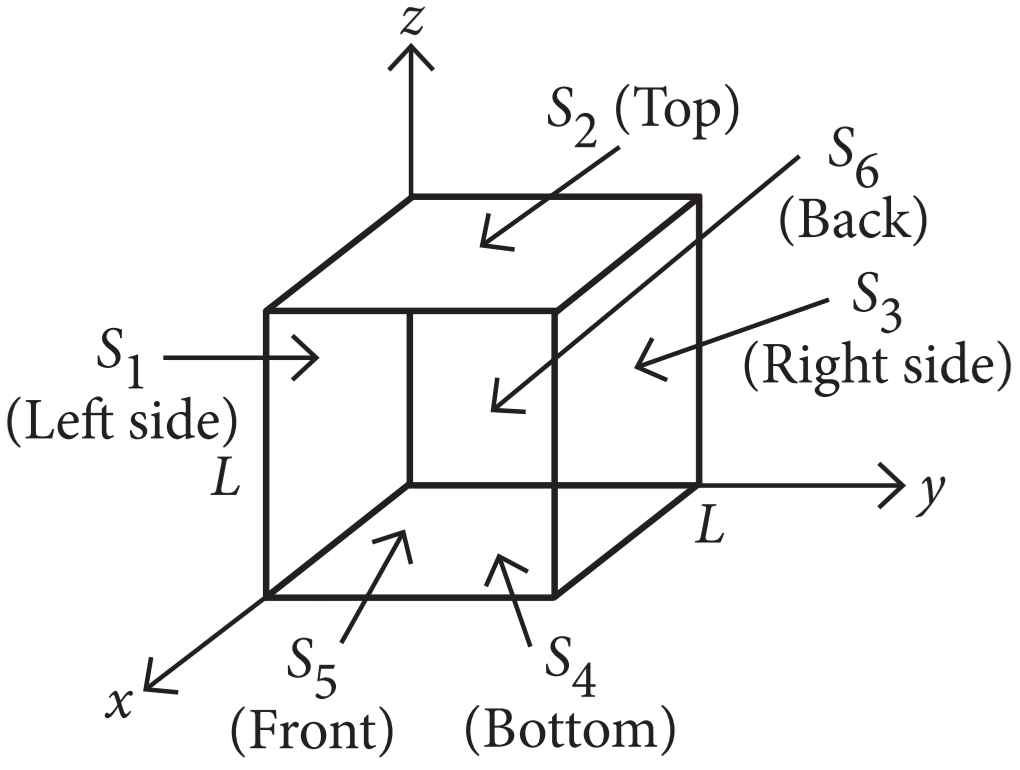
Net electric flux through a cube is the sum of fluxes through its six faces. Consider a cube as shown in figure, having sides of length L = 10.0cm. The electric field is uniform, has a magnitude $E = 4.00 \times 10^3N C^{-1}$ and is parallel to the xy plane at an angle of 37º measured from the + x - axis towards the + y - axis.
  1. Electric flux passing through surface $S_6$ is:
  1. $-24N\ m^2C^{-1}$
  2. $24N\ m^2C^{-1}$
  3. $32N\ m^2C^{-1}$
  4. $-32N\ m^2C^{-1}$
  1. Electric flux passing through surface $S_1$ is:
  1. $-24N\ m^2C^{-1}$
  2. $24N\ m^2 C^{-1}$
  3. $32N\ m^2 C^{-1}$
  4. $-32N\ m^2 C^{-1}$
  1. The surfaces that have zero flux are:
  1. $S_1$ and $S_3$
  2. $S_5$ and $S_6$
  3. $S_2$ and $S_4$
  4. $S_1$ and $S_2$
  1. The total net electric flux through all faces of the cube is:
  1. 8N $m^2\ C^{-1}$
  2. -8N $m^2\ C^{-1}$
  3. 24N $m^2\ C^{-1}$
  4. Zero.
  1. The dimensional formula of surface integral $\oint\vec{\text{E}}\cdot\text{d}\vec{\text{S}}$ of an electric field is:
  1. $[M\ L^2T^{-2} A^{-1}]$
  2. $[M\ L^3T^{-3} A^{-1}]$
  3. $[M\ L^{-1}T^3 A^{-3}]$
  4. $[M\ L^{-3}T^{-3} A^{-1}]$
A tungsten cathode and a thoriated-tungsten cathode have the same geometric dimensions and are operated at the same temperature. The thoriated-tungsten cathode gives 5000 times more current than the other cathode. Find the operating temperature. Take relevant data from the previous problem.
When the atomic dipoles are aligned partially or fully, there is a net magnetic moment in the direction of the field in any small volume of the material. The actual magnetic field inside material placed in magnetic field is the sum of the applied magnetic field and the magnetic field due to magnetisation. This field is called magnetic intensity (H).
$\text{H}=\frac{\text{B}}{\mu_0}-\text{M}$
where Mis the magnetisation of the material, flo is the permittivity of vacuum and B is the total magnetic field. The measure that tells us how a magnetic material responds to an external field is given by a dimensionless quantity is appropriately called the magnetic susceptibility: for a certain class of magnetic materials, intensity of magnetisation is directly proportional to the magnetic intensity.
  1. Magnetization of a sample is:
  1. Volume of sample per unit magnetic moment.
  2. Net magnetic moment per unit volume.
  3. Ratio of magnetic moment and pole strength.
  4. Ratio of pole strength to magnetic moment.
  1. Identify the wrongly matched quantity and unit pair.
  1. Pole strength - Am
  2. Magnetic susceptibility - dimensionless number
  3. Intensity of magnetisation $ - Am^{-1}$
  4. Magnetic permeability - Henry m
  1. A closed surface S encloses a magnetic dipole of magnetic moment 2ml. The magnetic flux emerging from the surface is:
  1. $2 \times 10^5A/ m$
  2. $3 \times 10^5A/ m$
  3. $4 \times 10^5A/ m$
  4. $5 \times 10^5A/ m$
  1. A solenoid has core of a material with relative permeability 500 and its windings carry a current of 1A. The number of turns of the solenoid is 500 per metre. The magnetization of the material is nearly,
  1. $2.5 \times 10^3Am^{-1}$
  2. $2.5 \times 10^5Am^{-1}$
  3. $2.0 \times 10^3Am^{-1}$
  4. $2.0 \times 10^5Am^{-1}$
  1. The relative penneability of iron is 6000. Its magnetic susceptibility is:
  1. $5999$
  2. $6001$
  3. $6000 \times 10^{-7}$
  4. $6000 \times 10^7$