MCQ
A magnetic field can be produced by
  • A
    A moving charge
  • B
    A changing electric field
  • C
    None of these
  • Both of these

Answer

Correct option: D.
Both of these
d
A moving charge and changing electric field both produces magnetic field.

Need a full question paper?

Generate a complete, print-ready paper with questions like this in minutes — across 16+ boards, with answer keys.
Start Generating Free

Similar questions

The magnitude of electric field E in the annular region of a charged cylindrical capacitor
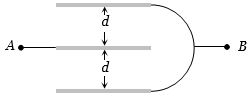
Three plates of common surface area $A$ are connected as shown. The effective capacitance will be
An e.m.f. of 5 volt is produced by a self inductance, when the current changes at a steady rate from 3 A to 2 A in 1 millisecond. The value of self inductance is
Two waves of same amplitude and same wavelength are superimposed in different phases. The amplitude of the resultant wave will be maximum when the phase difference between them is:
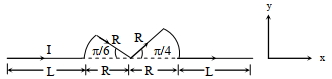
A conductor (shown in the figure) carrying constant current $I$ is kept in the $x-y$ plane in a uniform magnetic field $\vec{B}$. If $F$ is the magnitude of the total magnetic force acting on the conductor, then the correct statement$(s)$ is(are) $Image$

$(A)$ If $\vec{B}$ is along $\hat{z}, F \propto(L+R)$

$(B)$ If $\overrightarrow{ B }$ is along $\hat{ x }, F =0$

$(C)$ If $\vec{B}$ is along $\hat{y}, F \propto(L+R)$

$(D)$ If $\overrightarrow{ B }$ is along $\hat{ z }, F =0$
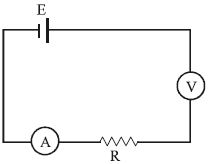
Assertion : All electric devices shown in the circuit are ideal. The reading of each of ammeter $(a)$ and voltmeter $(V)$ is zero.

Reason : An ideal voltmeter draws almost no current due to very large resistance, and hence $(V)$ and $(a)$ will read zero.
Which of the following statement is not true?
Kinetic energy of the emitted $\alpha-$ particle in the $\alpha -$ decay of ${{}_{88}^{226}Ra}$  will be,  .......... $MeV$

(where ${m_\alpha } = 4.00260\,u$, $m\left( {{}_{88}^{226}Ra} \right)=226.02540\,u$ and $m\left( {{}_{86}^{222}Rn} \right)=222.01750\,u)$

If you are provided three resistances $2  \,\Omega$, $3  \,\Omega$ and $6 \,\Omega$. How will you connect them so as to obtain the equivalent resistance of $4  \,\Omega$
When a thin transparent plate of thickness t and refractive index m is placed in the path of one of the two interfering waves of light, then the path difference changes by