MCQ
A magnetic field exerts no force on:
  • A
    An electrical charge moving perpendicular to its direction...
  • B
    An unmagnetised iron bar.
  • C
    A stationary electric charge.
  • D
    A magnet.

Answer

  1. A stationary electric charge.

Explanation:

Magnetic force is given by Lorentz equation as:

F = q(v × B)

Here, q = amount of electric charge, v = velocity of charge and B = magnetic flux

Thus, when velocity of charge​ (v) = 0, magnetic force (F) = 0

Need a full question paper?

Generate a complete, print-ready paper with questions like this in minutes — across 16+ boards, with answer keys.
Start Generating Free

Similar questions

The day is longer on the earth by about 4 minutes because:
  1. The earth is round in shape.
  2. The earth rotates on its axis.
  3. The earth revolves around the sun.
  4. The earth has atmosphere.
The human eye possesses the power of accommodation. This is the power to:
  1. Alter the diameter of the pupil as the intensity of light changes.
  2. Distinguish between lights of different colours.
  3. Focus on objects at different distances.
  4. Decide which of the two objects is closer.
To find the focal length of a concave mirror Rahul focuses a distant object with this mirror. The chosen object should be:
A person cannot see distant objects clearly. His vision can be corrected by using the spectacles containing:
  1. Concave lenses.
  2. Plane lenses.
  3. Contact lenses.
  4. Convex lenses.
If a spherical lens has a power of, -0.25D, the focal length of this lens will be:
  1. -4cm
  2. -400mm
  3. -4m
  4. -40cm
The work done in moving a unit charge across two points in an electric circuit is a measure of:
If the area of cross-section of a resistance wire is halved, then its resistance becomes:
  1. One-half.
  2. 2 times.
  3. One-fourth.
  4. 4 times.
Two resistors of resistance 2Ω and 4Ω when connected to a battery will have:
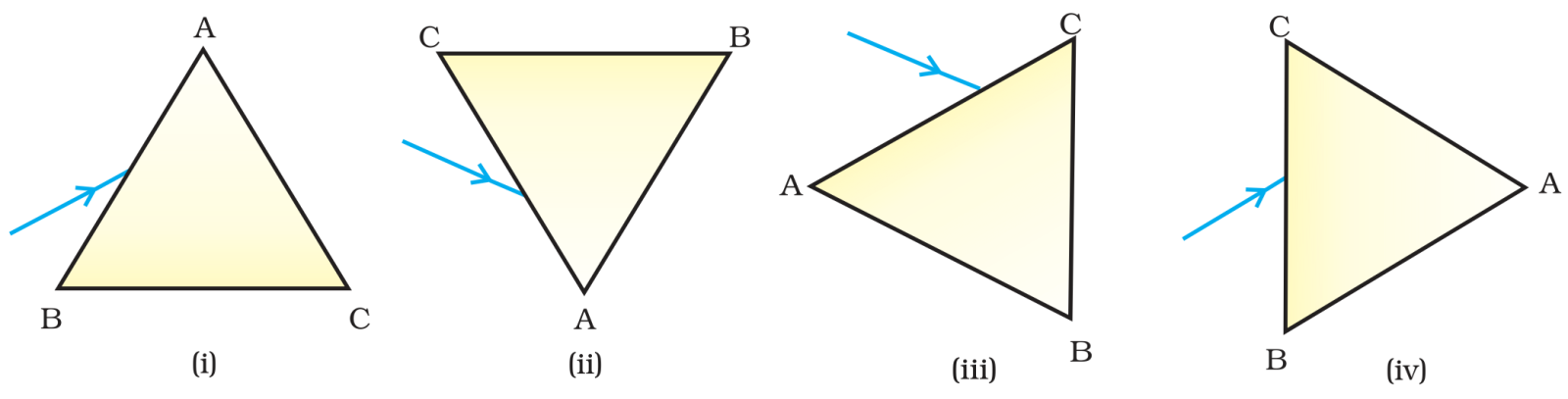
A prism ABC (with BC as base) is placed in different orientations. A narrow beam of white light is incident on the prism as shown in Figure. In which of the following cases, after dispersion, the third colour from the top corresponds to the colour of the sky?

  1. (i)
  2. (ii)
  3. (iii)
  4. (iv)
The least distance of distinct vision for a young adult with normal vision is about.