MCQ
A magnetic needle is kept in a non-uniform magnetic field. It experiences
  • A force and a torque
  • B
    A force but not a torque
  • C
    A torque but not a force
  • D
    Neither a torque nor a force

Answer

Correct option: A.
A force and a torque
a
(a) A magnetic needle is a magnetic dipole.

In a non uniform Magnetic field Force on each of the poles will be different in both magnitude and direction.

Due to difference in Magnitude the dipole experiences a Force,

Due to difference in Direction the dipole experiences a Torque.

Need a full question paper?

Generate a complete, print-ready paper with questions like this in minutes — across 16+ boards, with answer keys.
Start Generating Free

Similar questions

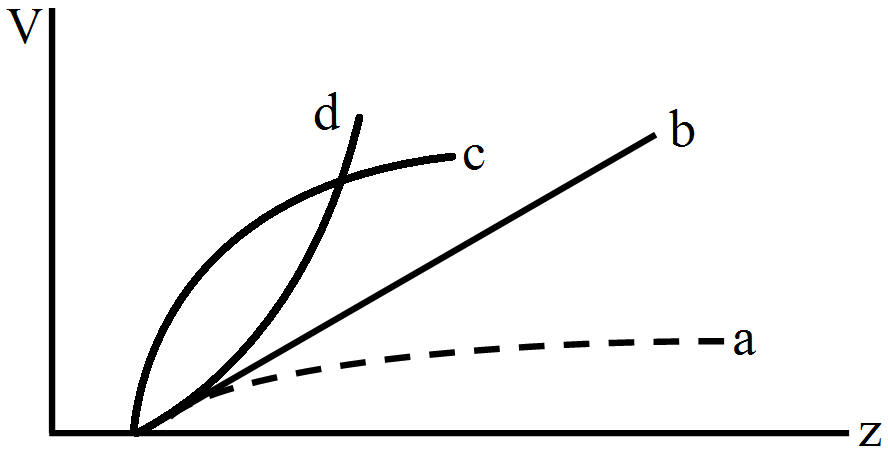
The figure shows the intensity-wavelength relations of $X -$rays coming from two different Coolidge tubes. The solid curve represents the relation for the tube A in which the potential difference between the target and the filament is $V_A$ and the atomic number of the target material is $Z_A$. These quantities are $V_B$ and $Z_B$ for the other tube. Then:
This question has Statement$-1$ and Statement$-2$. Of the four choices given after the Statements, choose the one that best describes the two Statements.

Statement $1$ : Davisson : Germer experiment established the wave nature of electrons.

Statement $2$ : If electrons have wave nature, they can interfere and show diffraction.
When the speed of a dc motor increases the armature current
A monochromatic beam of light of wavelength $400\,nm$ incident normally upon a photosensitive surface ($25\%$ reflects and rest absorbs), produces a pressure of $5 \times 10^{-7}\,Nm^{-2}$ on it. If $0.1\%$ of the incident photons produce electrons then corresponding saturation current will be..............$\mu A$ (consider area of photosensitive surface $= 5\,cm^2$)
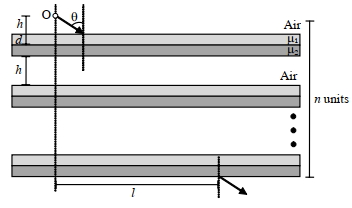
Consider a configuration of $n$ identical units, each consisting of three layers. The first layer is a column of air of height $h=\frac{1}{3} cm$, and the second and third layers are of equal thickness $d=\frac{\sqrt{3}-1}{2} cm$, and refractive indices $\mu_1=\sqrt{\frac{3}{2}}$ and $\mu_2=\sqrt{3}$, respectively. A light source $O$ is placed on the top of the first unit, as shown in the figure. A ray of light from $O$ is incident on the second layer of the first unit at an angle of $\theta=60^{\circ}$ to the normal. For a specific value of $n$, the ray of light emerges from the bottom of the configuration at a distance $l=\frac{8}{\sqrt{3}} cm$, as shown in the figure. The value of $n$ is. . . . . 
The focal length of a combination of lenses formed with lenses having powers of $+ 2.50 D$ and $-3.75 D$ will be....$cm$
A compound microscope with an objective lens of focal length $1\, cm$ and an eye piece  of $2 \,cm$ focal length has a tube length of $20 \,cm$. Calculate the magnifying power of  the microscope, if the final image is formed at least distance of distinct vision
The energy stored in a $50 \,mH$ inductor carrying a current of $4 \,A$ will be....$J$
A single slit Fraunhoffer diffraction pattern is formed with white light. For what wavelength of light the third secondary maximum in the diffraction pattern coincides with the second secondary maximum in the pattern for red light of wavelength $6500{\text{ }}\mathop {\text{A}}\limits^o $?........$\mathop A\limits^o $
When objects at different distances are seen by the eye, which of the following remain constant?