MCQ 11 Mark
A sheet is placed on a horizontal surface in front of a strong magnetic pole. A force is needed to:
$A$. hold the sheet there if it is magnetic.
$B$. hold the sheet there if it is non-magnetic.
$C$. move the sheet away from the pole with uniform velocity if it is conducting.
$D$. move the sheet away from the pole with uniform velocity if it is both, non-conducting and non-polar.
Choose the correct statement($s$) from the options given below:
- ✓
$A$ and $C$ only
- B
$A$, $C$ and $D$ only
- C
$C$ only
- D
$B$ and $D$ only
AnswerCorrect option: A. $A$ and $C$ only
a
$A$. A magnetic pole will repel or attract magnetic sheet so force is need.
$B$. If sheet is non-magnetic, no force needed.
$C$. If it is conducting, then there will be addy current in sheet, which opposes the motion. So forces is needed move sheet with uniform speed.
$D$. The non-conducting and non-polar sheet do not interact with magnetic field of magnet.
View full question & answer→MCQ 21 Mark
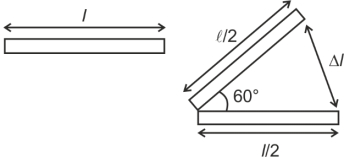
An iron bar of length $L$ has magnetic moment $M$. It is bent at the middle of its length such that the two arms make an angle $60^{\circ}$ with each other. The magnetic moment of this new magnet is :
- ✓
$\frac{M}{2}$
- B
$2 M$
- C
$\frac{M}{\sqrt{3}}$
- D
$M$
AnswerCorrect option: A. $\frac{M}{2}$
a
(image)
$M=m I$.
(image)
$\Delta l=2 \frac{l}{2} \sin 30^{\circ}$
$=\frac{l}{2}$
$M^{\prime}=m / / 2$
$=M / 2$
View full question & answer→MCQ 31 Mark
Match List-$I$ with List-$II$.
| List-$I$ (Material) |
List-$II$ (Susceptibility $(x)$ |
| $A$. Diamagnetic |
$I$. $\chi=0$ |
| $B$. Ferromagnetic |
$II$. $ 0>\chi \geq-1$ |
| $C$. Paramagnetic |
$II$I. $ x>1$ |
| $D$. Non-magnetic |
$IV$. $0<\gamma<\varepsilon$ (a small positive number) |
Choose the correct answer from the options given below
- A
$A-II, B-I, C-III, D-IV$
- B
$A-III, B-II, C-I, D-IV$
- C
$A-IV, B-III, C-II, D-I$
- ✓
$A-II, B-III, C-IV, D-I$
AnswerCorrect option: D. $A-II, B-III, C-IV, D-I$
d
| (Material) |
(Susceptibility $(\chi)$ ) |
| Diamagnetic |
($II$) $\quad 0>\chi \geq-1$ |
| Ferromagnetic |
($III$) $\quad \chi>>1$ |
| Paramagnetic |
($IV$) $0<\chi<\varepsilon$ |
| Non-magnetic |
($I$) $\quad \chi=0$ |
View full question & answer→MCQ 41 Mark
The net magnetic flux through any closed surface is
- A
$-ve$
- ✓
$0$
- C
$+ve$
- D
$\infty$
Answerb
$\oint \vec{B} \cdot d \vec{s}=$ zero
Magnetic monopole doesn't exist.
Hence net magnetic flux through any closed surface is zero.
View full question & answer→MCQ 51 Mark
An iron rod of susceptibility $599$ is subjected to a magnetising field of $1200\, Am ^{-1}$. The permeability of the material of the rod is
$\left(\mu_{0}=4 \pi \times 10^{-7}\, T\, m\, A ^{-1}\right)$
- A
$2.4 \pi \times 10^{-7} \,T\, m\, A ^{-1}$
- ✓
$2.4 \pi \times 10^{-4} \,T\, m \,A ^{-1}$
- C
$8.0 \times 10^{-5}\, T\, m\, A ^{-1}$
- D
$2.4 \pi \times 10^{-5} \,T\, m\, A ^{-1}$
AnswerCorrect option: B. $2.4 \pi \times 10^{-4} \,T\, m \,A ^{-1}$
b
$\mu_{ r }= x _{ m }+1=599+1=600$
$\mu=\mu_{ o } \mu_{ r }=4 \pi \times 10^{-7} \times 600$
$=2.4 \pi \times 10^{-4} \frac{ Tm }{ A }$
View full question & answer→MCQ 61 Mark
At a point $A$ on the earth's surface the angle of $\operatorname{dip}, \delta=+25^{\circ} .$ At a point $B$ on the earth's surface the angle of dip, $\delta=-25^{\circ} .$ We can interpret that
- A
$A$ and $B$ are both located in the northern hemisphere.
- B
$A$ is located in the southem hemisphere and $B$ is located in the notthem hemisphere.
- ✓
$A$ is located in the northem hemisphere and $B$ is located in the southern hemisphere.
- D
$A$ and $B$ are both located in the southem hemisphere
AnswerCorrect option: C. $A$ is located in the northem hemisphere and $B$ is located in the southern hemisphere.
c
In northern hemisphere dip is $+ve$ and in southem hemisphere dip is $-ve$.
View full question & answer→MCQ 71 Mark
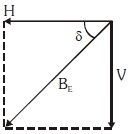
The relations amongst the three elements elements earth's magnettic fleld, namely horizontal component $H$, vertical component $V$ and dip $\delta$ are, $( B_{E}=$ total magnetic fleld)
- A
$\mathrm{V}=\mathrm{B}_{\mathrm{E}} \tan \delta, \mathrm{H}=\mathrm{B}_{\mathrm{E}}$
- ✓
$ \mathrm{V}=\mathrm{B}_{\mathrm{E}} \sin \delta, \mathrm{H}=\mathrm{B}_{\mathrm{E}} \cos \delta$
- C
$\mathrm{V}=\mathrm{B}_{\mathrm{E}} \cos \delta, \mathrm{H}=\mathrm{B}_{\mathrm{E}} \sin \delta$
- D
$\mathrm{V}=\mathrm{B}_{\mathrm{E}}, \mathrm{H}=\mathrm{B}_{\mathrm{E}} \tan \delta$
AnswerCorrect option: B. $ \mathrm{V}=\mathrm{B}_{\mathrm{E}} \sin \delta, \mathrm{H}=\mathrm{B}_{\mathrm{E}} \cos \delta$
b
$\mathrm{V}=\mathrm{B}_{\mathrm{E}} \sin \delta$
$\mathrm{H}=\mathrm{B}_{\mathrm{E}} \cos \delta$
View full question & answer→MCQ 81 Mark
A thin diamagnetic rod is placed vertically between the poles of an electromagnet. When the current in the electromagnet is switched on, then the diamagnetic rod is pushed up, out of the horizontal magnetic field. Hence the rod gains gravitational potential energy. The work required to do this comes from
- ✓
- B
- C
The induced electric field due to the changing magnetic field
- D
The lattice structure of the material of the rod
Answera
Energy of current source will be converted into gravitational potential energy of the rod.
View full question & answer→MCQ 91 Mark
A $250-$ turn rectangular coil of length $2.1\, cm$ and width $1.25\, cm$ carries a current of $85\, \mu A$ and subjected to a magnetic field of strength $0.85\, T.$ Work done for rotating the coil by $180^o $ against the torque is .............. $\mu\ J$
- A
$4.55 $
- B
$2.3$
- C
$1.15 $
- ✓
$9.1$
Answerd
Work done in a coil
$W=m B\left(\cos \theta_{1}-\cos \theta_{2}\right)$
When it is rotated by angle $180^{o}$ then
$W=2 m B=2(N I A) B$ .......... $(i)$
Given: $N=250$, $I=85\, \mu \mathrm{A}=85 \times 10^{-6}\, \mathrm{A}$
$A=1.25 \times 2.1 \times 10^{-4}\, \mathrm{m}^{2}=2.5 \times 10^{-4}\, \mathrm{m}^{2}$
$B=0.85\, \mathrm{T}$
Putting these values in eqn. $(i)$, we get
$W= 2 \times 250 \times 85 \times 10^{-6} \times 2.5 \times 10^{-4} \times 0.85$
$=9.1 \times 10^{-6} \,\mathrm{J}=9.1\, \mu \mathrm{J}$
View full question & answer→MCQ 101 Mark
If $\theta _1$ and $\theta_2$ be the apparent angles of dip observed in two vertical planes at right angles to each other, then the true angle of dip $\theta$ is given by
- ✓
$\cot ^2 \theta=\cot ^2 \theta_1+\cot ^2 \theta_2$
- B
$\tan ^2 \theta=\tan ^2 \theta_1+\tan ^2 \theta_2$
- C
$\cot ^2 \theta=\cot ^2 \theta_1-\cot ^2 \theta_2$
- D
$\tan ^2 \theta=\tan ^2 \theta_1-\tan ^2 \theta_2$
AnswerCorrect option: A. $\cot ^2 \theta=\cot ^2 \theta_1+\cot ^2 \theta_2$
a
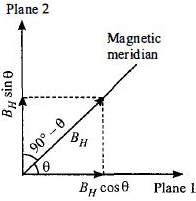
Let $B_H$ and $B_v$ be the horizontal and vertical components of earth's magnetic field $\vec B$. Since $\theta$ is the angle of dip
$\tan \theta = \frac{B_V}{B_H}$
or $cot\theta = \frac{B_H}{B_V}$
Suppose planes $1$ and $2$ are two mutually perpendicular planes and respectively make angles $\theta$ and $90°- \theta$ with the magnetic meridian. The vertical components of earth's magnetic field remain same in the two planes but the effective horizontal components in the planes will be
$B_{1}=B_{H} \cos \theta \text { and } B_{2}=B_{H} \sin \theta$
The angles of $\operatorname{dip} \theta_{1}$ and $\theta_{2}$ in the two planes are given by
$\tan \theta_{1}=\frac{B_{V}}{B_{1}}$
$\tan \theta_{1}=\frac{B_{V}}{B_{H} \cos \theta}$
or $\quad \cot \theta_{1}=\frac{B_{H} \sin \theta}{B_{V}}.........(ii)$
$\text { Similarly, } \cot \theta_{2}=\frac{B_{H} \sin \theta}{B_{V}}.........(iii)$
From eqns. $(ii)$ and $(iii)$
$\cot ^{2} \theta_{1}+\cot ^{2} \theta_{2}=\frac{B_{H}^{2}}{B_{V}^{2}}\left(\cos ^{2} \theta+\sin ^{2} \theta\right)=\frac{B_{H}^{2}}{B_{V}^{2}}$
$\therefore \quad \cot ^{2} \theta_{1}+\cot ^{2} \theta_{2}=\cot ^{2} \theta \quad[\text { from eqn. (i) }]$
View full question & answer→MCQ 111 Mark
Two reasons for using soft iron as the material for electromagnets
- ✓
high permeability and low retentivity
- B
low permeability and low retentivity
- C
low permeability and low retentivity
- D
low permeability and high retentivity
AnswerCorrect option: A. high permeability and low retentivity
a
Magnetic retentivity determines the magnetism left in the material after the magnetizing field has been switched off. Electromagnets are operated in conditions requiring fast reversal of polarity, so high retentivity is undesirable. Susceptibility determines to what extent the material responds to the applied field. This means it determines the extent to which the material will be magnetized when a field of given strength is applied. Therefore, electromagnets must be made of materials having high susceptibility and low retentivity. Soft iron is such a material.
View full question & answer→MCQ 121 Mark
A bar magnet is hung by a thin cotton thread in a uniform horizontal magnetic field and is in equilibrium state. The energy required to rotate it by $60^o $ is $W.$ Now the torque required to keep the magnet in this new position is
AnswerCorrect option: D. $\;\sqrt 3 W$
d
At equilibrium, potential energy of dipole
$U_{i}=-M B_{H}$
Final potential energy of dipole,
${U_{f}=-M B_{H} \cos 60^{\circ}=-\frac{M B_{H}}{2}}$
$W = {U_f} - {U_i} = - \frac{{M{B_H}}}{2} - \left( { - M{B_H}} \right) = \frac{{M{B_H}}}{2} \ldots ...(i)$
Required torque, $\tau=M B_{H} \sin 60^{\circ}$
$\tau=2 W \times \frac{\sqrt{3}}{2} \quad[\text { Using eqn. ( i ) }]$
$=\sqrt{3}\,W$
View full question & answer→MCQ 131 Mark
The magnetic susceptibility is negative for
- A
paramagnetic material only
- B
ferromagnetic material only
- C
paramagnetic and ferromagnetic materials
- ✓
diamagnetic material only
AnswerCorrect option: D. diamagnetic material only
d
Magnetic susceptibility $=\chi$ it is negative for dia-magnetic materials only
View full question & answer→MCQ 141 Mark
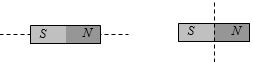
A magnet of magnetic moment $M$ and pole strength $m$ is divided in two equal parts, then magnetic moment of each part will be
Answerb
If cut along the axis of magnet of length $l$, then new pole strength $m' = \frac{m}{2}$and new length $l' = l$
$\therefore $New magnetic moment $M' = \frac{m}{2} \times l = \frac{{ml}}{2} = \frac{M}{2}$
If cut perpendicular to the axis of magnet, then new pole strength $m' = m$ and new length, $l' = l/2$
$\therefore $ New magnetic moment $M' = m \times \frac{l}{2} = \frac{{ml}}{2} = \frac{M}{2}$
View full question & answer→MCQ 151 Mark
Points $A$ and $B$ are situated along the extended axis of $2\, cm$ long bar magnet at a distance $x $ and $2x$ $ cm$ respectively. From the pole nearer to the points, the ratio of the magnetic field at $ A$ and $B$ will be
- A
$4 : 1 $ exactly
- B
$4 : 1$ approx.
- C
$8 : 1 $ exactly
- ✓
$8 : 1$ approx.
AnswerCorrect option: D. $8 : 1$ approx.
d
$ \Rightarrow \frac{{{B_1}}}{{{B_2}}} = {\left( {\frac{{{x_1}}}{{{x_2}}}} \right)^3} = {\left( {\frac{x}{{2x}}} \right)^3} = \frac{1}{8}$ (Approx.)
View full question & answer→MCQ 161 Mark
The distance of two points on the axis of a magnet from its centre is $10 \,cm$ and $20 \,cm$ respectively. The ratio of magnetic intensity at these points is $12.5 : 1. $ The length of the magnet will be......$cm$
Answerc
(c)$\frac{{{B_1}}}{{{B_2}}} = \frac{{{d_1}}}{{{d_2}}}{\left( {\frac{{d_2^2 - {l^2}}}{{d_1^2 - {l^2}}}} \right)^2} \Rightarrow \frac{{12.5}}{1} = \frac{{10}}{{20}}{\left( {\frac{{400 - {l^2}}}{{100 - {l^2}}}} \right)^2}$
$ \Rightarrow l = 5\;cm$
Hence length of magnet $ = 2l = 10\;cm$
View full question & answer→MCQ 171 Mark
The magnetic field at a point $x $ on the axis of a small bar magnet is equal to the field at a point $ y $ on the equator of the same magnet. The ratio of the distances of $x$ and $y$ from the centre of the magnet is
- A
${2^{ - 3}}$
- B
${2^{ - 1/3}}$
- C
${2^3}$
- ✓
${2^{1/3}}$
AnswerCorrect option: D. ${2^{1/3}}$
d
(d)${B_1} = \frac{{2M}}{{{x^3}}}\;and\;{B_2} = \frac{M}{{{y^3}}}$
As ${B_1} = {B_2}$
Hence $\frac{{2M}}{{{x^3}}} = \frac{M}{{{y^3}}}{\rm{or}}\frac{{{x^3}}}{{{y^3}}} = 2\;{\rm{or}}\;\frac{x}{y} = {2^{1/3}}$
View full question & answer→MCQ 181 Mark
Points $A$ and $B$ are situated perpendicular to the axis of a $2\,cm$ long bar magnet at large distances $X$ and $3X$ from its centre on opposite sides. The ratio of the magnetic fields at $ A$ and $B$ will be approximately equal to
- A
$1:9$
- B
$2:9$
- ✓
$27:1$
- D
$9:1$
AnswerCorrect option: C. $27:1$
c
(c)$B \propto \frac{1}{{{x^3}}} \Rightarrow \frac{{{B_1}}}{{{B_2}}} = {\left( {\frac{{{x_2}}}{{{x_1}}}} \right)^3} = {\left( {\frac{{3x}}{x}} \right)^3} = \frac{{27}}{1}$
View full question & answer→MCQ 191 Mark
Two small bar magnets are placed in a line with like poles facing each other at a certain distance $d$ apart. If the length of each magnet is negligible as compared to $ d,$ the force between them will be inversely proportional to
- A
$d$
- B
${d^2}$
- C
$\frac{1}{{{d^2}}}$
- ✓
${d^4}$
AnswerCorrect option: D. ${d^4}$
d
(d)$F = \frac{{{\mu _0}}}{{4\pi }}\left( {\frac{{6MM'}}{{{d^4}}}} \right)$in end-on position.
View full question & answer→MCQ 201 Mark
A bar magnet of length $10 \,cm$ and having the pole strength equal to $10^{-3}$ weber is kept in a magnetic field having magnetic induction $ (B)$ equal to $4\pi \times {10^{ - 3}}$ Tesla. It makes an angle of $30°$ with the direction of magnetic induction. The value of the torque acting on the magnet is
- ✓
$2\pi \times {10^{ - 7}}\,N \times m$
- B
$2\pi \times {10^{ - 5}}\,N \times m$
- C
$0.5\,N \times m$
- D
$0.5 \times {10^2}\,N \times m$
AnswerCorrect option: A. $2\pi \times {10^{ - 7}}\,N \times m$
a
(a)Torque $\tau = M{B_H}\sin \theta $
$ = 0.1 \times {10^{ - 3}} \times 4\pi \times {10^{ - 3}} \times \sin {30^o} = {10^{ - 7}} \times 4\pi \times \frac{1}{2}$
$ = 2\pi \times {10^{ - 7}}\,N \times m$
View full question & answer→MCQ 211 Mark
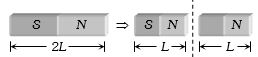
A long magnetic needle of length $2\,L$, magnetic moment $ M$ and pole strength $m$ units is broken into two pieces at the middle. The magnetic moment and pole strength of each piece will be
AnswerCorrect option: C. $\frac{M}{2},m$
c
(c)Pole strength of each part $=m$
Magnetic moment of each part
$ = M' = m'L' = mL = \frac{M}{2}$
View full question & answer→MCQ 221 Mark
A bar magnet of magnetic moment $10^4\,J/T$ is free to rotate in a horizontal plane. The work done in rotating the magnet slowly from a direction parallel to a horizontal magnetic field of $4×10^{-5}\, T$ to a direction $ 60° $ from the field will be.....$ J$
- ✓
$0.2$
- B
$2$
- C
$4.18$
- D
$2 × 10^2$
Answera
(a)Magnetic moment of bar $M = {10^4}\,J/T$
$B = \frac{{{\mu _0}}}{{4\pi }}.\frac{{2\sqrt 2 M}}{{{d^3}}}$
Hence work done $W = \overrightarrow M .\overrightarrow B $
$ = {10^4} \times 4 \times {10^{ - 5}} \times \cos {60^o} = 0.2\;J$
View full question & answer→MCQ 231 Mark
The dipole moment of a short bar magnet is $1.25\, A-m^2$. The magnetic field on its axis at a distance of $0.5$ metre from the centre of the magnet is
- A
$1.0 \times {10^{ - 4}}\,Newton/amp - meter$
- B
$4 \times {10^{ - 2}}\,Newton/amp - metre$
- ✓
$2 \times {10^{ - 6}}\,Newton/amp - metre$
- D
$6.64 \times {10^{ - 8}}\,Newton/amp - metre$
AnswerCorrect option: C. $2 \times {10^{ - 6}}\,Newton/amp - metre$
c
(c)$B = \frac{{{\mu _0}}}{{4\pi }}\frac{{2M}}{{{d^3}}} = {10^{ - 7}} \times \frac{{2 \times 1.25}}{{{{\left( {0.5} \right)}^3}}} = 2 \times {10^{ - 6}}\,N/A - m$
View full question & answer→MCQ 241 Mark
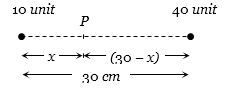
Two like magnetic poles of strength $ 10$ and $40$ $ SI$ units are separated by a distance $30 \,cm$. The intensity of magnetic field is zero on the line joining them
- A
At a point $ 10 \,cm$ from the stronger pole
- ✓
At a point $20\, cm$ from the stronger pole
- C
- D
AnswerCorrect option: B. At a point $20\, cm$ from the stronger pole
b
(b)Suppose magnetic field is zero at point $ P.$ Which lies at a distance $x$ from $10$ unit pole. Hence at $P$
$\frac{{{\mu _0}}}{{4\pi }}.\frac{{10}}{{{x^2}}} = \frac{{{\mu _0}}}{{4\pi }}.\frac{{40}}{{{{\left( {30 - x} \right)}^2}}} \Rightarrow x = 10\,cm$
So from stronger pole distance is $20\, cm.$
View full question & answer→MCQ 251 Mark
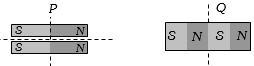
Two similar bar magnets $P $ and $Q$ , each of magnetic moment $M,$ are taken, If $P$ is cut along its axial line and $Q$ is cut along its equatorial line, all the four pieces obtained have
AnswerCorrect option: C. Magnetic moment $\frac{M}{2}$
c
(c)If pole strength, magnetic moment and length of each part are $m',M'$and $L'$respectively then
$m' = \frac{m}{2}$ $m' = m$
$L' = L$ $L' = \frac{L}{2}$
$ \Rightarrow M' = \frac{M}{2}$ $ \Rightarrow M' = \frac{M}{2}$
View full question & answer→MCQ 261 Mark
A bar magnet of magnetic moment $3.0\, A-m^2$ is placed in a uniform magnetic induction field of $2 \times 10^{-5}\, T$. If each pole of the magnet experiences a force of $6 \times 10^{-4} \,N$, the length of the magnet is.....$m$
Answerd
(d)$F = mB \Rightarrow F = \frac{M}{L} \times B$
$ \Rightarrow 6 \times {10^{ - 4}} = \frac{3}{L} \times 2 \times {10^{ - 5}} \Rightarrow L = 0.1\;m.$
View full question & answer→MCQ 271 Mark
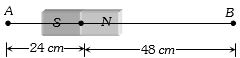
A bar magnet of length $ 3 \,cm$ has points $A $ and $ B$ along its axis at distances of $24\, cm$ and $48\, cm$ on the opposite sides. Ratio of magnetic fields at these points will be
- ✓
$8$
- B
$1/2\sqrt 2 $
- C
$3$
- D
$4$
Answera
(a)Both points $ A$ and $B$ lying on the axis of the magnet and on axial position
$B \propto \frac{1}{{{d^3}}}$$⇒$ $\frac{{{B_A}}}{{{B_B}}} = {\left( {\frac{{{d_B}}}{{{d_A}}}} \right)^3} = {\left( {\frac{{48}}{{24}}} \right)^3} = \frac{8}{1}$
View full question & answer→MCQ 281 Mark
The effective length of a magnet is $ 31.4 \,cm $ and its pole strength is $0.5\, Am$. The magnetic moment, if it is bent in the form of a semicircle will be.....$A{m^2}$
- ✓
$0.1$
- B
$0.01$
- C
$0.2$
- D
$1.2$
Answera
(a)New magnetic moment $M' = \frac{{2M}}{\pi } = \frac{{2mL}}{\pi } = \frac{{2 \times 0.5 \times 31.4 \times {{10}^{ - 2}}}}{{3.14}} = 0.1\,amp \times {m^2}$
View full question & answer→MCQ 291 Mark
The magnetic potential at a point on the axial line of a bar magnet of dipole moment $M$ is $V$. What is the magnetic potential due to a bar magnet of dipole moment $\frac{M}{4}$ at the same point
- A
$4\,V$
- B
$2\,V$
- C
$\frac{V}{2}$
- ✓
$\frac{V}{4}$
AnswerCorrect option: D. $\frac{V}{4}$
d
(d)Magnetic potential at a distance d from the bar magnet on it's axial line is given by
$V = \frac{{{\mu _0}}}{{4\pi }}.\frac{M}{{{d^2}}}$ $⇒$ $V \propto M$ $⇒$ $\frac{{{V_1}}}{{{V_2}}} = \frac{{{M_1}}}{{{M_2}}}$
$⇒$ $\frac{V}{{{V_2}}} = \frac{M}{{M/4}}$ $⇒$ ${V_2} = \frac{V}{4}$
View full question & answer→MCQ 301 Mark
In two separate experiments the neutral points due to two small magnets are at a distance of $r$ and $ 2r$ n broad side-on position. The ratio of their magnetic moments will be
Answerd
(d)At broad side-on position $B = \frac{M}{{{d^3}}}$
$\therefore \,\frac{{{M_1}}}{{d_1^3}} = \frac{{{M_2}}}{{d_2^3}}or\frac{{{M_1}}}{{{r^3}}} = \frac{{{M_2}}}{{8{r^3}}}or\frac{{{M_1}}}{{{M_2}}} = \frac{{{r^3}}}{{8{r^3}}} = \frac{1}{8}$
View full question & answer→MCQ 311 Mark
A short magnet of moment $6.75\, Am^2$ produces a neutral point on its axis. If horizontal component of earth's magnetic field is $5 \times {10^{ - 5}}\,Wb/{m^2}$, then the distance of the neutral point should be.....$cm$
Answerc
(c)At neutral point
$\left| \begin{array}{c}\,{\rm{Magnetic field due }}\\{\rm{to magnet}}\end{array} \right| = \,\left| \begin{array}{c}{\rm{Magnetic field due }}\\{\rm{to earth}}\end{array} \right|$$\frac{{{\mu _0}}}{{4\pi }}.\frac{{2M}}{{{d^3}}} = 5 \times {10^{ - 5}} \Rightarrow {10^{ - 7}} \times \frac{{2 \times 6.75}}{{{d^3}}} = 5 \times {10^{ - 5}}$
$ \Rightarrow d = 0.3\;m = 30\;cm$
View full question & answer→MCQ 321 Mark
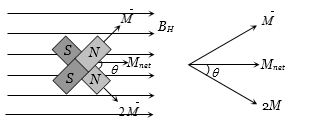
Two bar magnets with magnetic moments $ 2 M $ and $M$ are fastened together at right angles to each other at their centres to form a crossed system, which can rotate freely about a vertical axis through the centre. The crossed system sets in earth’s magnetic field with magnet having magnetic moment $2M $ making and angle $ \theta $ with the magnetic meridian such that
- A
$\theta = {\tan ^{ - 1}}\left( {\frac{1}{{\sqrt 3 }}} \right)$
- B
$\theta = {\tan ^{ - 1}}\left( {\sqrt 3 } \right)$
- ✓
$\theta = {\tan ^{ - 1}}\left( {\frac{1}{2}} \right)$
- D
$\theta = {\tan ^{ - 1}}\left( {\frac{3}{4}} \right)$
AnswerCorrect option: C. $\theta = {\tan ^{ - 1}}\left( {\frac{1}{2}} \right)$
c
(c)$ \Rightarrow \tan \theta = \frac{M}{{2M}} = \frac{1}{2} \Rightarrow \theta = {\tan ^{ - 1}} = \frac{1}{2}$
View full question & answer→MCQ 331 Mark
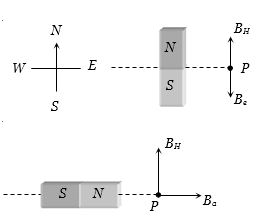
A short bar magnet with its north pole facing north forms a neutral point at $P$ in the horizontal plane. If the magnet is rotated by $90^o$ in the horizontal plane, the net magnetic induction at $P$ is (Horizontal component of earth’s magnetic field = ${B_H}$)
AnswerCorrect option: D. $\sqrt 5 \,{B_H}$
d
(d)Initially Neutral point obtained on equatorial line and at neutral point $\left| {{B_H}} \right| = \left| {{B_e}} \right|$
where $B_H$ = Horizontal component of earth’s magnetic field, $B_e$ = Magnetic field due to bar magnet on it’s equatorial line
Finally
Point $P $ comes on axial line of the magnet and at $P, $ net magnetic field $B = \sqrt {B_a^2 + B_H^2} $
$ = \sqrt {{{(2{B_e})}^2} + {{({B_H})}^2}} = \sqrt {{{(2{B_H})}^2} + B_H^2} = \sqrt 5 \;{B_H}$
View full question & answer→MCQ 341 Mark
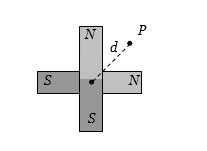
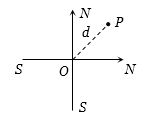
Two short magnets of equal dipole moments $M $ are fastened perpendicularly at their centre (figure). The magnitude of the magnetic field at a distance $d $ from the centre on the bisector of the right angle is
- A
$\frac{{{\mu _0}}}{{4\pi }}\frac{M}{{{d^3}}}$
- B
$\frac{{{\mu _0}}}{{4\pi }}\frac{{M\sqrt 2 }}{{{d^3}}}$
- ✓
$\frac{{{\mu _0}}}{{4\pi }}\frac{{2\sqrt 2 M}}{{{d^3}}}$
- D
$\frac{{{\mu _0}}}{{4\pi }}\frac{{2M}}{{{d^3}}}$
AnswerCorrect option: C. $\frac{{{\mu _0}}}{{4\pi }}\frac{{2\sqrt 2 M}}{{{d^3}}}$
c
(c)Resultant magnetic moment of the two magnets is
${M_{net}} = \sqrt {{M^2} + {M^2}} = \sqrt 2 M$
Imagine a short magnet lying along $OP$ with magnetic moment equal to $M\sqrt 2 $. Thus point $P$ lies on the axial line of the magnet.
$\therefore $ Magnitude of magnetic field at $P$ is given by $B = \frac{{{\mu _0}}}{{4\pi }}.\frac{{2\sqrt 2 M}}{{{d^3}}}$
View full question & answer→MCQ 351 Mark
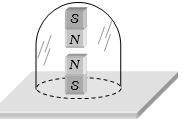
Two identical bar magnets with a length $10 \,cm $ and weight $50 \,gm$-weight are arranged freely with their like poles facing in a inverted vertical glass tube. The upper magnet hangs in the air above the lower one so that the distance between the nearest pole of the magnet is $3\,mm.$ Pole strength of the poles of each magnet will be.......$ amp × m$
AnswerCorrect option: A. $6.64$
a
(a)The weight of upper magnet should be balanced by the repulsion between the two magnet
$\therefore \;\frac{\mu }{{4\pi }}.\frac{{{m^2}}}{{{r^2}}} = 50\,gm - wt$
$ \Rightarrow {10^{ - 7}} \times \frac{{{m^2}}}{{(9 \times {{10}^{ - 6}})}} = 50 \times {10^{ - 3}} \times 9.8$
$ \Rightarrow m = 6.64\,amp \times m$
View full question & answer→MCQ 361 Mark
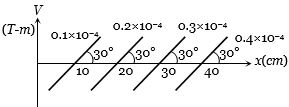
Some equipotential surfaces of the magnetic scalar potential are shown in the figure. Magnetic field at a point in the region is
- A
${10^{ - 4}}\,T$
- ✓
$2 \times {10^{ - 4}}\,T$
- C
$0.5 \times {10^{ - 4}}\,T$
- D
AnswerCorrect option: B. $2 \times {10^{ - 4}}\,T$
b
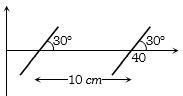
(b)$|B|\, = \frac{{\Delta V}}{{\Delta x}} = \frac{{0.1 \times {{10}^{ - 4}}}}{{0.1\;\sin {{30}^o}}} = 2 \times {10^{ - 4}}\,T$
View full question & answer→MCQ 371 Mark
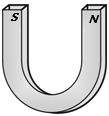
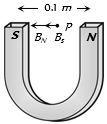
The distance between the poles of a horse shoe magnet is $0.1\, m$ and its pole strength is $0.01\, amp-m$. The induction of magnetic field at a point midway between the poles will be
- A
$2 \times {10^{ - 5}}\,T$
- B
$4 \times {10^{ - 6}}\,T$
- ✓
$8 \times {10^{ - 7}}\,T$
- D
AnswerCorrect option: C. $8 \times {10^{ - 7}}\,T$
c
(c) Net magnetic field at mid point $P$,$B = {B_N} + {B_S}$
where ${B_N} = $ magnetic field due to $N$ - pole
${B_S} = $ magnetic field due to $S$ - pole
${B_N} = {B_S} = \frac{{{\mu _0}}}{{4\pi }}\frac{m}{{{r^2}}}$
$ = {10^{ - 7}} \times \frac{{0.01}}{{{{\left( {\frac{{0.1}}{2}} \right)}^2}}} = 4 \times {10^{ - 7}}\,T$
$\therefore {B_{net}} = 8 \times {10^{ - 7}}\,T.$
View full question & answer→MCQ 381 Mark
Due to a small magnet intensity at a distance $x$ in the end on position is $9$ $Gauss$. What will be the intensity at a distance $\frac{x}{2}$ on broad side on position..... $Gauss$
Answerc
(c) In $C.G.S$. ${B_{axial}} = 9 = \frac{{2M}}{{{x^3}}}$.....$(i)$
${B_{{\rm{equaterial}}}} = \frac{M}{{{{\left( {\frac{x}{2}} \right)}^3}}} = \frac{{8M}}{{{x^3}}}$.....$(ii)$
From equation $(i)$ and $(ii)$ ${B_{{\rm{equaterial}}}} = 36\,$ $Gauss$.
View full question & answer→MCQ 391 Mark
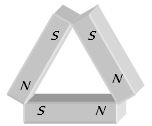
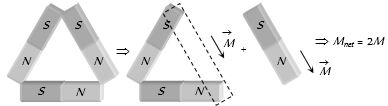
Three identical bar magnets each of magnetic moment $M$ are placed in the form of an equilateral triangle as shown. The net magnetic moment of the system is
- A
- ✓
$2\, M$
- C
$M\sqrt 3 $
- D
$\frac{{3M}}{2}$
AnswerCorrect option: B. $2\, M$
b
(b) The resultant magnetic moment can be calculated as follows.
View full question & answer→MCQ 401 Mark
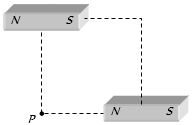
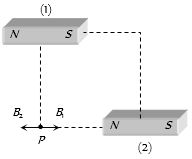
Two short magnets of magnetic moment $1000$ $A{m^2}$ are placed as shown at the corn ers of a square of side $10\, cm$. The net magnetic induction at $P$ is....$T$
- ✓
$0.1$
- B
$0.2$
- C
$0.3 $
- D
$0.4$
Answera
(a) Point $P$ lies on equatorial line of magnet $(1)$ and axial line of magnet $(2)$ as shown
${B_1} = \frac{{{\mu _0}}}{{4\pi }} \cdot \frac{M}{{{d^3}}} = {10^{ - 7}} \times \frac{{1000}}{{{{(0.1)}^3}}} = 0.1\,T$
${B_2} = \frac{{{\mu _0}}}{{4\pi }} \cdot \frac{{2M}}{{{d^3}}} = {10^{ - 7}} \times \frac{{2 \times 1000}}{{{{(0.1)}^3}}} = 0.2\,T$
$\therefore$ ${B_{{\rm{net}}}} = {B_2} - {B_1} = 0.1\,T$
View full question & answer→MCQ 411 Mark
A short magnet is allowed to fall along the axis of a horizontal metallic ring. Starting from rest, the distance fallen by the magnet in one second may be.....$m$
Answera
(a) We know that in this case acceleration of falling magnet will be lesser than $g$. If $‘g’$ would have been acceleration, then distance covered $ = \frac{1}{2}g{t^2} = 5m$.
Now the distance covered will be less than $5\, m$. hence only option $(a)$ is correct.
View full question & answer→MCQ 421 Mark
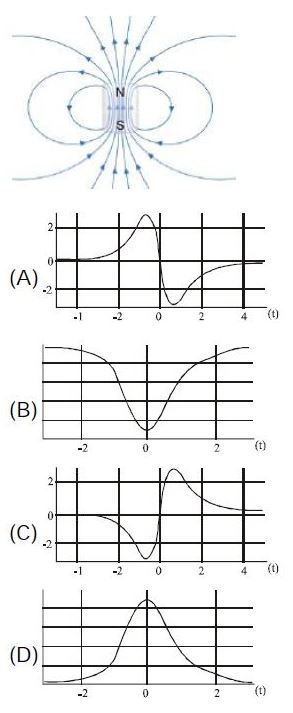
The diagram shows magnetic field lines. We move from above to below and back.Below shows the graph of variaton of magnetic flux with time. We will measure the flux of
- A
$A$ then $A$
- B
$A$ then $C$
- C
$B$ then $D$
- ✓
$D$ then $D$
AnswerCorrect option: D. $D$ then $D$
d
Flux first increases becomes max and then decreases
View full question & answer→MCQ 431 Mark
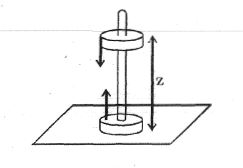
A donut-shaped permanent magnet (magnetization parallel to the axis) can slide frictionlessly on a vertical rod. Treat the magnets as dipoles with mass $m_d$ and dipole moment $M$ . When we put two back to back magnets on the rod the upper one will float. At what height $z$ does it float?
- A
${\left[ {\frac{{2{\mu _0}{M^2}}}{{3\pi {m_d}g}}} \right]^{1/4}}$
- B
${\left[ {\frac{{6{\mu _0}{M^2}}}{{\pi {m_d}g}}} \right]^{1/4}}$
- ✓
${\left[ {\frac{{3{\mu _0}{M^2}}}{{2\pi {m_d}g}}} \right]^{1/4}}$
- D
${\left[ {\frac{{{\mu _0}{M^2}}}{{6\pi {m_d}g}}} \right]^{1/4}}$
AnswerCorrect option: C. ${\left[ {\frac{{3{\mu _0}{M^2}}}{{2\pi {m_d}g}}} \right]^{1/4}}$
c
Force between two magnetic dipoles parallel to each. $=\vec{\mathrm{F}}_{\mathrm{ab}}=\frac{3 \mu_{0}}{2 \pi r^{4}}\left(\vec{\mathrm{m}}_{\mathrm{e}} \overrightarrow{\mathrm{m}}_{\mathrm{b}}\right) \hat{\mathrm{r}}$
$|\overrightarrow{\mathrm{F}}|=\mathrm{mg}$
$\therefore \frac{3 \mu_{0}}{2 \pi r^{4}}\left(\mathrm{m}_{\mathrm{b}} \mathrm{m}_{\mathrm{a}}\right)=\mathrm{mg}$
$r=\left(\frac{3 \mu_{0} m^{2}}{2 \pi m g}\right)^{1 / 4}$
View full question & answer→MCQ 441 Mark
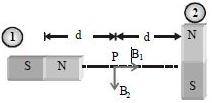
Two identical short bar magnets, each having magnetic moment $M$ are placed a distance of $2d$ apart with axes perpendicular to each other in a horizontal plane. The magnetic induction at a point midway between them is
- A
$\frac{{{\mu _0}}}{{4\pi }}\,\left( {\sqrt 2 } \right)\frac{M}{{{d^3}}}$
- B
$\frac{{{\mu _0}}}{{4\pi }}\,\left( {\sqrt 3 } \right)\frac{M}{{{d^3}}}$
- C
$\left( {\frac{{2{\mu _0}}}{\pi }} \right)\,\frac{M}{{{d^3}}}$
- ✓
$\frac{{{\mu _0}}}{{4\pi }}\,\left( {\sqrt 5 } \right)\frac{M}{{{d^3}}}$
AnswerCorrect option: D. $\frac{{{\mu _0}}}{{4\pi }}\,\left( {\sqrt 5 } \right)\frac{M}{{{d^3}}}$
d
At point $P$ net magnetic field ${B_{n\infty }} = \sqrt {B_1^2 + B_2^2} $
where ${{\text{B}}_1} = \frac{{{\mu _0}}}{{4\pi }} \cdot \frac{{2{\text{M}}}}{{{{\text{d}}^3}}}\,and\,{{\text{B}}_2} = \frac{{{\mu _0}}}{{4\pi }} \cdot \frac{{\text{M}}}{{{{\text{d}}^3}}}$
$ \Rightarrow {{\text{B}}_{{\text{rest}}}} = \frac{{{\mu _0}}}{{4\pi }} \cdot \frac{{\sqrt 5 {\text{M}}}}{{{{\text{d}}^3}}}$
View full question & answer→MCQ 451 Mark
Which statement is correct
- A
Magnetic field of current element is perpendicular to position vector
- B
Electric field of point charge is along position vector
- C
Magnetic mono pole physically does not exist
- ✓
View full question & answer→MCQ 461 Mark
A bar magnet is cut into two equal parts then which of the following quantity may change
$(a)$ Intensity of magnetization
$(b)$ Pole strength
$(c)$ Magnetic moment
- A
Only $a$
- B
$a, b$ and $c$
- ✓
$b$ and $c$
- D
Only $c$
AnswerCorrect option: C. $b$ and $c$
c
Intensity of magnetisation is property of magnet
View full question & answer→MCQ 471 Mark
Due to a small magnet, intensity at a distance $x$ in the end on position is $9$ $gauss$ . What will be the intensity at a distance $\frac{x}{2}$ on broad side on position....$gauss$
Answerc
In $C.G.S.$ $B_{\text {axial }}=9=\frac{2 M}{x^{3}}$.........$(i)$
$\mathrm{B}_{\text {equatorial }}=\frac{\mathrm{M}}{\left(\frac{\mathrm{x}}{2}\right)^{32}}=\frac{\mathrm{M}}{\mathrm{x}^{3}}$.........$(ii)$
From equation $(i)$ and $(ii)$, $B$$_{\text {equatorial }}=36$ $gauss.$
View full question & answer→MCQ 481 Mark
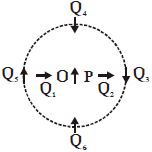
A small magnetised needle $P$ placed at point $O$ and the arrow shows the direction of its magnetic moment. The other arrow show different position (and orientation) of another identical magnets $(Q)$. In which configuration system is not in equilibrium
- A
$PQ_1,\,PQ_3$
- B
$PQ_2,\,PQ_6$
- ✓
$PQ_1,\,PQ_2$
- D
$PQ_2,\,PQ_5$
AnswerCorrect option: C. $PQ_1,\,PQ_2$
c
$\mathrm{B}_{\text {axis }}=\frac{2 \mu_{0} \mathrm{m}_{\mathrm{P}}}{4 \pi \mathrm{r}^{3}}$
$\mathrm{B}_{\text {equi }}=-\frac{\mu_{0}}{4 \mathrm{n}} \frac{\mathrm{m}_{\mathrm{P}}}{\mathrm{r}^{3}}$
if $\theta \neq 0$ or $180^{\circ}$
so $\mathrm{PQ}_{1}$ and $\mathrm{PQ}_{2}$
View full question & answer→MCQ 491 Mark
Earth magnetic field at equator is approximately $0.4\,G$ then earth's dipole moment would be (nearly) (ralius of earth $= 6.4 \times 10^6\,m$ )
- ✓
$1\times 10^{23}$
- B
$2\times 10^{23}$
- C
$.1\times 10^{23}$
- D
$.2\times 10^{23}$
AnswerCorrect option: A. $1\times 10^{23}$
a
$B_{\varepsilon}=\frac{\mu_{0} M}{4 \pi r^{3}}$
$4 \times 10^{-5}=\frac{4 \pi \times 10^{-7} \times M}{4 \pi \times\left(6.4 \times 10^{3}\right)^{3}}$
$M=1.05 \times 10^{23}\, \mathrm{A}-\mathrm{m}^{2}$
Accordy to fleming left hand rule.
View full question & answer→MCQ 501 Mark
A magnetic needle of negligible breadth and thickness compared to its length, oscillates in a horizontal plane with a period $T$. The period of oscillation of each part obtained on breaking the magnet into $n$ equal parts perpendicular to the length is
Answera
(a)
$T=2 \pi \sqrt{\frac{I}{M B}}$
$T^{\prime}=2 \pi \sqrt{\frac{I}{n^3 \frac{M}{n} B}}=\frac{2 \pi}{n} \sqrt{\frac{I}{M B}}$
$T^{\prime}=\frac{T}{n}$
View full question & answer→