MCQ
A man is $45 \,m$ behind the bus when the bus start accelerating from rest with acceleration $2.5$ $m/s^2$. With what minimum velocity should the man start running to catch the bus ?.......$m/s$
  • A
    $12$
  • B
    $14 $
  • $15$
  • D
    $16 $

Answer

Correct option: C.
$15$
c
(c) Let man will catch the bus after $'t'$ sec . So he will cover distance $ut$.

Similarly distance travelled by the bus will be $\frac{1}{2}a{t^2}$. For the given condition

$u\;t = 45 + \frac{1}{2}a\;{t^2}$$ = 45 + 1.25\;{t^2}$ $[As\;a = 2.5m/{s^2}]$

$⇒$  $u = \frac{{45}}{t} + 1.25\;t$

To find the minimum value of $u$

$\frac{{du}}{{dt}} = 0$ so we get $t = 6\sec$ then,

$u = \frac{{45}}{6} + 1.25 \times 6 = 7.5 + 7.5 = 15\,m/s$

Need a full question paper?

Generate a complete, print-ready paper with questions like this in minutes — across 16+ boards, with answer keys.
Start Generating Free

Similar questions

An angular impulse of $20 \,Nms$ is applied to a hollow cylinder of mass $2 \,kg$ and radius $20 \,cm$. The change in its angular speed is ............. $rad / s$
Four particle of masses $m, 2m, 3m$ and $4m$ are arranged at the corners of a parallelogram with each side equal to $a$ and one of the angle between two adjacent sides is $60^o$. The parallelogram lies in the $x-y$ plane with mass m at the origin and $4m$ on the  $x-$ axis. The centre of mass of the arrangement will be located at 
A vessel of volume V contains a mixture of 1 mole of hydrogen and 1 mole of oxygen (both considered as ideal). Let f1(v)dv denotes the fraction of molecules with speed between v and (v + dv) with f2(v)dv, similarly for oxygen. Then,
  1. f1(v) + f2(v) = f (v) obeys the Maxwell’s distribution law.
  2. f1(v), f2(v) will obey the Maxwell’s distribution law separately.
  3. Neither f1(v)nor f2(v)will obey the Maxwell’s distribution law.
  4. f2(v) and f1(v)will be the same.
A person with his hands in his pockets is skating on ice at the velocity of $10 \,m/s$ and describes a circle of radius $50\, m$. What is his inclination with vertical
A body of mass 1kg  is rotating in a vertical circle of radius 1m. What will be the difference in its kinetic energy at the top and bottom of the circle?
Take g = 10m/ s2
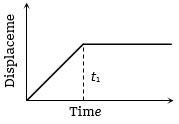
The $x - t$ graph shown in figure represents
In a certain region of space gravitational field is given by $E = \frac {-K}{r}$ where $'r'$ is the distance from a fixed point and $K$ is constant. Taking reference point to be at $r = r_0$ with $V = V_0$ the potential at a distance $r$ is
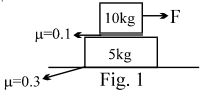
When $F = 2N$, the frictional force between $10 kg$ block and $5 kg$ block is ...... $N$
$N\,moles$ of a diatomic gas in a cylinder are at a temperature $T$. Heat is supplied to the cylinder such that the temperature remains constant but $n\,moles$ of the diatomic gas get converted into monoatomic gas. What is the change in the total kinetic energy of the gas ?
At what temperature is the root mean square velocity of gaseous hydrogen molecules is equal to that of oxygen molecules at $47°C$ ..... $K$