MCQ
A man is crossing a river flowing with velocity of $5\,\, m/s$. He reaches a point directly across at a distance of $60\,\, m$ in $5 \,\,sec$. His velocity in still water should be ........ $m/s$
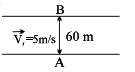
  • A
    $12$
  • $13$
  • C
    $5$
  • D
    $10$

Answer

Correct option: B.
$13$
b
$t=\frac{d}{\sqrt{v^{2}-u^{2}}}$

$\Rightarrow 5=\frac{60}{\sqrt{v^{2}-5^{2}}} \Rightarrow v=13 \mathrm{m} / \mathrm{s}$

Need a full question paper?

Generate a complete, print-ready paper with questions like this in minutes — across 16+ boards, with answer keys.

Start Generating Free

Similar questions

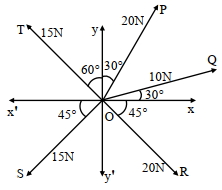
The resultant of these forces $\overrightarrow{O P}, \overrightarrow{O Q}, \overrightarrow{O R}, \overrightarrow{O S}$ and $\overrightarrow{{OT}}$ is approximately $\ldots \ldots {N}$.

[Take $\sqrt{3}=1.7, \sqrt{2}=1.4$ Given $\hat{{i}}$ and $\hat{{j}}$ unit vectors along ${x}, {y}$ axis $]$
A particle is projected vertically upwards from $O$ with velocity $v$ and a second particle is projected at the same instant from $P$ (at a height h above $O$) with velocity $v$ at an angle of projection $\theta$ . The time when the distance between them is minimum is
Along capillary tyube of radius $ ‘r’$ is initially just vertically completely imerged inside a liquid of angle of contact $0^o $. If the tube is slowly raised then relation between radius of curvature of of miniscus inside the capillary tube and displacement $(h)$ of tube can be represented by
A planet moving along an elliptical orbit is closest to the sun at a distance $r_1$ and farthest away at a distance of $r_2$. If $v_1$ and $v_2$ are the linear velocities at these points respectively, then the ratio $\frac{v_1}{v_2}$ is
Two sound waves of slightly different frequencies propagating in the same direction produce beats due to
The position of a projectile launched from the origin at $t = 0$ is given by $\vec r = \left( {40\hat i + 50\hat j} \right)\,m$ at $t = 2\,s$. If the projectile was launched at an angle $\theta$ from the horizontal, then $\theta$ is (take $g = 10\, ms^{-2}$)
Two masses of $1 \,gm$ and $4 \,gm$ are moving with equal kinetic energies. The ratio of the magnitudes of their linear momenta is
Two projectiles $A$ and $B$ thrown with speeds in the ratio $1:\sqrt{2}$ acquired the same height. If $A$ is thrown at an angle of $45^\circ$ with the horizontal, then angle of projection of $B$ will be:
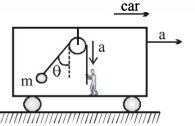
A bob is hanging over a pulley inside a car through, a string. The second end of the string is in the hand of a person standing in the car. The car is moving with constant acceleration ' $a$ ' directed horizontally as shown in figure. Other end of the string is pulled with constant acceleration ' $a$ ' vertically. The tension in the string is equal to-
A whistle emitting a loud sound of frequency $540 \,Hz$ is whirled in a horizontal circle of radius $2 \,m$ and at a constant angular speed of $15 \,rad / s$. The speed of sound is $330 \,m / s$. The ratio of the highest to the lowest frequency heard by a listener standing at rest at a large distance from the centre of the circle is