A man is standing on a railway platform listening to the whistle of an engine that passes the man at constant speed without stopping. If the engine passes the man at time ${t_0}$. How does the frequency $f$ of the whistle as heard by the man changes with time
- A
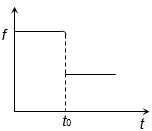
- B
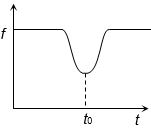
- C
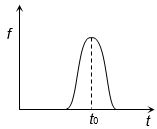
- D
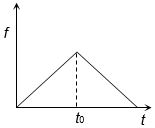
Diffcult


Download our appand get started for free
Experience the future of education. Simply download our apps or reach out to us for more information. Let's shape the future of learning together!No signup needed.*
Similar Questions
- 1A standing wave exists in a string of length $150\ cm$ , which is fixed at both ends with rigid supports . The displacement amplitude of a point at a distance of $10\ cm$ from one of the ends is $5\sqrt 3\ mm$ . The nearest distance between the two points, within the same loop and havin displacment amplitude equal to $5\sqrt 3\ mm$ is $10\ cm$ . Find the maximum displacement amplitude of the particles in the string .... $mm$View Solution
- 2A wire of density $9 \times 10^{-3} \,kg\, cm ^{-3}$ is stretched between two clamps $1\, m$ apart. The resulting strain in the wire is $4.9 \times 10^{-4}$. The lowest frequency of the transverse vibrations in the wire is......$HZ$View Solution
(Young's modulus of wire $Y =9 \times 10^{10}\, Nm ^{-2}$ ), (to the nearest integer),
- 3A $12 \,m$ long vibrating string has the speed of wave $48 \,m / s$. To what frequency it will resonate ........... $cps$View Solution
- 4A $1 cm$ long string vibrates with fundamental frequency of $256\, Hz$. If the length is reduced to $\frac{1}{4}cm$ keeping the tension unaltered, the new fundamental frequency will beView Solution
- 5The displacement $y$ of a wave travelling in the x-direction is given by $y = {10^{ - 4}}\sin \,\,\left( {600t - 2x + \frac{\pi }{3}} \right)$ metres, where $x$ is expressed in metres and $t$ in seconds. The speed of the wave-motion, in ..... $ms^{-1}$, isView Solution
- 6Equation of a progressive wave is given by $y = a\,\sin \pi \,\left[ {\frac{t}{2} - \frac{x}{4}} \right]\,,$ where $t$ is in seconds and $x$ is in meters. The distance through which the wave moves in $8 sec$ is .... $(m)$ (in meter)View Solution
- 7Beats are produced with the help of two sound waves of amplitudes $3$ and $5$ units. The ratio of maximum to minimum intensity in the beats isView Solution
- 8A standing wave is established in single loop. At $t = 0$ , $K.E.$ of string is zero. Choose the correct optionView Solution
- 9View SolutionIt is possible to recognise a person by hearing his voice even if he is hidden behind a wall. This is due to the fact that his voice
- 10Two cars $A$ and $B$ are moving away from each other in opposite directions. Both the cars are moving with a speed of $20\, ms^{-1}$ with respect to the ground. If an observer in car $A$ detects a frequency $2000\, Hz$ of the sound coming from car $B$, what is the natural frequency of the sound source of car $B$ .... $Hz$ ? (speed of sound in air $= 340\, ms^{-1}$)View Solution