A standing wave exists in a string of length $150\ cm$ , which is fixed at both ends with rigid supports . The displacement amplitude of a point at a distance of $10\ cm$ from one of the ends is $5\sqrt 3\ mm$ . The nearest distance between the two points, within the same loop and havin displacment amplitude equal to $5\sqrt 3\ mm$ is $10\ cm$ . Find the maximum displacement amplitude of the particles in the string .... $mm$
Diffcult


Download our appand get started for free
Experience the future of education. Simply download our apps or reach out to us for more information. Let's shape the future of learning together!No signup needed.*
Similar Questions
- 1The persistence of sound in a room after the source of sound is turned off is called reverberation. The measure of reverberation time is the time required for sound intensity to decrease by $60 \,dB$. It is given that the intensity of sound falls off as $I_0 \exp \left(-c_1 \alpha\right)$ where $I_0$ is the initial intensity, $c_1$ is a dimensionless constant with value $1 / 4$. Here, $\alpha$ is a positive constant which depends on the speed of sound, volume of the room, reverberation time, and the effective absorbing area $A_e$. The value of $A_e$ is the product of absorbing coefficient (with value between $0$ and $1,1$ being a perfect absorber) and the area of the room. For a concert hall of volume $600 \,m ^3$, the value of $A_e$ (in $m ^2$ ) required to give a reverberation time of $1 s$ is closest to (speed of sound in air $=340 \,m / s$ )View Solution
- 2A stationary sound source $'s'$ of frequency $334\,\, Hz$ and a stationary observer $'O'$ are placed near a reflecting surface moving away from the source with velocity $2\,\, m/sec$ as shown in the figure. If the velocity of the sound waves is air is $V = 330\,\, m/sec$, the apparent frequency of the echo is ... $Hz$View Solution

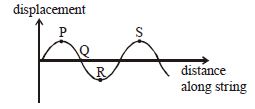
- 3The given graph illustrates a transverse wave travelling on a string at a particular instant, and the points $P, Q, R$ and $S$ represent elements of the string. Which of the following statements about the motion of the elements is correct?View Solution
- 4The speed of a wave in a certain medium is $960\, m/s$. If $3600$ waves pass over a certain point of the medium in $1\, minute$, the wavelength is .... $metres$View Solution
- 5In stationary waves, distance between a node and its nearest antinode is $20 cm$. The phase difference between two particles having a separation of $60 cm$ will beView Solution
- 6Following statements are given for a stationary waveView Solution
$(a)$ Every particle has a fixed amplitude which is different from the amplitude of its nearest particle.
$(b)$ All the particles cross their mean position at the same time.
$(c)$ All the particles are oscillating with same amplitude.
$(d)$ There is no net transfer of energy across any plane.
$(e)$ There are some particles which are always at rest.
Which of the following is correct
- 7A plane wave $y=A\,\, sin\,\, \omega \left( {t - \frac{x}{v}} \right)$ undergo a normal incidence on a plane boundary separating medium $M_1$ and $M_2$ and splits into a reflected and transmitted wave having speeds $v_1$ and $v_2$ thenView Solution
- 8View SolutionThe ratio of speed of sound in hydrogen gas to the speed of sound in oxygen gas at the same temperature is
- 9A one metre long (both ends open) organ pipe is kept in a gas that has double the density of air at $STP$. Assuming the speed of sound in air at $STP$ is $300\; \mathrm{m} / \mathrm{s}$, the frequency difference between the fundamental and second harmonic of this pipe is ___ $\mathrm{Hz}$View Solution
- 10In a gultar, two strings $A$ and $B$ made of same materlal are slightly out of tune and produce beats of frequency $6\, Hz$. When tension in $B$ is slightly decreased, the beat frequency increases to $7 \,Hz$. If the frequency of $A$ is $530\, Hz ,$ the orlginal frequency of $B$ will be $.........Hz$View Solution