A man sitting in a moving train hears the whistle of the engine. The frequency of the whistle is $600 Hz$
Easy


Download our appand get started for free
Experience the future of education. Simply download our apps or reach out to us for more information. Let's shape the future of learning together!No signup needed.*
Similar Questions
- 1The number of beats produced per second by two vibrations: $x_1 =x_0$ sin $646\pi t$ and $x_2 = x_0 sin 652 \pi t$ isView Solution
- 2A stationary observer receives sound from two identical tuning forks, one of which approaches and the other one recedes with the same speed (much less than the speed of sound). The observer hears $2\; beats/sec$. The oscillation frequency of each tuning fork is $v_{0}=1400 \;\mathrm{Hz}$ and the velocity of sound in air is $350\; \mathrm{m} / \mathrm{s}$. The speed of each tuning fork is close toView Solution
- 3Two waves are given by ${y_1} = a\sin (\omega t - kx)$ and ${y_2} = a\cos (\omega \,t - kx)$ The phase difference between the two waves isView Solution
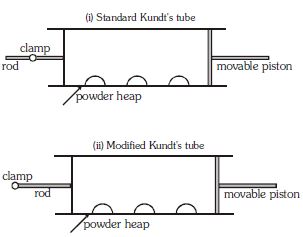
- 4In the Kundts tube experiment (shown in fig. $(i)$), the rod is clamped at the end instead of clamping it at the center as shown in fig. $(ii).$ It is known that speed of sound in air is $330\ m/s$, powder piles up at successive distance of $0.6\ m$ and length of rod used is $1\ m$, speed of sound in rod is .... $\frac{m}{s}$View Solution
- 5A man sitting in a moving train hears the whistle of the engine. The frequency of the whistle is $600 Hz$View Solution
- 6A plane sound waves passes from medium $1$ into medium $2$. The speed of sound in medium $1$ is $200\,m/s$ and in medium $2$ is $100 \,m/s$. The ratio of amplitude of the transmitted wave to that of incident wave is :-View Solution
- 7An observer starts moving with uniform acceleration $'a'$ towards a stationary sound source of frequency $f.$ As the observer approaches the source, the apparent frequency $f'$ heard by the observer varies with time $t$ as:View Solution
- 8A closed orgain pipe has length $'l’$. The air in it is vibrating in $3^{rd}$ overtone with maximum displacement amplitude $'a’$. The displacement amplitude at distance $l / 7$ from closed end of the pipe is:View Solution
- 9View SolutionThe phenomenon of sound propagation in air is
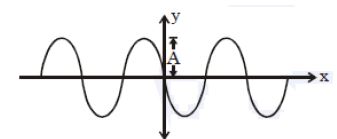
- 10A progressive wave travelling along the positive $x-$ direction is represented by $y(x, t) = A\,sin\,\left( {kx - \omega t + \phi } \right)$. Its snapshot at $t = 0$ is given in the figure For this wave, the phase $\phi $ isView Solution