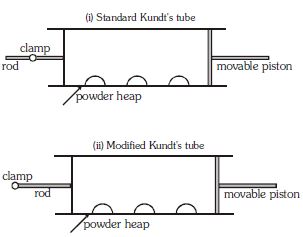
In the Kundts tube experiment (shown in fig. $(i)$), the rod is clamped at the end instead of clamping it at the center as shown in fig. $(ii).$ It is known that speed of sound in air is $330\ m/s$, powder piles up at successive distance of $0.6\ m$ and length of rod used is $1\ m$, speed of sound in rod is .... $\frac{m}{s}$
Diffcult


Download our appand get started for free
Experience the future of education. Simply download our apps or reach out to us for more information. Let's shape the future of learning together!No signup needed.*
Similar Questions
- 1In a closed organ pipe, the frequency of fundamental note is $30 \mathrm{~Hz}$. A certain amount of water is now poured in the organ pipe so that the fundamental frequency is increased to $110 \mathrm{~Hz}$. If the organ pipe has a cross-sectional area of $2 \mathrm{~cm}^2$, the amount of water poured in the organ tube is _____________$g.$ (Take speed of sound in air is $330 \mathrm{~m} / \mathrm{s}$ )View Solution
- 2The phase difference between two waves, represented by ${y_1} = {10^{ - 6}}\sin \left\{ {100t + \left( {x/50} \right) + 0.5} \right\}\ m$ , ${y_2} = {10^{ - 6}}\cos \left\{ {100t + \left( {\frac{x}{{50}}} \right)} \right\}\ m$ where $x$ is expressed in metres and $t$ is expressed in seconds, is approximately .... $radians$View Solution
- 3View SolutionWith what velocity an observer should move relative to a stationary source so that he hears a sound of double the frequency of source
- 4A wave represented by the equation ${y_1} = a\,\cos \,\left( {kx - \omega t} \right)$ is superimposed with another wave to form a stationary wave such that the point $x = 0$ is node. The equation for the other wave isView Solution
- 5Beats are produced with the help of two sound waves of amplitudes $3$ and $5$ units. The ratio of maximum to minimum intensity in the beats isView Solution
- 6A train whistling at constant frequency is moving towards a station at a constant speed $V$ . The train goes past a stationary observer on the station. The frequency $n'$ of the sound as heard by the observer is plotted as a function of time $t$ (Fig.) . Identify the expected curveView Solution
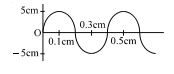
- 7Figure shown the shape of part of a long string in which transverse waves are produced by attaching one end of the string to tuning fork of frequency $250 Hz$. What is the velocity of the waves .... $ms^{-1}$ ?View Solution
- 8A uniform tube of length $60.5\,cm$ is held vertically with its lower end dipped in water. A sound source of frequency $500\,Hz$ sends sound waves into the tube. When the length of tube above water is $16\,cm$ and again when it is $50\,cm,$ the tube resonates with the source of sound. Two lowest frequencies (in $Hz$), to which tube will resonate when it is taken out of water, are (approximately).View Solution
- 9A progressive wave travelling in positive $x$-direction given by $y=a \cos (k x-\omega t)$ meets a denser surface at $x=0, t=0$. The reflected wave is then given byView Solution
- 10View SolutionAs a wave propagates