MCQ
A man standing in front of a mountain beats a drum at regular intervals. The rate of drumming is generally increased and he finds that the echo is not heard distinctly when the rate becomes $40$ per minute. He then moves nearer to the mountain by $90 m$ and finds that echo is again not heard when the drumming rate becomes $60$ per minute. The distance between the mountain and the initial position of the man is .... $m$
  • A
    $205$
  • B
    $300$
  • C
    $180$
  • $270$

Answer

Correct option: D.
$270$
d
(d) For not hearing the echo the time interval between the beats of drum must be equal to time of echo.
==> ${t_1} = \frac{{2d}}{v} = \frac{{60}}{{40}} = \frac{3}{2}$......$(i)$
and ${t_2} = \frac{{2(d - 90)}}{v} = \frac{{60}}{{60}} = 1$
==> $2d - 180 = v$......$(ii)$
Form $(i),$ we get $2d = \frac{3}{2}v$. Substituting in $(ii),$ we get
==> $\frac{3}{2}v - 180 = v$ ==> $180 = \frac{v}{2}$ ==> $v = 360m{s^{ - 1}}$
==> $\frac{{2(d)}}{{360}} = \frac{3}{2}$ ==> $d = 270m$.

Need a full question paper?

Generate a complete, print-ready paper with questions like this in minutes — across 16+ boards, with answer keys.

Start Generating Free

Similar questions

A capacitor $C _1$ of capacitance $1 \mu F$ and a capacitor $C _2$ of capacitance $2 \mu F$ are separately charged by a common battery for a long time. The two capacitors are then separately discharged through equal resistors. Both the discharge circuits are connected at $t =0$.
A stone of mass $1 \,kg$ is tied with a string and it is whirled in a vertical circle of radius $1 \,m$. If tension at the highest point is $14 \,N$, then velocity at lowest point will be ............ $m / s$
If a Second's pendulum is moved to a planet where acceleration due to gravity is $4$ times, the length of the second's pendulum on the planet should be made .......... times
A uniform tube of length $60.5\,cm$ is held vertically with its lower end dipped in water. A sound source of frequency $500\,Hz$ sends sound waves into the tube. When the length of tube above water is $16\,cm$ and again when it is $50\,cm,$ the tube resonates with the source of sound. Two lowest frequencies (in $Hz$), to which tube will resonate when it is taken out of water, are (approximately).
A boat crosses a river with a velocity of $8\, km/h$. If the resulting velocity of boat is $10 \,km/h $ then the velocity of river water is...........$km/h$
$N$ molecules each of mass $m$ of gas $A$ and $2N$ molecules each of mass $2m$ of gas $B$ are contained in the same vessel at temperature $T.$ The mean square of the velocity of molecules of gas $B$ is ${v^2}$ and the mean square of $x$ component of the velocity of molecules of gas $A$ is ${w^2}$. The ratio $\frac{{{w^2}}}{{{v^2}}}$ is
When both the listener and source are moving towards each other, then which of the following is true regarding frequency and wavelength of wave observed by the observer?
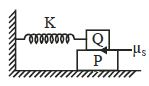
A block $P$ of mass $m$ is placed on a smooth horizontal surface. A block $Q$ of same mass is placed over the block $P$ and the coefficient of static friction between them is ${\mu _S}$. A spring of spring constant $K$ is attached to block $Q$. The blocks are displaced together to a distance $A$ and released. The upper block oscillates without slipping over the lower block. The maximum frictional force between the block is
Taking into account of the slgnificant figures, what is the value of $9.99\, m -0.0099\, m ?$
Distance does not depend on $.............$