Question
A man stands in between two parallel cliffs and blows a whistle. He hears first echo after $0.6s$ and second echo after $2.4s$. Calculate the distance between cliffs.
[Speed of sound $= 336 m/s]$

Answer

Given: $t_1 =$ Time after which first echo is heard $= 0.6s$
$t_2 =$ Time after which second echo is heard $= 2.4s$
$v =$ Velocity of sound = 336 m/s.
For an echo the distance travelled by the sound is 2d.
$d _1=\frac{ v \times t _1}{2}$
Or, $d _1=\frac{336 \times 0.6}{2}=100.8 m$
And $d_2=\frac{v \times t_2}{2}$
Or, $d_2=\frac{336 \times 2.4}{2}=403.2 m$
$\therefore$ Total distance between two cliffs
$= d_1 + d_2 = (100.8 + 403.2)m = 504 m.$

Need a full question paper?

Generate a complete, print-ready paper with questions like this in minutes — across 16+ boards, with answer keys.
Start Generating Free

Similar questions

Draw neat diagrams for the formation of images in case of concave lens and state their characteristics when the object is:
(a) at infinity,
(b) anywhere between infinity and the optical centre
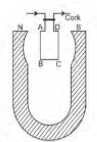
(i) The diagram given shows a rectangular coil ABCD , suspended freely between the concave pole pieces of a permanent horse-shoe magnet, such N that the plane of coil is parallel to magnetic field.
(a) State your observation when the current is switched on.
(b) Give an explanation for your observation in (a)-
(c) State the rule which will help you to find the motion of rotation of the coil.
Image
(ii) State four ways of increasing the magnitude of the force acting on the coil.
(iii) Draw a diagram showing the magnetic field around solenoid when electric current flows through it.
State the effect of enhancement of green house effect.
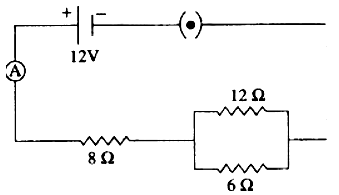
Three resistors are connected to a $12 \ V$ battery as shown in the figure given below:

(i) What is the current through the $8$ ohm resistor?
(ii) What is the potential difference across the parallel combination of $6$ ohm and $12$ ohm resistor?
(iii) What is the current through the $6$ ohm resistor?
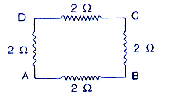
In the network shown in the following adjacent Figure, calculate the equivalent resistance between the points.
  1. A and B
  2. A and C
How does a concave lens act as a ‘diverging lens’?
How does the average potential energy of molecules of a substance change during its change in phase at a constant temperature?
What is an Ohmic resistor?
In which direction the force need to applied, when a single pulley is used with a mechanical advantage greater than one? How can you change the direction of force applied without altering its mechanical advantage? Draw a labelled diagram of the system.
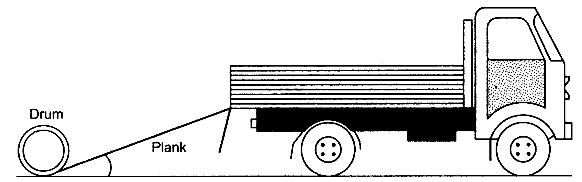
A truck driver can load oil drums into the back of the truck by pushing them up a sloping plank, or by lifting them directly. Each drum has a mass of 80 kg, the plank is $3$ m long, and the back of the truck is 0.8 m above the ground

(i) How much force would be needed to lift a drum into the truck directly/without using the plank? (Take $g = 10 m/s^2$)
(ii) How much energy would be required in lifting the drum into the truck without the plank?
(iii) If the force needed to push the drum up the plank is 300 N, why is this less than the answer to part (i)?
(iv) When the truck is loaded, the driver drives off. List the major energy changes that take place in moving the truck.
(v) The driver has to stop at the factory gates. What happens to the kinetic energy of the truck?