Question
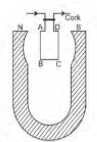
(i) The diagram given shows a rectangular coil ABCD , suspended freely between the concave pole pieces of a permanent horse-shoe magnet, such N that the plane of coil is parallel to magnetic field.
(a) State your observation when the current is switched on.
(b) Give an explanation for your observation in (a)-
(c) State the rule which will help you to find the motion of rotation of the coil.
Image
(ii) State four ways of increasing the magnitude of the force acting on the coil.
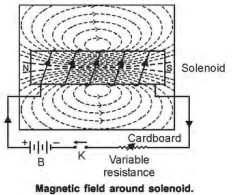
(iii) Draw a diagram showing the magnetic field around solenoid when electric current flows through it.
Answer

(i) (a) The coil ABCD will turn about its axis. The arm $A B$ of the coil will move out of the plane of the paper and arm CD into the plane of the paper. Thus, coil will tum in the anti-clockwise direction.
(b) A magnetic field is set up by this coil due to the passage of electric current, which is at right angles to the magnetic field of permanent magnet. Thus, a magnetic couple acts, which turns the coil.
(c) Fleming's Left Hand Rule : It tells the direction of motion of conductor carrying current in a magnetic field. It states :
Stretch the thumb, the forelinger and the middle finger of left hand at right angles with each other, such that forefinger points in the direction of the magnetic field, middle finger points in the direction of the current. Then, the thumb points in the direction of the motion of the conductor.
(ii) We can increase the magnitude of the force acting on the coil
(a) By increasing the number of turns in the coil.
(b) By increasing the area of cross-section of the coil.
(c) By placing a laminated soft iron core within the coil
(d) By increasing the magnitude of current in the coil.
(iii)
Image

Need a full question paper?

Generate a complete, print-ready paper with questions like this in minutes — across 16+ boards, with answer keys.

Start Generating Free

Similar questions

Steam at 100°C is passed over 1000 g of ice at 0°C. After some time, 600 g of ice at 0°C is left and 450 g of water at 0°C is formed. Calculate the specific latent heat of vaporization of steam (Given: specific heat capacity of water = 4200 J/kg°C, specific latent heat of fusion of ice = 336,000 J/kg.)
(i) Define machine and write functions of a machine.
(ii) Describe mechanical advantage and its types.
(iii) (a) Derive relation between the efficiency, mechanical advantage, and the velocity ratio of a practical machine.
(b) Derive relation between ideal mechanical advantage and velocity ratio for a perfect machine
Describe a simple experiment to verify the principle of moments, if you are supplied with a metre rule, a fulcrum and two springs with slotted weights.
When an arrow is shot from a bow, it has kinetic energy in it. Explain briefly from where does it get its kinetic energy?
What do you understand by forced vibrations?
Explain briefly what causes the twinkling of stars at night.
What is the cause of resistance offered by the metallic wire in the flow of current through it?
The frequency of the stretched string of a fixed length is f when it is plucked in the middle. Where should it be plucked so that string vibrates with frequency (i) 2f, (ii) 3f?
Draw diagrams to show these vibrations and name them.
Two bulbs are rated: bulb A 100W, 120 V bulb B 10 W, 120 V. If both are connected across a 120V supply, which bulb will consume more energy, When in series? Also calculate the current through each bulb in above cases.
How is sound perceived by us?