Question
A man walking briskly in rain with speed v must slant his umbrella forward making an angle $\theta$ with the vertical. A student derives the following relation between $\theta$ and v: $\tan \theta = \text{v}$ and checks that the relation has a correct limit: as $\text{v}\rightarrow 0,\ \theta \rightarrow0,$ as expected. (We are assuming there is no strong wind and that the rain falls vertically for a stationary man). Do you think this relation can be correct? If not, guess the correct relation.

Answer

Incorrect; on dimensional ground The relation is $\tan \theta=\mathrm{v}$ Dimension of R.H.S $=\mathrm{M}^0 \mathrm{~L}^1 \mathrm{~T}^{-1}$ Dimension of L.H.S = $M^0 L^0 T^0(\because$ The trigonometric function is considered to be a dimensionless quantity) Dimension of R.H.S is not equal to the dimension of L.H.S. Hence, the given relation is not correct dimensionally. To make the given relation correct, the R.H.S should also be dimensionless. One way to achieve this is by dividing the R.H.S by the speed of rainfall v'. Therefore, the relation reduces to $\tan \theta=\frac{\mathrm{v}}{\mathrm{v}^{\prime}}$. This relation is dimensionally correct.

Need a full question paper?

Generate a complete, print-ready paper with questions like this in minutes — across 16+ boards, with answer keys.

Start Generating Free

Similar questions

Figure. shows two vessels A and B with rigid walls containing ideal gases. The pressure, temperature and the volume are $p_A, T_A, V$ in the vessel A and $p_B, T_B$, V in the vessel B. The vessels are now connected through a small tube. Show that the pressure p and the temperature T satisfy $\frac{\text{p}}{\text{T}}=\frac{1}{2}\Big(\frac{\text{P}_\text{A}}{\text{T}_\text{A}}+\frac{\text{p}_\text{B}}{\text{T}_\text{B}}\Big)$ when equilibrium is achieved.
The coil of an electric bulb takes 40 watts to start glowing. If more than 40W is supplied, 60% of the extra power is converted into light and the remaining into heat. The bulb consumes 100W at 220V. Find the percentage drop in the light intensity at a point if the supply voltage changes from 220V to 200V.
What is the difference between cathode rays and beta rays? When the two are travelling in space, can you make out which is the cathode ray and which is the beta ray?
How many is energy states are present in one mole of sodium vapour? Are they all filled in normal conditions? "How many 3s energy states are present in one mole of sodium vapour? Are they all filled in normal conditions?
Consider the situation of the previous problem. Suppose the block of mass $m_1$ is pulled by a constant force $F_1$ and the other block is pulled by a constant force $F_2$. Find the maximum elongation that the spring will suffer.
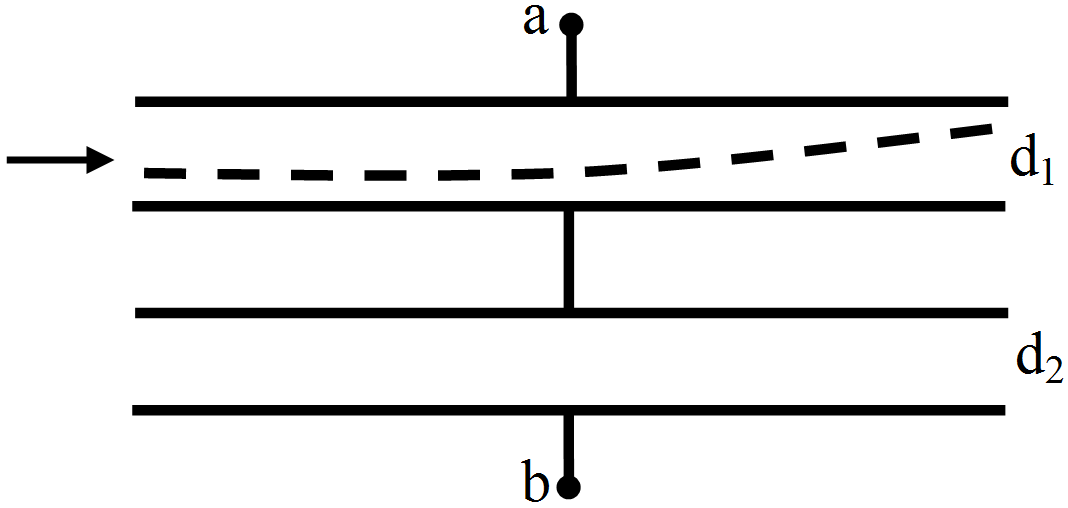
Both the capacitors shown in figure are made of square plates of edge a. The separations between the plates of the capacitors are $d_1$ and $d_2$ as shown in the figure. A potential difference V is applied between the points a and b, An electron is projected between the plates of the upper capacitor along the central line. With what minimum speed should the electron be projected so that it does not collide with any plate? Consider only the electric forces.
Consider the situation of the previous problem. If $1.0\mu\text{C}$ is placed on the upper plate instead of the middle, what will be the potential difference between:
  1. The upper and the middle plates?
  2. The middle and the lower plates?
Assume that the thermal conductivity of copper is four times that of brass. Two rods of copper and brass of the same length, and cross-section are joined end to end. The free end of the copper rod is kept at 0°C and the free end of the brass rod at 100°C. Calculate the temperature at the junction of the two rods at equilibrium. (Ignore radiation losses.)
What is the amplitude, wavelength and velocity of the wave represented by
$\phi(\text{x, t})=5\sin(6\pi\text{t}-4\text{x})?$
A normal eye has retina 2cm behind the eye-lens. What is the power of the eye-lens when the eye is
  1. Fully relaxed,
  2. Most strained?