Question
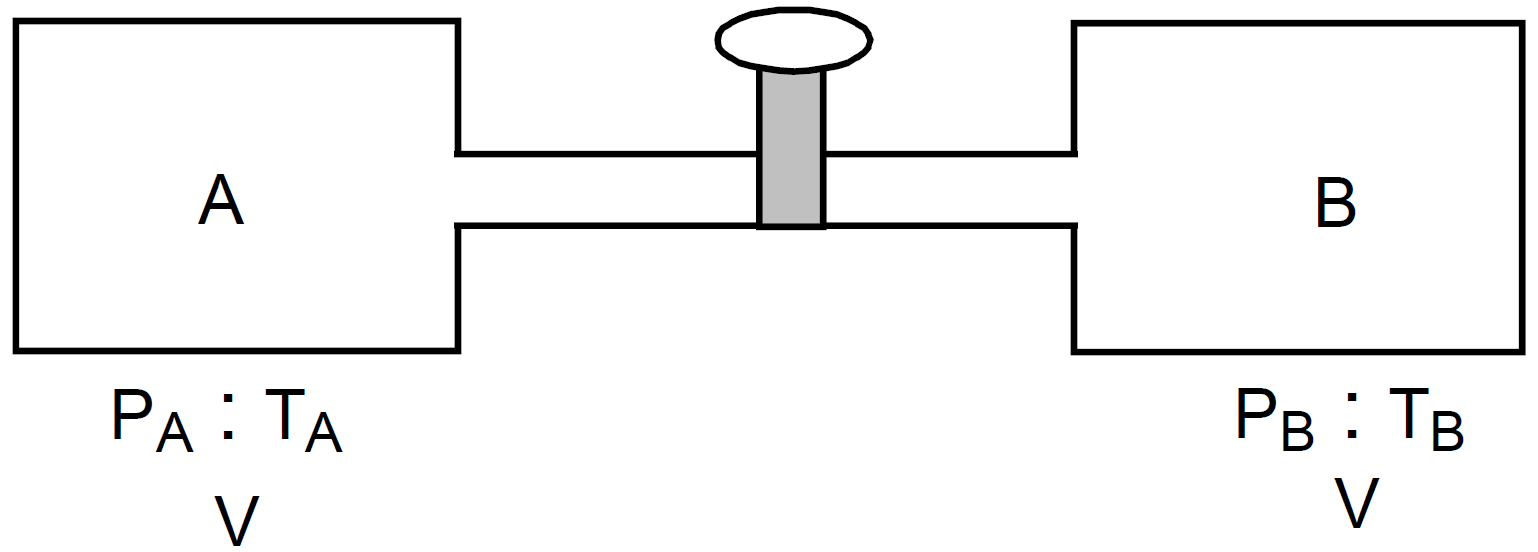
Figure. shows two vessels A and B with rigid walls containing ideal gases. The pressure, temperature and the volume are $p_A, T_A, V$ in the vessel A and $p_B, T_B$, V in the vessel B. The vessels are now connected through a small tube. Show that the pressure p and the temperature T satisfy $\frac{\text{p}}{\text{T}}=\frac{1}{2}\Big(\frac{\text{P}_\text{A}}{\text{T}_\text{A}}+\frac{\text{p}_\text{B}}{\text{T}_\text{B}}\Big)$ when equilibrium is achieved.

Answer


Now, Let the final pressure; Volume & Temp be
After connection = $P_A' \rightarrow$ Partial pressure of A
$P_B' \rightarrow$ Partial pressure of B
Now, $\frac{\text{P}_\text{A}'\times2\text{V}}{\text{T}}=\frac{\text{P}_\text{A}\times\text{V}}{\text{T}_\text{A}}$
Or $\frac{\text{P}_\text{A}'}{\text{T}}=\frac{\text{P}_\text{A}}{2\text{T}_\text{A}}\ ...(1)$
Similarly, $\frac{\text{P}_\text{B}'}{\text{T}}=\frac{\text{P}_\text{B}}{2\text{T}_\text{B}}\ ...(2)$
Adding (1) & (2)
$\frac{\text{P}_\text{A}'}{\text{T}}+\frac{\text{P}_\text{B}'}{\text{T}}=\frac{\text{P}_\text{A}}{2\text{T}_\text{A}}+\frac{\text{P}_\text{B}}{2\text{T}_\text{B}}=\frac{1}{2}\Big(\frac{\text{P}_\text{A}}{\text{T}_\text{A}}+\frac{\text{P}_\text{B}}{\text{T}_\text{B}}\Big)$
$\Rightarrow\frac{\text{P}}{\text{T}}=\frac{1}{2}\Big(\frac{\text{P}_\text{A}}{\text{T}_\text{A}}+\frac{\text{P}_\text{B}}{\text{T}_\text{B}}\Big)$ $\big[\therefore\text{P}_\text{A}'+\text{P}_\text{B}'=\text{P}\big]$

Need a full question paper?

Generate a complete, print-ready paper with questions like this in minutes — across 16+ boards, with answer keys.

Start Generating Free

Similar questions

A mild steel wire of length $1.0m$ and cross-sectional area $0.50 \times 10^{-2}cm^2$ is stretched, well within its elastic limit, horizontally between two pillars. A mass of $100g$ is suspended from the mid-point of the wire. Calculate the depression at the midpoint.
What are the three forms of energy possessed by a flowing fluid? Find their expressions.
A uniform wheel of radius R is set into rotation about its axis at an angular speed $\omega.$ This rotating wheel is now placed on a rough horizontal surface with its axis horizontal. Because of friction at the contact, the wheel accelerates forward and its rotation decelerates till the wheel starts pure rolling on the surface. Find the linear speed of the wheel after it starts pure rolling.
Explain the angle of friction and angle of repose.
A wheel in uniform motion about an axis passing through its centre and perpendicular to its plane is considered to be in mechanical (translational plus rotational) equilibrium because no net external force or torque is required to sustain its motion. However, the particles that constitute the wheel do experience a centripetal acceleration directed towards the centre.How do you reconcile this fact with the wheel being in equilibrium? How would you set a half-wheel into uniform motion about an axis passing through the centre of mass of the wheel and perpendicular to its plane? Will you require external forces to sustain the motion?
If the above capacitor is connected across a $6.0V$ battery, find:
  1. The charge supplied by the battery.
  2. The induced charge on the dielectric.
  3. The net charge appearing on one of the coated surfaces.
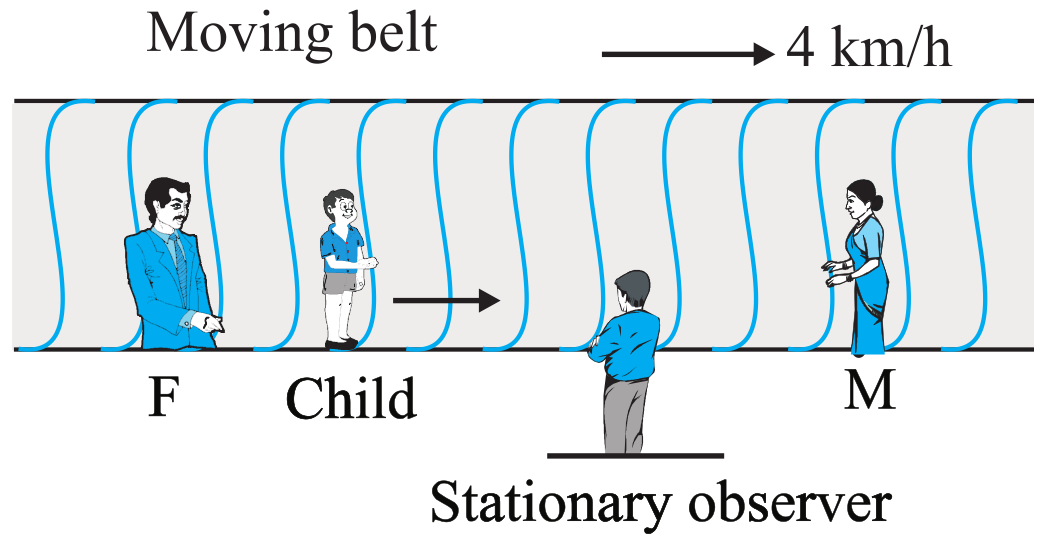
On a long horizontally moving belt a child runs to and fro with a speed $9km h^{–1}$​​​​​​​ (with respect to the belt) between his father and mother located $50$ m apart on the moving belt. The belt moves with a speed of $4km h^{–1}$​​​​​​​. For an observer on a stationary platform outside, what is the
  1. speed of the child running in the direction of motion of the belt?.
  2. speed of the child running opposite to the direction of motion of the belt?
  3. time taken by the child in (a) and (b)?
Which of the answers alter if motion is viewed by one of the parents?
A curved surface is shown in. The portion BCD is free of friction. There are three spherical balls of identical radii and masses. Balls are released from rest one by one from A which is at a slightly greater height than C.
With the surface AB, ball 1 has large enough friction to cause rolling down without slipping, ball 2 has a small friction and ball 3 has a negligible friction.
  1. For which balls is total mechanical energy conserved?
  2. Which ball (s) can reach D?
  3. For balls which do not reach D, which of the balls can reach back A?
A small object is placed at the centre of the bottom of a cylindrical vessel of radius 3cm and height 4cm filled completely with water. Consider the ray leaving the vessel through a corner. Suppose this ray and the ray along the axis of the vessel are used to trace the image. Find the apparent depth of the image and the ratio of real depth to the apparent depth under the assumptions taken. Refractive index of water = 1.33
Derive a relation for work done in a gravitational field. Using it, (i) find potential difference between a pair of points. (ii) express whether gravitational force is conservative or non-conservative.