Question
A man walks on a straight road from his home to a market 2.5 km away with a speed of $5 km^{ h -1}$. Finding the market closed, he instantly turns and walks back home with a speed of $7.5 km h ^{-1}$. What is the Average speed of the man over the interval of time
i. $0$ to $30$ min ,
ii. $0$ to $50$ min ,
iii. $0$ to $40$ min ?
[Note: You will appreciate from this exercise why it is better to define average speed as total path length divided by time, and not as magnitude of average velocity. You would not like to tell the tired man on his return home that his average speed was zero!]
Answer


i. 0 to 30 min ,
Average velocity $=$ Displacement/Time $=2.5 /(1 / 2)=5 km / h$
Average speed $=$ Distance $/$ Time $=2.5 /(1 / 2)=5 km / h$
ii. 0 to 50 min
Time $=50 min=50 / 60=5 / 6 h$
Net displacement $=0$
Total distance $=2.5+2.5=5 km$
Average velocity $=$ Displacement/Time $=0$
Average speed $=$ Distance $/$ Time $=5 /(5 / 6)=6 km / h$
iii. 0 to 40 min
Speed of the man $=7.5 km / h$
Distance travelled in first $30 min=2.5 km$
Distance travelled by the man (from market to home) in the next 10 min $=7.5 \times 10 / 60=1.25 km$
Net displacement $=2.5-1.25=1.25 km$
Total distance travelled $=2.5+1.25=3.75 km$
Average velocity $=$ Displacement $/$ Time $=1.25 /(40 / 60)=1.875 km / h$
Average speed $=$ Distance $/$ Time $=3.75 /(40 / 60)=5.625 km / h$

Need a full question paper?

Generate a complete, print-ready paper with questions like this in minutes — across 16+ boards, with answer keys.

Start Generating Free

Similar questions

A person standing on a road sends a sound signal to the driver of a car going away from him at a speed of 72km/h. The signal travelling at 330m/s in air and having a frequencyof 1600Hz gets reflected d from the body of the car and returns. Find the frequency of the reflected signal as heard by the person.
The count rate from a radioactive sample falls from $4.0 \times 10^6$ per second to $1.0 \times 10^6$ per second in 20 hours. What will be the count rate 100 hours after the beginning?
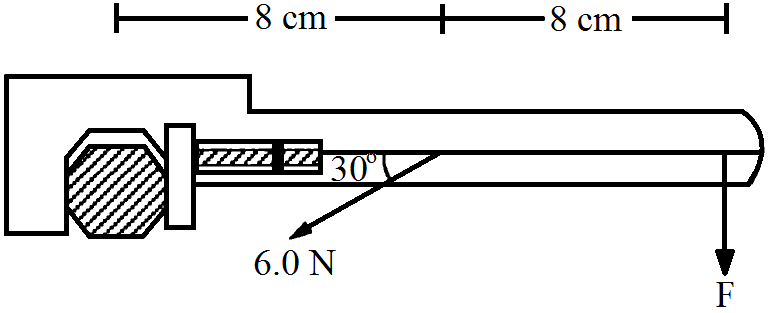
When a force of 6.0N is exerted at 30° to a wrench at a distance of 8cm from the nut, it is just able to loosen the nut. What force F would be sufficient to loosen it if it acts perpendicularly to the wrench at 16cm from the nut?
A stationary object is released from a point P a distance 3R from the centre of the moon which has radius R and mass M. Calculate the speed of the object on hitting the moon.
A steel wire of length $4.7m$ and cross-sectional area $3.0 \times 10^{-5}m^2$ stretches by the same amount as a copper wire of length $3.5m$ and cross-sectional area of $4.0 \times 10^{-5}m^2$​​​​​​​ under a given load. What is the ratio of the Young’s modulus of steel to that of copper?
“Every great physical theory starts as a heresy and ends as a dogma”. Give some examples from the history of science of the validity of this incisive remark.
Suppose the rod in the previous problem has a mass of $1\ kg$ distributed uniformly over its length:
  1. Find the initial angular acceleration of the rod.
  2. Find the tension in the supports to the blocks of mass $2\ kg$ and $5\ kg$.
Pressure decreases as one ascends the atmosphere. If the density of air is $\rho,$ what is the change in pressure dp over a differential height dh?
A charged capacitor of capacitance C is discharged through a resistance R. A radioactive sample decays with an average-life $\tau.$ Find the value of R for which the ratio of the electrostatic field energy stored in the capacitor to the activity of the radioactive sample remains constant in time.
Artificial diamond crystals have been manufactured by subjecting carbon in the form of graphite to a pressure of $1.55 \times 10^{10} \mathrm{Nm}^{-2}$ at a high temperature. Assuming that natural dimonds were formed at similar high pressures within the earth, what must have been the original volume o the Kohinoor diamond, whose mass before cutting was about 175 g ? The density of the diamond $=3.5 \mathrm{~g} / \mathrm{cm}^{-3}$ and its bulk modulus $=62 \times 10^{10} \mathrm{Nm}^{-2}$.