Question types

Motion in a Straight Line question types

590 questions across 8 question groups — pick any mix to generate a Physics paper with step-by-step answer keys.

590
Questions
8
Question groups
5
Question types
Sample Questions

Motion in a Straight Line questions

One sample from each question group in this chapter. Select any group above to see the full set with answer keys.

Select the correct statements for a particle going on a straight line:
  • A
    If the position and velocity are in opposite directions, the particle is moving towards the origin.
  • B
    It the acceleration and velocity are in opposite directions, the particle is slowing down.
  • C
    If the velocity is zero for a time interval, the acceleration is zero at any moment within that time interval.
  • If the velocity is zero at any instant, then the acceleration must also be zero at that instant.

Answer: D.

View full solution
What will be the velocity v/s time graph of a ball falling from a height before hitting the ground look like?
  • A straight line with positive slope
  • B
    A straight line with negative slope
  • C
    A straight line with zero slope
  • D
    A parabola

Answer: A.

View full solution
An object may have:
$i.$ varying speed without having varying velocity.
$ii.$ varying velocity without having varying speed.
$iii.$ non-zero acceleration without having varying velocity.
$iv.$ non-zero acceleration without having varying speed.
  • A
    $i$ and $ii$ are correct.
  • B
    $ii$ and $iii$ are correct.
  • $ii$ and $iv$ are correct.
  • D
    None of the above.

Answer: C.

View full solution
Two particles $A$ and $B$ are moving in a straight line with the same speed. Which of the following statement (s) is/ are correct for the relative motion of the two particles?
  • A
    The relative velocity $V_{AB}$ Or $V_{BA}$ is zero. Only if they are moving in the same direction.
  • B
    If the particles are moving in opposite direction, the magnitude of $V_{AB}$ Or $V_{BA}$ is twice, then the magnitude of velocity of $A$ or that of $B.$
  • C
    The relative velocity $V_{AB}$ Or $V_{BA}$ is always zero.
  • Both $(a)$ and $(b).$

Answer: D.

View full solution
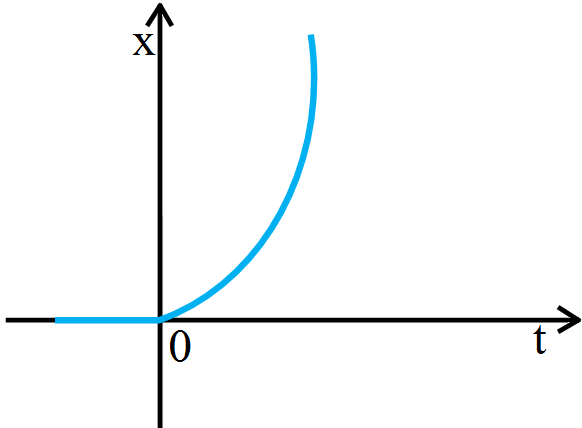
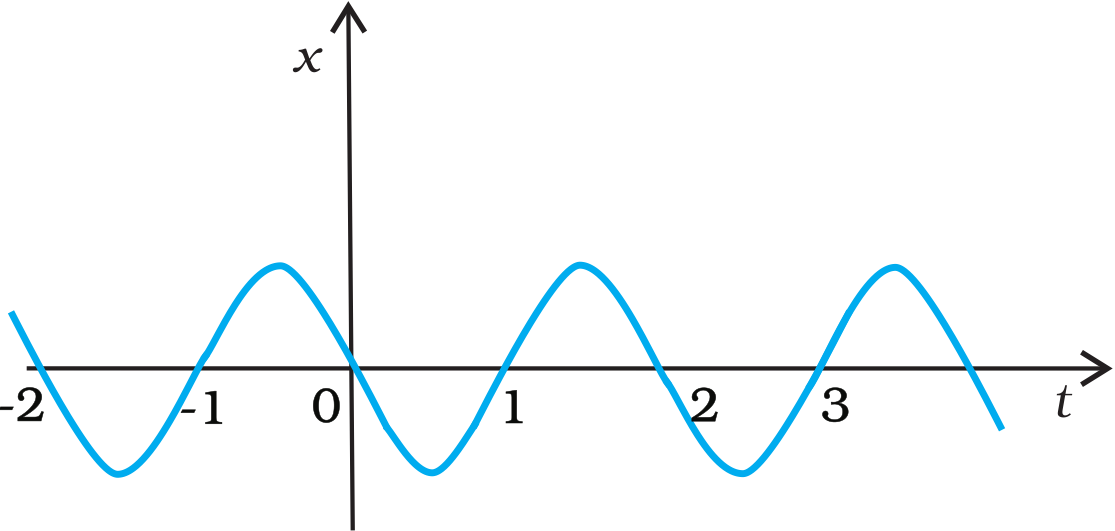
Shows the x-t plot of one-dimensional motion of a particle. Is it correct to say from the graph that the particle moves in a straight line for t < 0 and on a parabolic path for t > 0? If not, suggest a suitable physical context for this graph.
View full solution
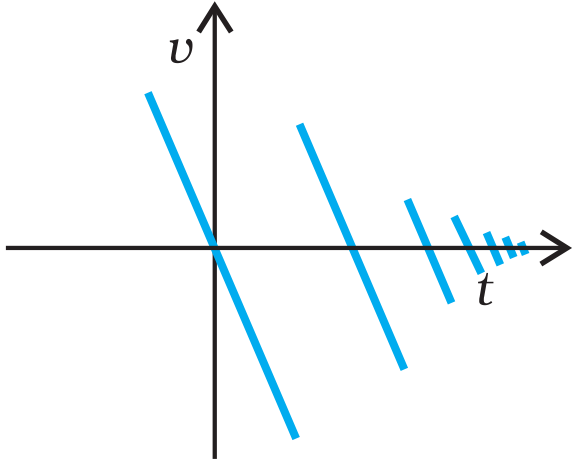
A ball is dropped from a height of $90m$ on a floor. At each collision with the floor, the ball loses one tenth of its speed. Plot the speed$-$time graph of its motion between $t = 0$ to $12s$.
View full solution
In which of the following examples of motion, can the body be considered approximately a point object: A spinning cricket ball that turns sharply on hitting the ground.
View full solution
A player throws a ball upwards with an initial speed of $29.4 \mathrm{~m} \mathrm{~s}^{-1}$. What is the direction of acceleration during the upward motion of the ball?
View full solution
Read statement below carefully and state with reasons and examples, if it is true or false; A particle in one-dimensional motion. With zero speed may have non-zero velocity.
View full solution
In which of the following examples of motion, can the body be considered approximately a point object: A tumbling beaker that has slipped off the edge of a table.
View full solution
Q 213 Marks Question3 Marks
In Exercises $3.13$ and $3.14$, we have carefully distinguished between average speed and magnitude of average velocity. No such distinction is necessary when we consider instantaneous speed and magnitude of velocity. The instantaneous speed is always equal to the magnitude of instantaneous velocity. Why?
View full solution
Q 223 Marks Question3 Marks
A jet airplane travelling at the speed of $500 km\ h^{–1}$ ejects its products of combustion at the speed of $1500km\ h^{–1}$ relative to the jet plane. What is the speed of the latter with respect to an observer on the ground?
View full solution
Q 233 Marks Question3 Marks
A player throws a ball upwards with an initial speed of $29.4 \mathrm{~m} \mathrm{~s}^{-1}$. To what height does the ball rise and after how long does the ball return to the player's hands? (Take $\mathrm{g}=9.8 \mathrm{~m}^{\mathrm{s}-2}$ and neglect air resistance).
View full solution
Q 243 Marks Question3 Marks
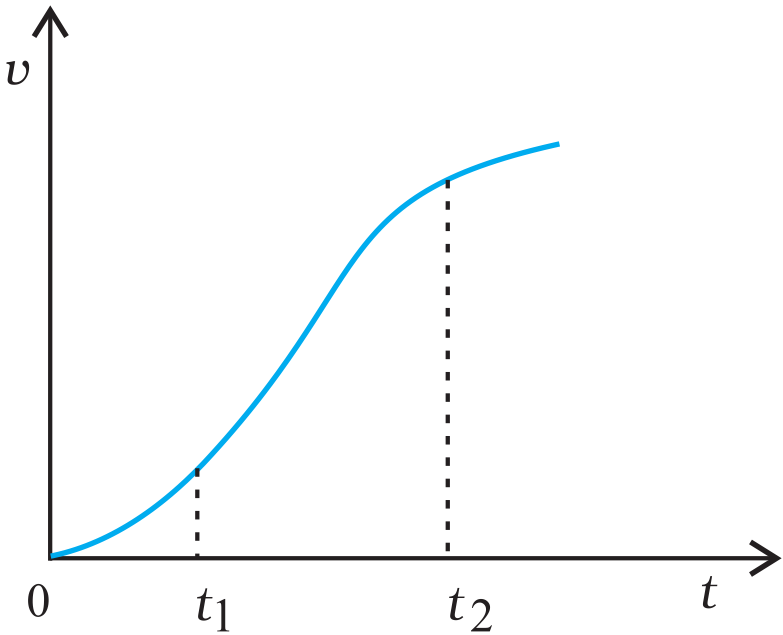
The velocity-time graph of a particle in one-dimensional motion is shown in:

Which of the following formulae are correct for describing the motion of the particle over the time-interval $t_1$ to $t_2$:
a. $x\left(t_2\right)=x\left(t_1\right)+v\left(t_1\right)\left(t_2-t_1\right)+(1 / 2) a\left(t_2-t_1\right)^2$
b. $v\left(t_2\right)=v\left(t_1\right)+a\left(t_2-t_1\right)$
c. $v_{\text {average }}=\left(x\left(t_2\right)-x\left(t_1\right)\right) /\left(t_2-t_1\right)$
d. $\mathrm{a}_{\text {average }}=\left(\mathrm{v}\left(\mathrm{t}_2\right)-\mathrm{v}\left(\mathrm{t}_1\right)\right) /\left(\mathrm{t}_2-\mathrm{t}_1\right)$
e. $x\left(t_2\right)=x\left(t_1\right)+v_{\text {average }}\left(t_2-t_1\right)+(1 / 2) a_{\text {average }}\left(t_2-t_1\right)^2$
f. $x\left(t_2\right)-x\left(t_1\right)=$ area under the v-t curve bounded by the $t$-axis and the dotted line shown.
View full solution
Q 253 Marks Question3 Marks
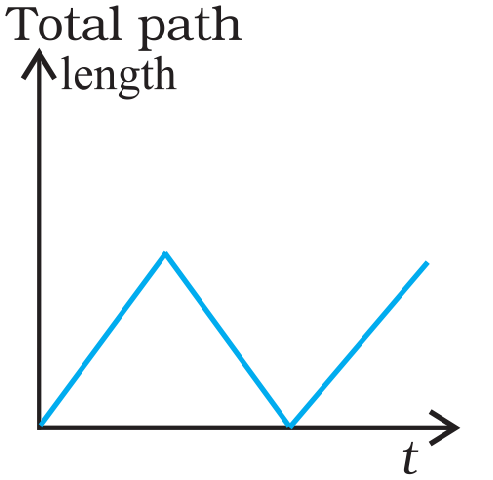
 A man walks on a straight road from his home to a market $2.5$ km away with a speed of $5 km^{ h -1}$. Finding the market closed, he instantly turns and walks back home with a speed of $7.5 km h ^{-1}$. What is the Average speed of the man over the interval of time
i. $0$ to $30$ min ,
ii. $0$ to $50$ min ,
iii. $0$ to $40$ min ?
[Note: You will appreciate from this exercise why it is better to define average speed as total path length divided by time, and not as magnitude of average velocity. You would not like to tell the tired man on his return home that his average speed was zero!]
 
View full solution
Read statement below carefully and state with reasons and examples, if it is true or false; A particle in one-dimensional motion. With positive value of acceleration must be speeding up.
View full solution
Gives the x-t plot of a particle executing one-dimensional simple harmonic motion. (You will learn about this motion in more detail in Chapter 14). Give the signs of position, velocity and acceleration variables of the particle at t = 0.3 s, 1.2 s, – 1.2 s.
View full solution
A car moving along a straight highway with speed of $126km\ h^{–1}$ is brought to a stop within a distance of $200m$. What is the retardation of the car (assumed uniform), and how long does it take for the car to stop?
View full solution
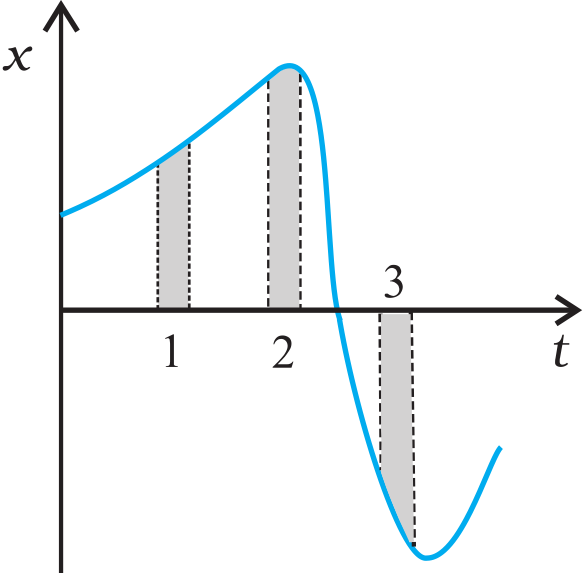
Gives the x-t plot of a particle in one-dimensional motion. Three different equal intervals of time are shown. In which interval is the average speed greatest, and in which is it the least? Give the sign of average velocity for each interval.
View full solution
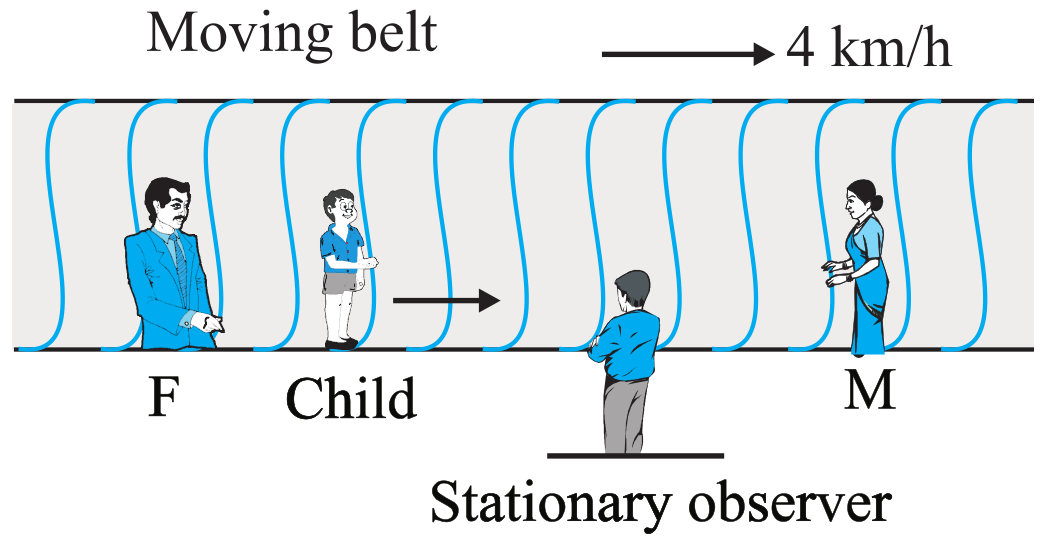
On a long horizontally moving belt a child runs to and fro with a speed $9\ km h^{–1} ($with respect to the belt$)$ between his father and mother located $50 m$ apart on the moving belt. The belt moves with a speed of $4\ km h^{–1}$. For an observer on a stationary platform outside, what is the
  1. speed of the child running in the direction of motion of the belt?.
  2. speed of the child running opposite to the direction of motion of the belt?
  3. time taken by the child in $(a)$ and $(b)?$
Which of the answers alter if motion is viewed by one of the parents?
View full solution
Read the passage given below and answer the following questions from $1$ to $5$. When an object is in motion, its position changes with time. But how fast is the position changing with time and in what direction? To describe this, we define the quantity average velocity. Average velocity is defined as the change in position or displacement (x) divided by the time intervals (t), in which the displacement occurs: $\text{V}=\frac{\text{x2}-\text{x1}}{\text{t2}-\text{t1}}=\frac{\triangle\text{x}}{\triangle\text{t}}$ Where $x2$ and $x1$ are the positions of the object at time t2and t1, respectively. The SI unit for velocity is m/s or $m s^{–1},$ although km $h^{–1} $ is used in many everyday applications. Like displacement, average velocity is also a vector quantity. Average speed is defined as the total path length travelled divided by the total time interval during which the motion has taken place: Average speed = Total path length/ Total time interval. Average speed has obviously the same unit $(m s^{–1})$ as that of velocity. But it does not tell us in what direction an object is moving. Thus, it is always positive (in contrast to the average velocity which can be positive or negative). If the motion of an object is along a straight line and in the same direction, the magnitude of displacement is equal to the total path length. The velocity at an instant is defined as the limit of the average velocity as the time interval Dt becomes infinitesimally small. In other words $\text{V}=\lim_{\text{dt}-0}\frac{\text{dx}}{\text{dt}}$
$\text{V}=\frac{\text{dx}}{\text{dt}}$ Note that for uniform motion, velocity is the same as the average velocity at all instants. Instantaneous acceleration is defined in the same way as the instantaneous velocity $\text{A}=\lim_{\text{dt}-0}\frac{\text{dv}}{\text{dt}}$
$\text{A}=\frac{\text{dv}}{\text{dt}}$
  1. For uniform motion instantaneous velocity is same as:
  1. Average velocity
  2. Average acceleration
  3. Instantaneous speed
  4. None of these
  1. If velocity is constant then
  1. Acceleration is zero
  2. Acceleration is positive
  3. Acceleration is negative
  4. None of these
  1. Define average speed
  1. Define instantaneous acceleration
  1. Define average velocity
View full solution
When an object is in motion, its position changes with time. So, the quantity that describes how fast is the position changingm w.r.t. time and in what direction is given by average velocity. It is defined as the change in position or displacement $(\triangle\text{x})$ divided by the time interval $(\triangle\text{t})$ in which that displacement occur. However, the quantity used to describe the rate of motion over the actual path, is average speed. It defined as the total distance travelled by the object divided by the total time taken.
  1. A $250m$ long train is moving with a uniform velocity of $45\ kmh^{-1}.$ The time taken by the train to cross a bridge of length $750m$ is:
  1. $56s$
  2. $68s$
  3. $80s$
  4. $92s$
  1. A truck requires 3hr to complete a journey of $150\ km$. What is average speed?
  1. $50\ km/h$
  2. $25\ km/h$
  3. $15\ km/h$
  4. $10\ km/h$
  1. Average speed of a car between points $A$ and $B$ is $20\ m/s$, between $B$ and $C$ is 15m/s and between $C$ and $D$ is $10\ m/s.$ What is the average speed between $A$ and $D$, if the time taken in the mentioned sections is $20s, 10s$ and $5s,$ respectively?
  1. $17.14\ m/s$
  2. $15\ m/s$
  3. $10\ m/s$
  4. $45\ m/s$
  1. A cyclist is moving on a circular track of radius 40m completes half a revolution in $40s.$ Its average velocity is:
  1. $\text{Zero}$
  2. $2\text{ms}^{-1}$
  3. $4\pi\text{ms}^{-1}$
  4. $8\pi\text{ms}^{-1}$
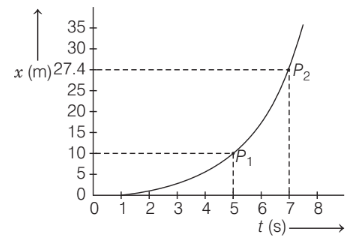
  1. In the following graph, average velocity is geometrically represented by:
  1. Length of the line $P_1 P_2.$
  2. Slope of the straight line $P_1 P_2.$
  3. Slope of the tangent to the curve at $P_1.$
  4. Slope of the tangent to the curve at $P_2.$
View full solution
Read the passage given below and answer the following questions from $1$ to $5$. When an object moves along a straight line with uniform acceleration, it is possible to relate its velocity, acceleration during motion and the distance covered by it in a certain time interval by a set of equations known as the equations of motion. For convenience, a set of three such equations are given below: $v = u + at $$\text{s}=\text{ut}+\frac{1}{2}\text{at}^2$ $2a s = v^2 – u^2$ Where u is the initial velocity of the object which moves with uniform acceleration a for Time $t, v$ is the final velocity and s is the distance travelled by the object in time.
  1. equation of motions are applicable to motion with
  1. uniform acceleration
  2. non uniform acceleration
  3. constant velocity
  4. none of these
  1. There are $4$ equation of motion. True or false?
  1. True
  2. False
  1. The brakes applied to a car produce an acceleration of $10\ m/s^2$​​​​​​​ in the opposite direction to the motion. If the car takes $1\ s$ to stop after the application of brakes, calculate the distance traveled during this time by car.
  1. An object is dropped from a tower falls with a constant acceleration of $10\ m/s2$. Find its speed $10\ s$ after it was dropped.
  1. A bullet hits a Sand box with a velocity of $10\ m/s$ and penetrates it up to a distance of $5\ cm$. Find the deceleration of the bullet in the sand box
View full solution
Read the passage given below and answer the following questions from i to v. If an object moving along the straight line covers equal distances in equal intervals of time, it is said to be in uniform motion along a straight line. Distance and displacement are two quantities that seem to mean the same but are different with different meanings and definitions. Distance is the measure of actual path length travelled by object. It is scalar quantity having SI unit of metre while displacement refers to the shortest distance between initial and final position of object. It is vector quantity. The magnitude of the displacement for a course of motion may be zero but the corresponding path length is not zero. using this data answer following questions.
  1. Can path length be zero for motion of body from one point to other point?
  1. Yes
  2. No
  1. For any given motion from point A to B, displacement =10m and distance = 5m. Is it possible?
  1. Yes
  2. No
  1. For rectilinear motion displacement can be
  1. Positive only
  2. Negative only
  3. Can be zero
  4. All of the above
  1. Define distance and displacement of particle.
  1. Write difference between distance and displacement.
View full solution
Read the passage given below and answer the following questions from 1 to 5 . Relative velocity is velocity of any object with respect to other object which may be stationary or moving. Consider two objects A and B moving uniformly with average velocities vA and $v B$ in one dimension, say along $x$-axis. (Unless otherwise specified, the velocities mentioned in this chapter are measured with reference to the ground). If $x_A(0)$ and $x_B(0)$ are positions of objects $A$ and $B$, respectively at time $t=0$, their positions $x_A(t)$ and $x_B(t)$ at time $t$ are given by $x_A(t)=x_A(0)+v_A t x_B$ $(t)=x_B(0)+v_B t$ Then, the displacement from object $A$ to object $B$ is given by $x_{B A}(t)=x_B(t)-x_A(t)=\left[x_B(0)-x_A(0)\right]$ $+\left(v_B-v_A\right) t$. It tells us that as seen from object $A$, object $B$ has a velocity $v_B-v_A$ because the displacement from $A$ to $B$ changes steadily by the amount $v B-v A$ in each unit of time. We say that the velocity of object $B$ relative to object $A$ is $v_B-v_A V_{B A}=v_B-v_A$ Similarly, velocity of object $A$ relative to object $B$ is: $V_{A B}=v_A-v_B$ This shows $V_{B A}=-V_{A B}$.
  1. Velocity of object A relative to object B is:
  1. $V_{AB} = v_A – v_B$
  2. $V_{BA} = v_B – v_A$
  3. None of these
  1. Velocity of object B relative to object A is:
  1. $v_B – v_A$
  2. $v_A – v_B$
  3. None of these
  1. What is relative velocity?
  1. What is relative displacement?
  1. Show that $V_{BA}= – V_{AB}$_ :
View full solution
Read statement below carefully and state with reasons and examples, if it is true or false; A particle in one-dimensional motion. With zero speed may have non-zero velocity.
View full solution
Read statement below carefully and state with reasons and examples, if it is true or false; A particle in one-dimensional motion. With zero speed at an instant may have non-zero acceleration at that instant.
View full solution
Read statement below carefully and state with reasons and examples, if it is true or false; A particle in one-dimensional motion. With constant speed must have zero acceleration.
View full solution
Read statement below carefully and state with reasons and examples, if it is true or false; A particle in one-dimensional motion. With positive value of acceleration must be speeding up.
View full solution

Generate a Motion in a Straight Line paper free

Pick question groups from the list above, set marks and difficulty, and export a branded PDF with step-by-step answer keys. First 3 chapters free — no signup.

Download App