Question
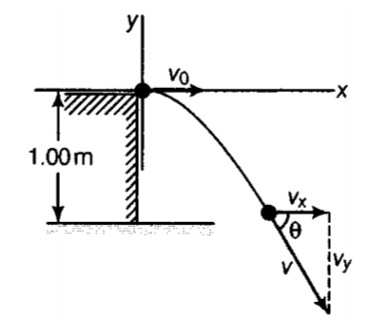
A marble rolls along a table at a constant speed of $1.00 m / s$ and then falls off the edge of the table to the floor 1.00 m below,
i. How long does the marble take to reach the floor?
ii. At what horizontal distance from the edge of the table does the marble land?
iii. What is its velocity as it strikes the floor?
Answer

As the marble was rolling on the table, therefore it has horizontal velocity and it will act as a projectile as soon as it leaves the edge of the table and fall freely under the effect of gravity.
Since, the marble is initially moving horizontally, $v _{ y 0}=0$ and $v _{ x 0}=1.00 m / s$. We must consider the origin to be at the edge of the table, so that $x _0= y _0=0$
Image

i. $t=?$ and $y=-1.00 m$
$
\begin{aligned}
& \therefore y=\frac{-1}{2} gt^2 \\
& \Rightarrow t=\sqrt{\frac{-2 y}{g}}=\sqrt{\frac{(-2)(-1.00)}{9.8}}=0.452 s
\end{aligned}
$
ii. $x =$ ?, when $t =0.452 s$
$
\therefore x=v_{x 0} t=1.00 \times 0.452 s=0.452 m
$
iii. $v =$ ?, $\theta=$ ? at $t =0.452 s$
The $x$-component of velocity is constant throughout the motion,
$
v_{x}=v_{x 0}=1.00 m / s
$
The $y$-component of velocity is given by
$
\begin{aligned}
& v_{y}=v_{y 0}-gt=0-9.8 \times 0.452=-4.43 m / s \\
& \therefore v=\sqrt{v_x^2+v_y^2}=\sqrt{(1.00)^2+(-4.43)^2}=4.54 m / s \text {, the magnitude of the resultant velocity of the motion. } \\
& \theta=\tan ^{-1}\left|\frac{v_y}{v_x}\right|=\frac{4.43}{1.00}=77.3^{\circ}
\end{aligned}
$
As the marble hits the floor, its velocity is $4.54 m / s$ directed $77.3^{\circ}$ downward with respect to the horizontal.

Need a full question paper?

Generate a complete, print-ready paper with questions like this in minutes — across 16+ boards, with answer keys.

Start Generating Free

Similar questions

Which of the following symptoms is likely to afflict an astronaut in space (a) swollen feet, (b) swollen face, (c) headache, (d) orientational problem.
In the previous problem, if $15.0cm$ of water and spirit each are further poured into the respective arms of the tube, what is the difference in the levels of mercury in the two arms? (Specific gravity of mercury = $13.6$)
Figure. shows a cylindrical tube of radius 5cm and length 20cm. It is closed by a tight-fitting cork. The friction coefficient between the cork and the tube is 0.20. The tube contains an ideal gas at a pressure of 1 atm and a temperature of 300K. The tube is slowly heated and it is found that the cork pops out when the temperature reaches 600K Let dN denote the magnitude of the normal contact force exerted by a small length dl of the cork along the periphery (see the figure). Assuming that the temperature of the gas is uniform at any instant, calculate $\frac{\text{dN}}{\text{dl}}.$
The voltmeter shown in the figure. reads 18V across the $50\Omega$ resistor. Find the resistance of the voltmeter.
An empty plastic box of mass m is found to accelerate up at the rate of $\frac{\text{g}}{6}$ when placed deep inside water. How much sand should be put inside the box so that it may accelerate down at the rate of $\frac{\text{g}}{6}?$
What are the arithmatic operations of significant figures. What are the rules for rounding off a number? Explain each rule with example.
Air is pumped into an automobile tyre's tube up to a pressure of 200kPa in the morning when the air temperature is 20°C. During the day the temperature rises to 40°C and the tube expands by 2%. Calculate the pressure of the air in the tube at this temperature.
Explain the following :
(a) Rise of liquid in capillary of insufficient length,
(b) effect of detergents.
The system containing the rails and the wire of the previous problem is kept vertically in a uniform horizontal magnetic field B that is perpendicular to the plane of the rails (figure). It is found that the wire stays in equilibrium. If the wire ab is replaced by another wire of double its mass, how long will it take in falling through a distance equal to its length?
A wire of length L and radius r is clamped rigidly at one end. When the other end of the wire is pulled by a force f, its length increases by l. Another wire of the same material of length 2L and radius 2r, is pulled by a force 2f. Find the increase in length of this wire.