Question
Explain the following :
(a) Rise of liquid in capillary of insufficient length,
(b) effect of detergents.

Answer

SELF

Need a full question paper?

Generate a complete, print-ready paper with questions like this in minutes — across 16+ boards, with answer keys.
Start Generating Free

Similar questions

A body of mass $0.40kg$ moving initially with a constant speed of $10ms^{-1}$ to the north is subject to a constant force of $8.0 N$ directed towards the south for 30s. Take the instant the force is applied to be $t = 0$, the position of the body at that time to be $x = 0$, and predict its position at $t = –5s, 25s, 100s$.
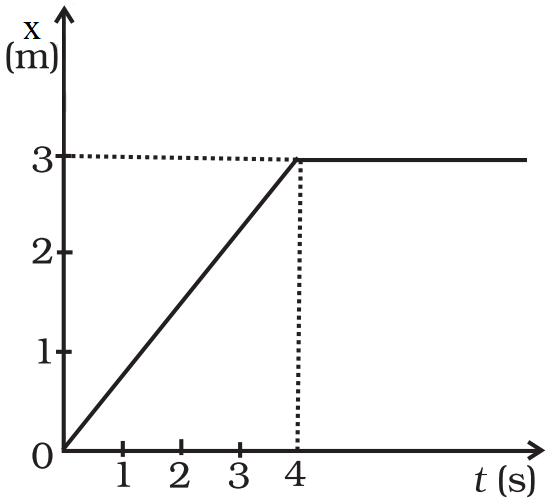
The position time graph of a body of mass $2kg$ is as given in What is the impulse on the body at $t = 0 s$ and $t = 4s$.
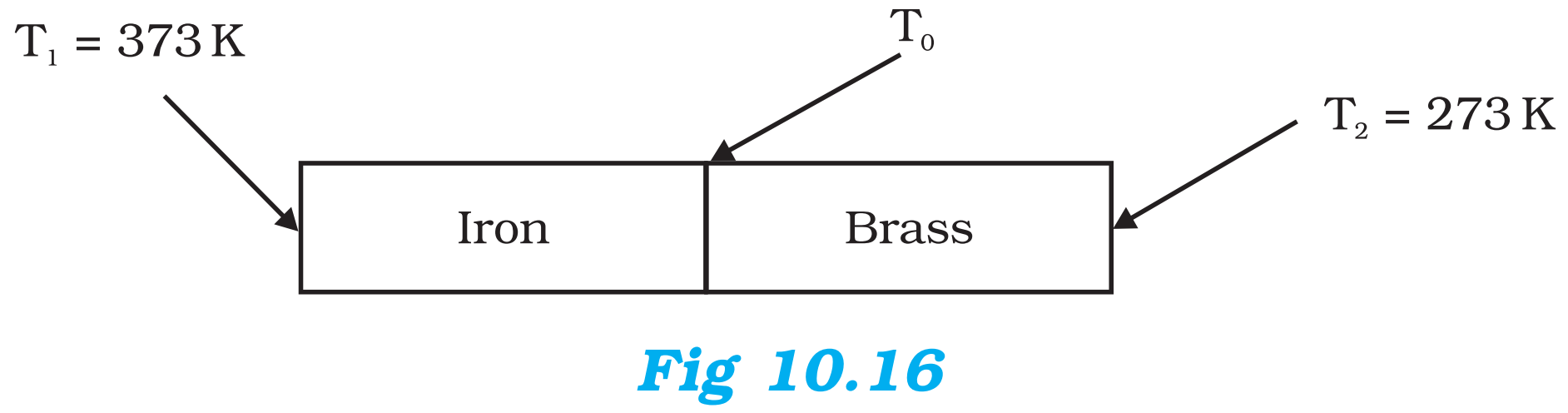
An iron bar $\left(L_1=0.1 m , A_1=\right. \left.0.02 m ^2, K_1=79 W m ^{-1} K ^{-1}\right)$ and a brass bar $\left(L_2=0.1 m , A_2=0.02 m ^2\right.$, $K_2=109 W m ^{-1} K ^{-1}$ ) are soldered end to end as shown in Fig. $10.16.$ The free ends of the iron bar and brass bar are maintained at $373 K$ and $273 K$ respectively. Obtain expressions for and hence compute $(i)$ the temperature of the junction of the two bars, $(ii)$ the equivalent thermal conductivity of the compound bar, and $(iii)$ the heat current through the compound bar.
Image
Show that when a string fixed at its two ends vibrates in 1 loop, 2 loops, 3 loops and 4 loops, the frequencies are in the ratio 1 : 2 : 3 : 4.
A parallel-plate capacitor having plate area $400cm^2$ and separation between the plates $1.0mm$ is connected to a power supply of 100V. A dielectric slab of thickness $1.0mm$ and dielectric constant $5.0$ is inserted into the gap:
  1. Find the increase in electrostatic energy.
  2. If the power supply is now disconnected and the dielectric slab is taken out, find the further increase in energy.
  3. Why does the energy increase in inserting the slab as well as in taking it out?
A wire of resistance $15.0\Omega$ is bent to form a regular hexagon ABCDEFA. Find the equivalent resistance of the loop between the points (a) A and B (b) A and C and (c) A and D.
Given $\vec{a}+\vec{b}+\vec{c}+\vec{d}=0$, which of the following statements are correct:
i. $\vec{a}, \vec{b}, \vec{c}$, and $\vec{d}$ must each be a null vector.
ii. The magnitude of $(\vec{a}+\vec{c})$ equals the magnitude of $(\vec{b}+\vec{d})$.
iii. The magnitude of ' $\vec{a}$ ' can never be greater than the sum of the magnitudes of $\vec{b}, \vec{c}$, and $\vec{d}$.
iv. $\vec{b}+\vec{c}$ must lie in the plane of $\vec{a}$ and $\vec{d}$ if $\vec{a}$ and $\vec{d}$ are not collinear, and in the line of $\vec{a}$ and $\vec{d}$, if they are collinear?
Explain linear simple harmonic motion by taking an example. Find the expression for its period and explain its dependence.
A magnetic field of $(4.0\times10^{-3}\vec{\text{k}})$ T exerts a force of $(4.0\vec{\text{i}}+3.0\vec{\text{j}})\times10^{-10}$ N on a particle with a charge of $1.0\times10^{-9}\text{C}$ and going in the x−y plane. Find the velocity of the particle.
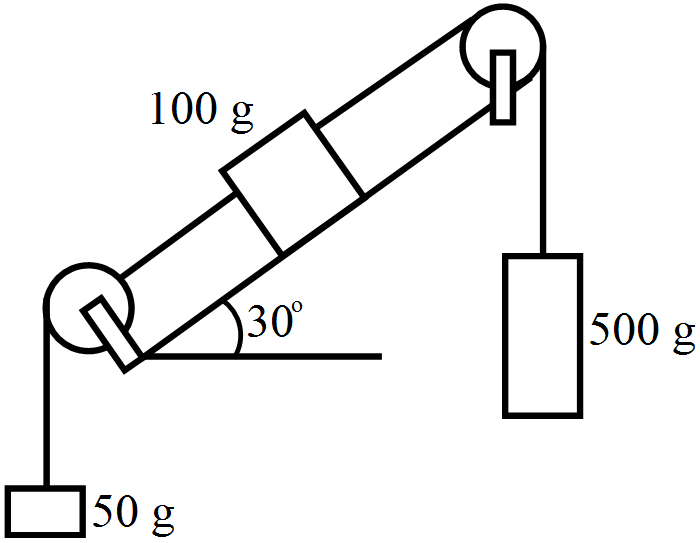
Find the acceleration of the $500\ g$ block in figure.