Question
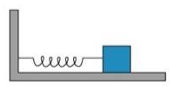
A mass attached to a spring is free to oscillate, with angular velocity $\omega,$ in a horizontal plane without friction or damping. It is pulled to a distance $x_0$ and pushed towards the centre with a velocity $\upsilon_0$ at time t = 0. Determine the amplitude of the resulting oscillations in terms of the parameters $\omega,x_0$ and $υ_0$. [Hint: Start with the equation $\text{x}=\text{a}\cos(\omega\text{t}+\theta)$ and note that the initial velocity is negative.]
 

Answer

The displacement rquation for an oscillating mass is given by:$\text{x}=\text{A}\cos(\omega\text{t}+\theta)$
where,
A is the amplitude
x is the displacement
$\theta$ is the phase constant
Velcoity, $\text{v}=\frac{\text{dx}}{\text{dt}}=-\text{A}\omega\sin(\omega\text{t}+\theta)$
At, $t = 0, x = x_0$
$\text{x}_0=\text{A}\cos\theta=\text{x}_0\ .....(\text{i})$
and, $\frac{\text{dx}}{\text{dt}}=-v_0=\text{A}\omega\sin\theta$
$\text{A}\sin\theta=\frac{v_0}{\omega}\ ....(\text{ii})$
Squaring and adding equations (i) and (ii), we get:
$\text{A}^2(\cos^2\theta+\sin^2\theta)=\text{x}_0^2+\Big(\frac{v_0^2}{\omega^2}\Big)$
$\therefore\ \text{A}=\sqrt{\text{x}_0^2+\Big(\frac{v_0}{\omega}\Big)^2}$
Hence, the amplitude of the resulting oscillation is $\text{x}_0^2+\Big(\frac{v_0}{\omega}\Big)^2.$

Need a full question paper?

Generate a complete, print-ready paper with questions like this in minutes — across 16+ boards, with answer keys.

Start Generating Free

Similar questions

A source of sound emitting a 1200Hz note travelg along a straight line at a speed of 170m/s. A detector is placed at a distance of 200m from the line of motion of the source.
  1. Find the frequency of sound received by the detector at the instant when the source gets closest to it.
  2. Find the distance between the source and the detector at the instant it detects the frequency 1200Hz. Velocity of sound in air = 340m/s.
The triple points of neon and carbon dioxide are $24.57K$ and $216.55K$ respectively. Express these temperatures on the Celsius and Fahrenheit scales.
What is anomalous expansion of water? Explain its examples in daily.
A calorimeter of negligible heat capacity contains 100 cc of water at $40^{\circ} \mathrm{C}$. The water cools to $35^{\circ} \mathrm{C}$ in 5 minutes. The water is now replaced by K -oil of equal volume at $40^{\circ} \mathrm{C}$. Find the time taken for the temperature to become $35^{\circ} \mathrm{C}$ under similar conditions. Specific heat capacities of water and K -oil are $4200 \mathrm{Jkg}^{-1} \mathrm{~K}^{-1}$ and $2100 \mathrm{Jgg}^{-1} \mathrm{~K}^{-1}$ respectively. Density of K-oil $=800 \mathrm{kgm}^3$.
The position of a particle is given by $\text{r}=3.0\text{t}\hat{\text{i}}-2.0\text{t}^2\hat{\text{j}}+4.0\hat{\text{k }}\text{m}$ Where t is in seconds and the coefficients have the proper units for r to be in metres. (a) Find the v and a of the particle? (b) What is the magnitude and direction of velocity of the particle at t = 2.0s?
Give example of a motion where x > 0, v < 0, a > 0 at a particular instant.
A spring having with a spring constant $1200 N m ^{-1}$ is mounted on a horizontal table as shown in Fig. A mass of 3 kg is attached to the free end of the spring. The mass is then pulled sideways to a distance of 2.0 cm and released.
Image

Take the position of mass when the spring is unstreched as $x=0$, and the direction from left to right as the positive direction of $x$-axis. Give $x$ as a function of time $t$ for the oscillating mass if at the moment we start the stopwatch $(t=0)$, the mass is
a. at the mean position,
b. at the maximum stretched position, and
c. at the maximum compressed position.
In what way do these functions for SHM differ from each other, in frequency, in amplitude or the initial phase?
A brass rod of length $50$ cm and diameter $3.0$ mm is joined to a steel rod of the same length and diameter. What is the change in length of the combined rod at $250^{\circ} \mathrm{C}$, if the original lengths are at $40.0^{\circ} \mathrm{C}$ ? Is there a 'thermal stress' developed at the junction? The ends of the rod are free to expand (Co-efficient of linear expansion of brass $=2.0 \times$ $10^{-5} \mathrm{~K}^{-1}$, steel $\left.=1.2 \times 10^{-5} \mathrm{~K}^{-1}\right)$.
Mean solar day is the time interval between two successive noon when sun passes through zenith point (meridian). Sidereal day is the time interval between two successive transit of a distant star through the zenith point (meridian). By drawing appropriate diagram showing earth’s spin and orbital motion, show that mean solar day is four minutes longer than the sidereal day. In other words, distant stars would rise 4 minutes early every successive day.
Two vector forces 5 N and 3 N are acting on a particle. Find the magnitude and direction of resultant force.(a) When both the forces are in same direction.(b) When both the forces are at right angles.(c) When both the forces are inclined at angle $60^{\circ}$.