Question
Two vector forces 5 N and 3 N are acting on a particle. Find the magnitude and direction of resultant force.(a) When both the forces are in same direction.(b) When both the forces are at right angles.(c) When both the forces are inclined at angle $60^{\circ}$.
Answer

(a) When both forces are in same direction :
Resultant force $\vec{R}=\vec{P}+\vec{Q}$
$\begin{array}{l}
\vec{R}=5+3 \\
\vec{R}=8 N
\end{array}$
Direction of $\vec{R}$ will be same as the direction of forces.
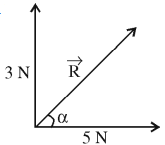
(b) When both the forces are at right angle :
$\begin{aligned}
R & =\sqrt{P^2+Q^2} \\
& =\sqrt{(5)^2+(3)^2}=\sqrt{25+9} \\
& =\sqrt{34}
\end{aligned}$
Hence, resultant force $=\sqrt{34}$
Direction of R, $\quad \tan \alpha=\frac{3}{5}$
$\alpha=\tan ^{-1}\left(\frac{3}{5}\right)$
Image
Direction of resultant force will be at angle $\tan ^{-1} \frac{3}{5}$ from SN force.
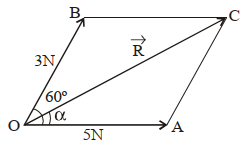
(c) When both the forces are at angle $60^{\circ}$ :
$\begin{aligned}
R^2 & =P^2+Q^2+2 PQ \cos \theta \\
& =(5)^2+(3)^2+2 \times 5 \times 3 \times \cos 60^{\circ} \\
& =25+9+2 \times 5 \times 3 \times \frac{1}{2} \\
R^2 & =25+9+15=49 \\
\therefore \quad R & =\sqrt{49}=7 N
\end{aligned}$
Direction of $\vec{R}$ is,
$\begin{aligned} \tan \alpha & =\frac{ Q \sin \theta}{ P + Q \cos \theta} \\ & =\frac{3 \sin 60^{\circ}}{5+3 \cos 60^{\circ}} \\ & =\frac{3 \times \frac{\sqrt{3}}{2}}{5+3 \times \frac{1}{2}}=\frac{\frac{3 \sqrt{3}}{2}}{\frac{13}{2}}=\frac{3 \sqrt{3}}{13} \\ \alpha & =\tan ^{-1}\left(\frac{3 \sqrt{3}}{13}\right)\end{aligned}$

Image

Need a full question paper?

Generate a complete, print-ready paper with questions like this in minutes — across 16+ boards, with answer keys.

Start Generating Free

Similar questions

Explain why,
  1. A horse cannot pull a cart and run in empty space.
  2. Passengers are thrown forward from their seats when a speeding bus stops suddenly.
  3. It is easier to pull a lawn mower than to push it.
  4. A cricketer moves his hands backwards while holding a catch.
A metal block of heat capacity $800^{\circ} \mathrm{C}^{-1}$ placed in a room at $20^{\circ} \mathrm{C}$ is heated electrically. The heater is switched off when the temperature reaches $30^{\circ} \mathrm{C}$. The temperature of the block rises at the rate of $2^{\circ} \mathrm{Cs}^{-1}$ just after the heater is switched on and falls at the rate of $0.2^{\circ} \mathrm{Cs}^{-1}$ just after the heater is switched off. Assume Newton's law of cooling to hold.
  1. Find the power of the heater.
  2. Find the power radiated by the block just after the heater is switched off.
  3. Find the power radiated by the block when the temperature of the block is $25^\circ C$.
  4. Assuming that the power radiated at $25^\circ C$ represents the average value in the heating process, find the time for which the heater was kept on.
A cyclist is riding with a speed of $27km/h$. As he approaches a circular turn on the road of radius 80m, he applies brakes and reduces his speed at the constant rate of $0.50m/s$ every second. What is the magnitude and direction of the net acceleration of the cyclist on the circular turn?
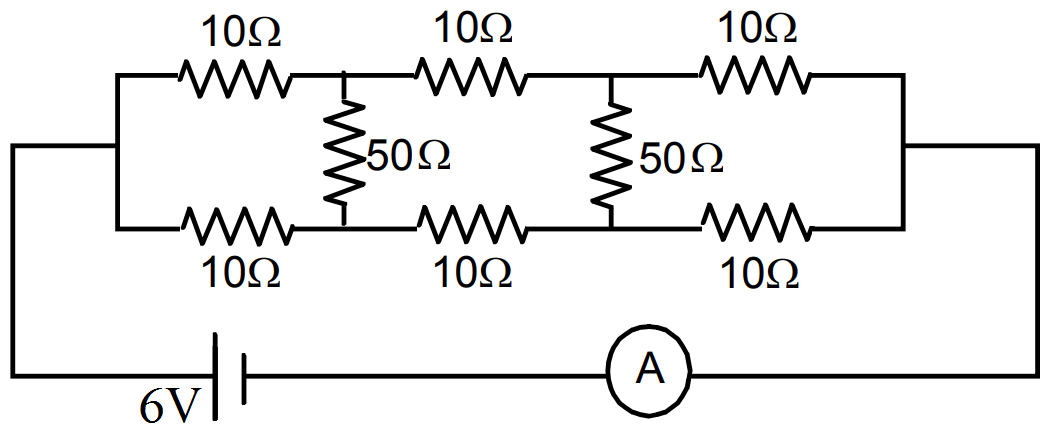
Find the current measured by the ammeter in the circuit shown in the figure.
An aircraft is flying at a height of 3400m above the ground. If the angle subtended at a ground observation point by the aircraft positions 10.0s apart is 30°, what is the speed of the aircraft?
Write the parallelogram rule of vector addition. Draw the necessary labelled picture. Obtain an expression for the resulting vector $\overrightarrow{ R }$. Mention their special circumstances also.
or
The angle between two vectors $\overrightarrow{ P }$ and $\overrightarrow{ Q }$ is $\theta$. Write the magnitude and direction of their resultant vector in terms of their magnitude and $\theta$.
Or
Write and prove the parallelogram law of vector addition. Discuss some specific examples.
A solid sphere rolls down two different inclined planes of the same heights but different angles of inclination.
  1. Will it reach the bottom with the same speed in each case?
  2. Will it take longer to roll down one plane than the other?
  3. If so, which one and why?
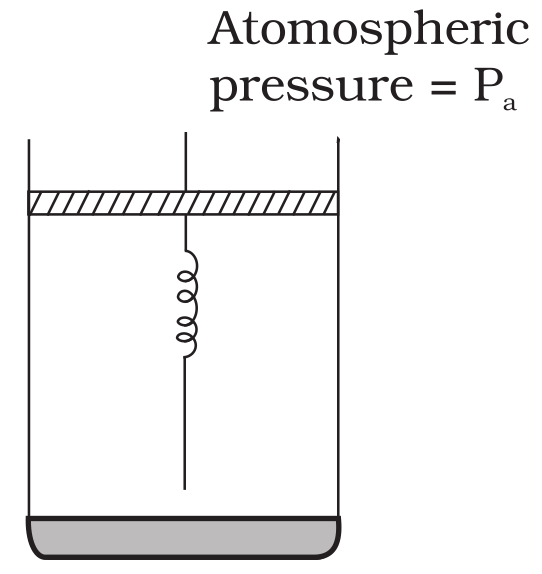
Consider one mole of perfect gas in a cylinder of unit cross section with a piston attached (Fig.) A spring (spring constant k) is attached (unstretched length L) to the piston and to the bottom of the cylinder. Initially the spring is unstretched and the gas is in equilibrium. A certain amount of heat Q is supplied to the gas causing an increase of volume from $V_o$ to $V_1$.
  1. What is the initial pressure of the system.
  2. What is the final pressure of the system.
  3. Uing the first law of thermodynamics, write down a relation between $Q, P_a, V, V_o$ and $k$.
The position of a particle is given by $\text{r}=3.0\text{t}\hat{\text{i}}-2.0\text{t}^2\hat{\text{j}}+4.0\hat{\text{k }}\text{m}$ Where t is in seconds and the coefficients have the proper units for r to be in metres. (a) Find the v and a of the particle? (b) What is the magnitude and direction of velocity of the particle at t = 2.0s?
What do you understand by friction? Discuss about static friction, limiting friction, kinetic friction and rolling friction.