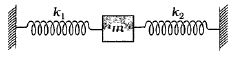
A mass m is suspended from a spring of length l and force constant $K$. The frequency of vibration of the mass is ${f_1}$. The spring is cut into two equal parts and the same mass is suspended from one of the parts. The new frequency of vibration of mass is ${f_2}$. Which of the following relations between the frequencies is correct
Easy


Download our appand get started for free
Experience the future of education. Simply download our apps or reach out to us for more information. Let's shape the future of learning together!No signup needed.*
Similar Questions
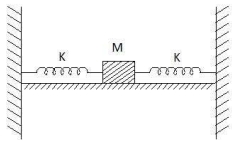
- 1In the figure given below. a block of mass $M =490\,g$ placed on a frictionless table is connected with two springs having same spring constant $\left( K =2 N m ^{-1}\right)$. If the block is horizontally displaced through ' $X$ 'm then the number of complete oscillations it will make in $14 \pi$ seconds will be $.........$View Solution
- 2A body executing simple harmonic motion has a maximum acceleration equal to $ 24\,metres/se{c^2} $ and maximum velocity equal to $ 16\;metres/sec $. The amplitude of the simple harmonic motion isView Solution
- 3A particle executes $SHM$ with amplitude of $20 \,cm$ and time period is $12\, sec$. What is the minimum time required for it to move between two points $10\, cm$ on either side of the mean position ..... $\sec$ ?View Solution
- 4A body is executing simple harmonic motion with an angular frequency $2\,rad/s$. The velocity of the body at $20\, mm$ displacement, when the amplitude of motion is $60\, mm$, is ...... $mm/s$View Solution
- 5A bob of mass $'m'$ suspended by a thread of length $l$ undergoes simple harmonic oscillations with time period ${T}$. If the bob is immersed in a liquid that has density $\frac{1}{4}$ times that of the bob and the length of the thread is increased by $1 / 3^{\text {rd }}$ of the original length, then the time period of the simple harmonic oscillations will be :-View Solution
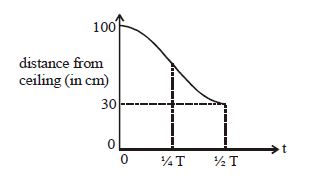
- 6A spring hangs vertically from the ceiling and a mass is attached to its free end. When the mass is pulled down and released, it oscillates vertically with simple harmonic motion of period $T$ . The variation with time $t$ of its distance from the ceiling is as shown. Which statement gives a correct deduction from this graph?View Solution
- 7A pendulum with time period of $1\, s$ is losing energy due to damping. At certain time its energy is $45\, J$. If after completing $15\,oscillations$ , its energy has become $15\, J$, its damping constant (in $s^{-1}$ ) isView Solution
- 8A block with mass $M$ is connected by a massless spring with stiffiess constant $k$ to a rigid wall and moves without friction on a horizontal surface. The block oscillates with small amplitude $A$ about an equilibrium position $x_0$. Consider two cases: ($i$) when the block is at $x_0$; and ($ii$) when the block is at $x=x_0+A$. In both the cases, a perticle with mass $m$ is placed on the mass $M$ ?View Solution
($A$) The amplitude of oscillation in the first case changes by a factor of $\sqrt{\frac{M}{m+M}}$, whereas in the second case it remains unchanged
($B$) The final time period of oscillation in both the cases is same
($C$) The total energy decreases in both the cases
($D$) The instantaneous speed at $x_0$ of the combined masses decreases in both the cases
- 9The particle executing $SHM$ of amplitude $'a'$ has displacement $-\frac {a}{2}$ at $t = \frac {T}{4}$ and a positive velocity. Find the initial phase of particleView Solution
- 10Two springs, of force constants $k_1$ and $k_2$ are connected to a mass $m$ as shown. The frequency of oscillation of the mass is $f$ If both $k_1$ and $k_2$ are made four times their original values, the frequency of oscillation becomesView Solution