A pendulum with time period of $1\, s$ is losing energy due to damping. At certain time its energy is $45\, J$. If after completing $15\,oscillations$ , its energy has become $15\, J$, its damping constant (in $s^{-1}$ ) is
JEE MAIN 2015, Medium
Download our app for free and get started
As we know, $E=E_{0} e^{-\frac{b t}{m}}$
$15=45 e^{-\frac{b 15}{m}}$
[As no. of oscillations $=15 \text { so } t=15 \mathrm{sec}]$
$\frac{1}{3}=e^{-\frac{b 15}{m}}$
Taking log on both sides
$\frac{b}{m}=\frac{1}{15} \ell \mathrm{n} 3$

Download our appand get started for free
Experience the future of education. Simply download our apps or reach out to us for more information. Let's shape the future of learning together!No signup needed.*
Similar Questions
- 1The displacement of a particle is given at time $t$, by:$x=A \sin (-2 \omega t)+B \sin ^2 \omega t \quad$ Then,View Solution
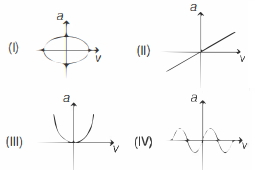
- 2In $SHM,$ acceleration versus displacement (from mean position) graph :View Solution
- 3If the speed $v$ of the bob in a simple pendulum is plotted against the tangential acceleration $a$, the correct graph will be represented byView Solution
- 4View SolutionThe total energy of a particle executing S.H.M. is proportional to
- 5View SolutionThe velocity of simple pendulum is maximum at
- 6Two pendulums have time periods $T$ and $\frac{{5T}}{4}.$They start $S.H.M.$ at the same time from the mean position. What will be the phase difference between them after the bigger pendulum has complete one oscillation ..... $^o$View Solution
- 7View SolutionWhich of the diagrams shown in figure represents variation of total mechanical energy of a pendulum oscillating in water as function of time ?
- 8The $K.E.$ and $P.E.$ of a particle executing $SHM$ with amplitude $A$ will be equal when its displacement isView Solution
- 9A pendulum has time period $T$. If it is taken on to another planet having acceleration due to gravity half and mass $ 9 $ times that of the earth then its time period on the other planet will beView Solution
- 10A bar of mass $m$ is suspended horizontally on two vertical springs of spring constant $k$ and $3k$ . The bar bounces up and down while remaining horizontal. Find the time period of oscillation of the bar (Neglect mass of springs and friction everywhere).View Solution