- A$V=V^{\prime}+v$
- B$V^{\prime}=V+v$
- C$V^{\prime}=\frac{(V+v)}{2}$
- ✓$v=V+V^{\prime}$
Collision is elastic, so both linear momentum and kinetic energy are conserved.
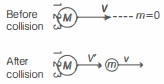
We have following situation,
According to figure,
$M V=M V^{\prime}+m v \ldots$ $(i)$ (linear momentum conservation)
$\frac{1}{2} M V^2=\frac{1}{2} M V^{\prime 2}+\frac{1}{2} m v^2 \dots(ii)$
(kinetic energy conservation)
From Eqs. $(i)$ and $(ii)$, we get
$M\left(V-V^{\prime}\right)=m v \dots(iii)$
and $M\left(V^2-V^{\prime 2}\right)=m v^2 \dots(iv)$
Dividing Eq. $(iv)$ by Eq. $(iii)$, we have
$\frac{M(V^2-V^{\prime 2})}{M(V-V^{\prime})}=\frac{mv^2}{mv}$
$\text { or } V+V^{\prime}=v$
Generate a complete, print-ready paper with questions like this in minutes — across 16+ boards, with answer keys.

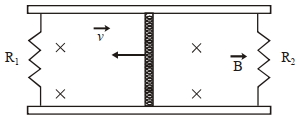
The correct statement about the directions of induced currents $I _{1}$ and $I _{2}$ flowing through $R _{1}$ and $R _{2}$ respectively is