Question
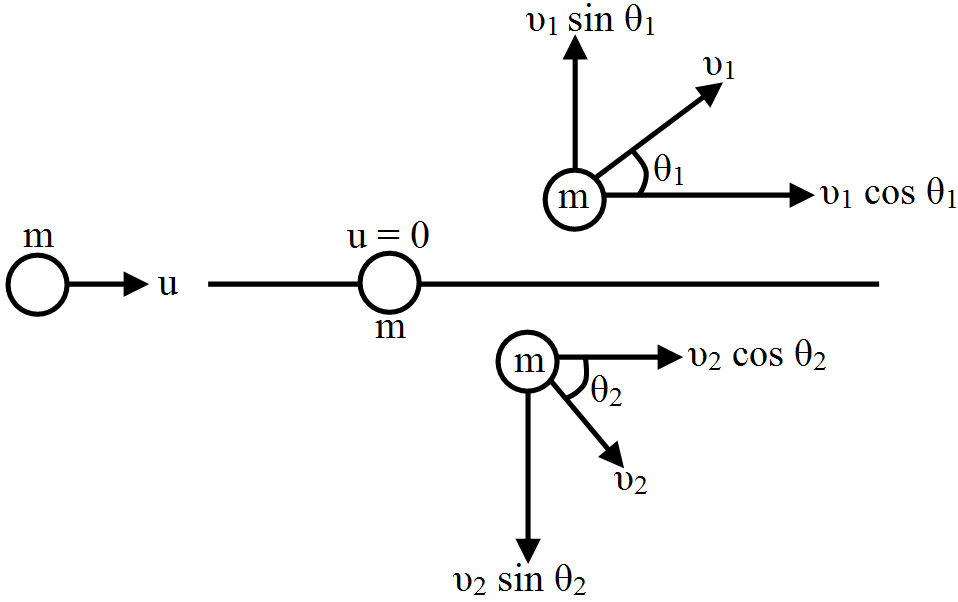
A mass m moving with a speed u collides with a similar mass m at rest, elastically and obliquely. Prove that they will move in directions making an angle $\frac{\pi}{2}$ with each other.
Answer

Let the equal masses be m. Let the velocity at their motion initially be u and zero. Since momentum is a vector, we have, $\text{mu}=\text{mv}_1\cos\theta_1+\text{mv}_2\cos\theta_2$ i.e., $\text{u}=\text{v}_1\cos\theta_1+\text{v}_2\cos\theta_2\cdots\text{(i)}$ $0=\text{v}_1\sin\theta_1+\text{v}_2\sin\theta_2\cdots\text{(ii)}$ based on the conservation of momentum.
Being an elastic collision, kinetic energy is also conserved
$\therefore\frac{1}{2}\text{mu}^2=\frac{1}{2}\text{mv}_1^2+\frac{1}{2}\text{mv}_2^2$
$\therefore\text{u}^2=\text{v}_1^2+\text{v}_2^2\cdots\text{(iii)}$
Squaring and adding (i) and (ii) we have,
$\text{u}^2=\text{v}_1^2+\text{v}_2^2+2\text{v}_1\text{v}_2$
$(\cos\theta_1\cos\theta_2-\sin\theta_1\sin\theta_2)$
$\text{u}^2=\text{v}_1^2+\text{v}_2^2+2\text{v}_1\text{v}_2\cos(\theta_1+\theta_2)$
Using (iii) in this equation, we have
$2\text{v}_1\text{v}_2\cos(\theta_1+\theta_2)=0$
$\therefore\cos(\theta_1+\theta_2)=0$
$\theta_1+\theta_2=\frac{\pi}{2}$
i.e., the masses move at right angles after the collision.

Need a full question paper?

Generate a complete, print-ready paper with questions like this in minutes — across 16+ boards, with answer keys.

Start Generating Free

Similar questions

A satellite orbits the earth at a height of 400 km above the surface. How much energy must be expended to rocket the satellite out of the earth's gravitational influence? Mass of the satellite $=200 \mathrm{~kg}$; mass of the earth $=6.0 \times$ $10^{24} \mathrm{~kg}$; radius of the earth $=6.4 \times 10^6 \mathrm{~m} ; \mathrm{G}=6.67 \times 10^{-11} \mathrm{~N} \mathrm{~m}^2 \mathrm{~kg}^{-2}$.
State first law of thermodynamics. On the basis of this establish the relation between two molar specific heats for an ideal gas.
Considering the pressure p to be proportional to the density, find the pressure p at a height h if the pressure on the surface of the earth is $p_0$.
Two absolute scales $A$ and $B$ have triple points of water defined to be $200A$ and $350B$. What is the relation between $TA$ and $TB$?
A ball is thrown vertically upwards with a velocity of $20 m s ^{-1}$ from the top of a multistorey building. The height of the point from where the ball is thrown is $25.0 m$ from the ground. (a) How high will the ball rlse? and (b) how long will it be before the ball hits the ground? Take $g =10 m s ^{-2}$.
A spaceship is stationed on Mars. How much energy must be expended on the spaceship to launch it out of the solar system? Mass of the space ship $= 1000kg;$ mass of the sun $= 2 \times 10^{30}kg;$ mass of mars $= 6.4 \times 10^{23}kg;$ radius of mars = 3395km; radius of the orbit of mars $= 2.28 \times 10^8km;\ G = 6.67 \times 10^{-11}N\ m^2\ kg^{-2}.$
The coefficient of volume expansion of glycerine is $49 \times 10^{–5} K^{–1}$. What is the fractional change in its density for a $30°C$ rise in temperature?
It is often said that the world is witnessing now a second industrial revolution, which will transform the society as radically as did the first. List some key contemporary areas of science and technology, which are responsible for this revolution.
a. A steel wire of mass $\mu$ per unit length with a circular cross section has a radius of $0.1 cm$ . The wire is of length $10 m$ when measured lying horizontal, and hangs from a hook on the wall. A mass of $25 kg$ is hung from the free end of the wire. Assuming the wire to be uniform and lateral strains $<<$ longitudinal strains, find the extension in the length of the wire. The density of steel is $7860 \mathrm{~kg} \mathrm{~m}^{-3}$ (Young's modules $\mathrm{Y}=2 \times 10^{11} \mathrm{Nm}^{-2}$ ).
b. If the yield strength of steel is $2.5 \times 10^8 \mathrm{Nm}^{-2}$, what is the maximum weight that can be hung at the lower end of the wire?
Define radius of gyration and give the physical significance of moment of inertia.