Define radius of gyration and give the physical significance of moment of inertia.
Download our app for free and get started
The radius of gyration of a body about the axis of rotation of a body is the point at which the weighed mass of the body acts. It is also equal to the square root of moment of inertia of all particles of the body about the axis of rotation divided by the total mass of the body i.e., $\text{k}=\sqrt{\frac{\text{m}_1\text{r}^2_1+\text{m}_2\text{r}^2_3+\text{m}_3\text{r}^2_3+\dots+\text{m}_{\text{n}\text{r}^2_\text{n}}}{\text{m}_1+\text{m}_2+\text{m}_3+\dots\text{m}_{\text{n}}}}$ $=\sqrt{\frac{\Sigma\text{mR}^2}{\text{M}}=\sqrt{\frac{\text{I}}{\text{M}}}}$ Its dimensions are those of length and its is measured in metre in SI units. The moment of a body is a quantity which comes in rotational motion and plays same role in rotational motion as does mass in translational motion. Thus a body continues of rotate or be at rest in the absence of any external torque. This is similar to the law of inertia in translational motion. This aspect is used in over creasing the dead points in the engines and crankshafts. Similarly, the kinetic energy of rotation is dependent on the moment of inertia of the body in the same manner the kinetic energy of translation of motion depends, on the mass of the body. For a given angular velocity $(\omega)$ kinetic energy of rotation $\propto\text{I.}$ If equal torques are applied $I_1$ and $I_2$ the their angular acceleration are inversely proportional to the moments of inertia of the bodies. $\frac{\text{I}_1\alpha_1}{\text{I}_1\alpha_2}=1$ $\text{or }\frac{\alpha_1}{\alpha_2}=\frac{\text{I}_2}{\text{I}_1}$ $\text{or }\alpha\propto\frac{1}{\text{I}}$ Similarly if two bodies have same angular acceleration, then the moments of inertia are directly proportional to the torque applied on then. $\frac{\tau}{\tau}=\frac{\text{I}_1}{\text{I}_2}\text{ or }\alpha_1=\alpha_2$ The linear momentum of a body depends on its mass and velocity. If two bodies have same velocity, then their moments are proportional to their masses i.e., $\frac{\rho_1}{\rho_2}=\frac{\text{m}_1}{\text{m}_2}$ Similarly for angular momentum $\frac{\text{L}_1}{\text{L}_2}=\frac{\text{I}_1}{\text{I}_2}$ Thus, moment of inertia of a body plays same role in the rotational motion as does mass in translational motion. The moment of inertia determines the amount of torque to be applied to produce desired angular acceleration.

Download our appand get started for free
Experience the future of education. Simply download our apps or reach out to us for more information. Let's shape the future of learning together!No signup needed.*
Similar Questions
- 1$3$ A man stands on a rotating platform, with his arms stretched horizontally holding a $5kg$ weight in each hand. The angular speed of the platform is $30$ revolutions per minute. The man then brings his arms close to his body with the distance of each weight from the axis changing from $90cm$ to $20cm$. The moment of inertia of the man together with the platform may be taken to be constant and equal to $7.6kgm^2$.View Solution
- What is his new angular speed? (Neglect friction).
- Is kinetic energy conserved in the process? If not, from where does the change come about?
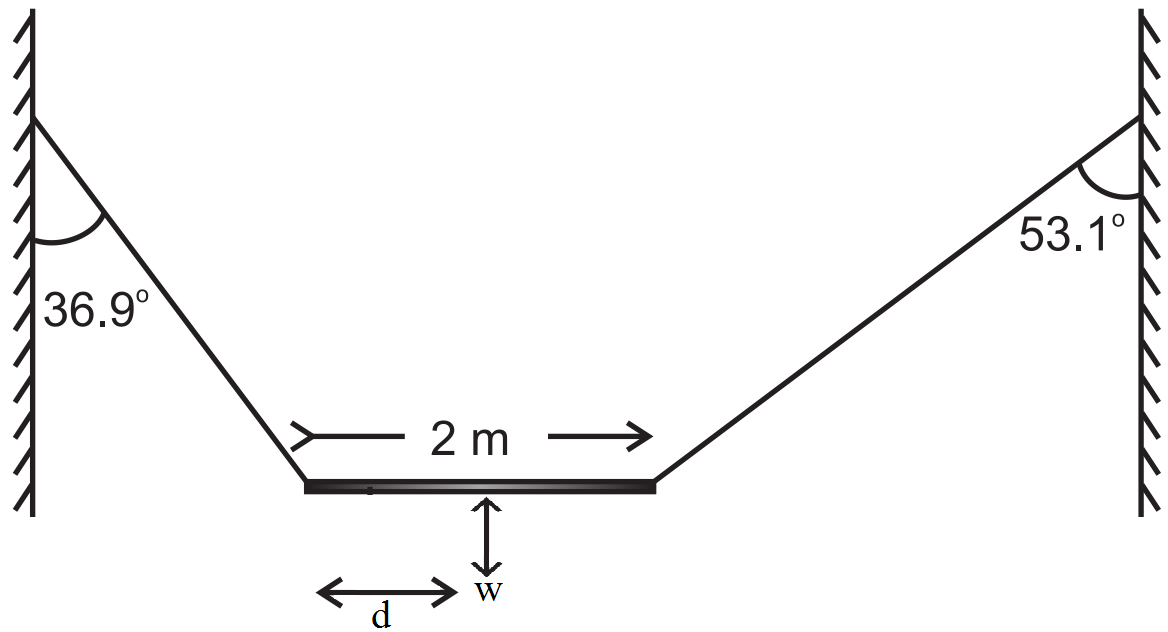
- 2A non-uniform bar of weight W is suspended at rest by two strings of negligible weight as shown in. The angles made by the strings with the vertical are $36.9°$ and $53.1°$ respectively. The bar is $2m$ long. Calculate the distance d of the centre of gravity of the bar from its left end.View Solution
- 3View SolutionEstablish the relationship between Torque and Moment of Inertia.
- 4View SolutionA uniform rod of mass m and length l is struck at an end by a force F perpendicular to the rod for a short time interval t. Calculate:
- The speed of the centre of mass.
- The angular speed of the rod about the centre of mass.
- The kinetic energy of the rod.
- The angular momentum of the rod about the centre of mass after the force has stopped to act. Assume that t is so small that the rod does not appreciably change its direction while the force acts.
- 5A $2kg$ body and a $3kg$ body are moving along the x-axis. At a particular instant, the $2kg$ body is $1m$ from the origin and has a velocity of $3ms^{-1}$ and the $3kg$ body is $2m$ from the origin and has velocity of $-1 ms^{-1}$. Find the position and velocity of the centre of mass and also find the total momentum.View Solution
- 6View SolutionA body is in translational equilibrium under the action of coplanar forces. If the torque of these forces is zero about a point, is it necessary that it will also be zero about any other point?
- 7A hoop of radius $2m$ weighs $100kg$. It rolls along a horizontal floor so that its centre of mass has a speed of $20cm/s$. How much work has to be done to stop it?View Solution
- 8Prove the result that the velocity v of translation of a rolling body (like a ring, disc, cylinder or sphere) at the bottom of an inclined plane of a height h is given by $\text{v}^2=\frac{2\text{gh}}{\Big(\frac{1+\text{k}^2}{\text{R}^2}\Big)}$ using dynamical consideration (i.e. by consideration of forces and torques).View Solution
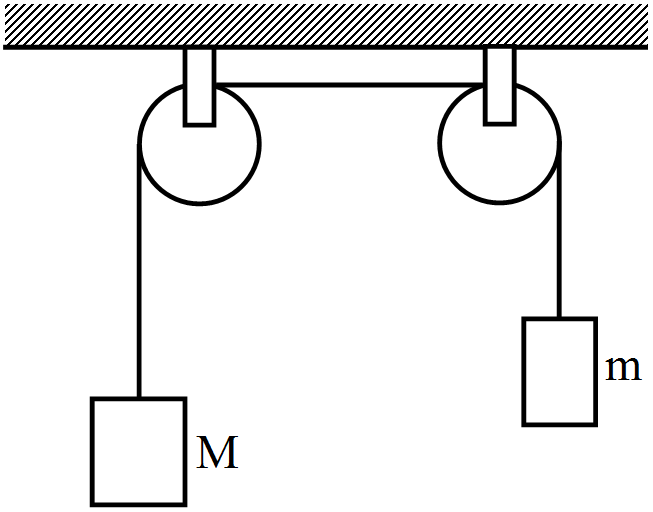
Note: k is the radius of gyration of the body about its symmetry axis, and R is the radius of the body. The body starts from rest at the top of the plane. - 9View SolutionThe pulleys in figure are identical, each having a radius R and moment of inertia I. Find the acceleration of the block M.
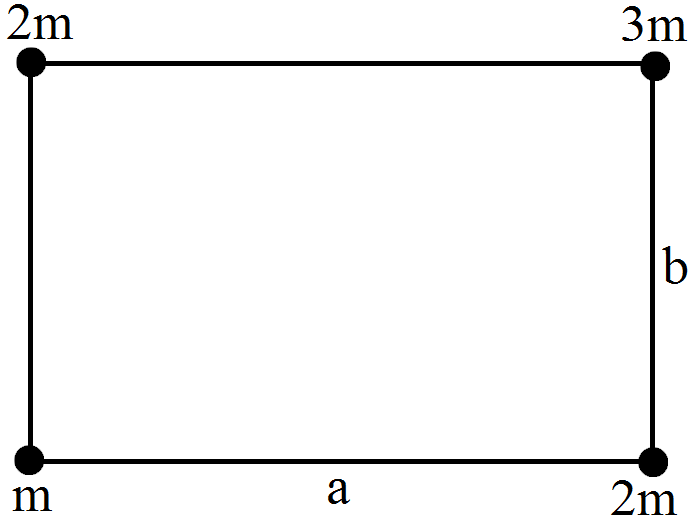
- 10View SolutionFour bodies have been arranged at the corners of a rectangle shown in figure. Find the centre of mass of the system.