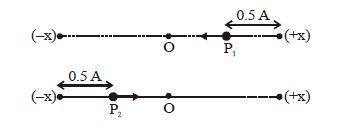
A mass m oscillates with simple harmonic motion with frequency $f = \frac{\omega }{{2\pi }}$ and amplitude A on a spring with constant $K$ , therefore
Medium
Download our app for free and get started
(d)

Download our appand get started for free
Experience the future of education. Simply download our apps or reach out to us for more information. Let's shape the future of learning together!No signup needed.*
Similar Questions
- 1Two identical pendulums oscillate with a constant phase difference $\frac{\pi}{4}$ and same amplitude. If the maximum velocity of one is $v$, the maximum velocity of the other will be ........View Solution
- 2Two bodies performing $S.H.M.$ have same amplitude and frequency. Their phases at a certain instant are as shown in the figure. The phase difference between them isView Solution
- 3A particle of mass $m$ in a unidirectional potential field have potential energy $U(x)=\alpha+2 \beta x^2$, where $\alpha$ and $\beta$ are positive constants. Find its time period of oscillation.View Solution
- 4View SolutionA simple pendulum hangs from the ceiling of a car. If the car accelerates with a uniform acceleration, the frequency of the simple pendulum will
- 5The displacement of a body executing $SHM$ is given by $x = A \sin (2\pi t + \pi /3).$ The first time from $t = 0$ when the velocity is maximum is .... $\sec$View Solution
- 6The displacement of a particle executing SHM is given by $x=10 \sin \left(\omega t+\frac{\pi}{3}\right) \mathrm{m}$. The time period of motion is $3.14 \mathrm{~s}$. The velocity of the particle at $\mathrm{t}=0$is_________. $\mathrm{m} / \mathrm{s}$.View Solution
- 7A particle has simple harmonic motion. The equation of its motion is $x = 5\sin \left( {4t - \frac{\pi }{6}} \right)$, where $x$ is its displacement. If the displacement of the particle is $3$ units, then it velocity isView Solution
- 8The displacement of a particle executing periodic motion is given by :View Solution
$y = 4cos^2\,(t/2)sin\,(1000t)$
This expression may be considered to be a result of superposition of - 9An ideal spring with spring-constant $K$ is hung from the ceiling and a block of mass $M$ is attached to its lower end. The mass is released with the spring initially unstretched. Then the maximum extension in the spring isView Solution
- 10The potential energy of a particle with displacement $X$ is $U(X)$. The motion is simple harmonic, when ($K$ is a positive constant)View Solution