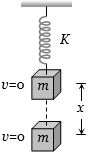
An ideal spring with spring-constant $K$ is hung from the ceiling and a block of mass $M$ is attached to its lower end. The mass is released with the spring initially unstretched. Then the maximum extension in the spring is
IIT 2002, Medium


Download our appand get started for free
Experience the future of education. Simply download our apps or reach out to us for more information. Let's shape the future of learning together!No signup needed.*
Similar Questions
- 1An object of mass $0.2\ kg$ executes simple harmonic along $X-$ axis with frequency of $\frac{{25}}{\pi } Hz$ . At the position $x$ = $0.04\ m$ , the object has kinetic energy of $0.5\ J$ and potential energy of $0.4\ J$ amplitude of oscillation in meter is equal toView Solution
- 2A particle executes $S.H.M.$ of amplitude A along $x$-axis. At $t =0$, the position of the particle is $x=\frac{A}{2}$ and it moves along positive $x$-axis the displacement of particle in time $t$ is $x=A \sin (\omega t+\delta)$, then the value $\delta$ will beView Solution
- 3A simple harmonic motion is represented by $F(t) = 10\sin \,(20\,t + 0.5)$. The amplitude of the $S.H.M.$ is $a$ $=$ ....View Solution
- 4A particle has simple harmonic motion. The equation of its motion is $x = 5\sin \left( {4t - \frac{\pi }{6}} \right)$, where $x$ is its displacement. If the displacement of the particle is $3$ units, then it velocity isView Solution
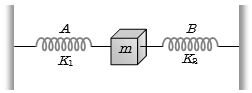
- 5View SolutionIn arrangement given in figure, if the block of mass m is displaced, the frequency is given by
- 6The displacement of a particle varies according to the relation $x = 4(cos\pi t + sin\pi t).$ The amplitude of the particle isView Solution
- 7View SolutionIf a particle is executing simple harmonic motion, then acceleration of particle
- 8Two particles $P$ and $Q$ start from origin and execute Simple Harmonic Motion along $X-$axis with same amplitude but with periods $3$ seconds and $6$ seconds respectively. The ratio of the velocities of $ P$ and $Q$ when they meet isView Solution
- 9Two particles oscillating in $SHM$ along two very close parallel path such that they have same mean position. The equation of $SHM$ of two particles are $x_1 = A\, sin\,\omega t$ and $x_2 = A\,sin(\omega t + \phi )$ respectively. If maximum distance between them is $\frac{6A}{5}$ then $\phi $ equal to ..... $^o$View Solution
- 10A particle performs $SHM$ on $x-$ axis with time period of $0.5\,sec,$ such that it's velocity is zero at $x = -3\,cm$ and at $x = 9\,cm$. It was located at $x = 0$ and moving in negative $'x'$ at $t = 0$. The equation of $SHM$ of the particle isView Solution