MCQ
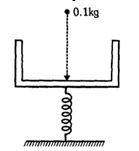
A massless platform is kept on a light elastic spring as shown in fig. When a sand particle of mass $0.1\; kg$ is dropped on the pan from a height of $0.24 \;m$, the particle strikes the pan and spring is compressed by $0.01\; m$.

From what height should the particle be dropped to cause a compression of $0.04\; m$.
  • $3.96$
  • B
    $5.25$
  • C
    $2$
  • D
    $6.2$

Answer

Correct option: A.
$3.96$
a
$mg ( h + x )=\frac{1}{2} kx$

mg(0.24+0.01)= $\frac{1}{2} k (0.01)^2$

$mg ( h +0.04)=\frac{1}{2} k (0.04)^2$

$\frac{ h +0.04}{0.24+0.01}=\frac{16}{1}$

$\therefore h +0.4=16 \times 0.25=4$

$h =3.96 \;m$

Need a full question paper?

Generate a complete, print-ready paper with questions like this in minutes — across 16+ boards, with answer keys.

Start Generating Free

Similar questions

Which of the following quantities is the same for all ideal gases at the same temperature?
  1. The kinetic energy of 1 mole.
  2. The kinetic energy of 1g.
  3. The number of molecules in 1 mole.
  4. The number of molecules in 1g.
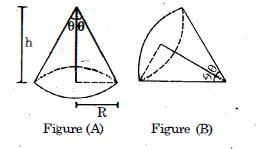
A solid cone is placed on a horizontal surface has height $h$, radius $R$ and apex angle $\theta$ as show.If gravitational potential energy of the cone does not change as position of the cone is changed from figure $(A)$ to figure $(B)$, then,
A person sitting firmly over a rotating stool has his arms stretched. If he folds his arms, his angular momentum about the axis of rotation:
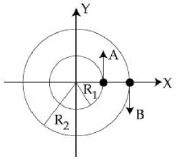
Two particles $A, B$ are moving on two concentric circles of radii $R_1$ and $R_2$ with equal angular speed $\omega $. At $t = 0,$ their positions and direction of motion are shown in the figure

The relative velocity $\overrightarrow {{V_A}}  - \overrightarrow {{V_B}} $ at $t = \frac{\pi }{{2\omega }}$ is given by

A swimmer swims in still water at a speed $= 5\,\, km/hr$. He enters a $200\,\, m$ wide river, having river flow speed $= 4\,\, km/hr$ at point A and proceeds to swim at an angle of $127^o$ (sin $37^o = 0.6$) with the river flow direction.Another point $B$ is located directly across Aon the other side. The swimmer lands on the other bank at a point $C$, from which he walks the distance $CB$ with a speed $= 3\,\, km/hr.$ The total time in which he reachrs from $A$ to $B$ is..........$minutes$
A neutron exerts a force on a proton which is:
  1. Gravitational.
  2. Electromagnetic.
  3. Nuclear.
  4. Weak.
An object of mass $m _{1}$ collides with another object of mass $m _{2}$, which is at rest. After the collision the objects move with equal speeds in opposite direction. The ratio of the masses $m _{2}: m _{1}$ is
A particle moves in a circular path of radius $R$ with an angular velocity $\omega = a -bt$ where $a$ and $b$ are positive constants and $t$ is time. The magnitude of the acceleration of the particle after time $\frac {2a}{b}$ is
If $v$ is the velocity of a body moving along $x$-axis, then acceleration of body is .........
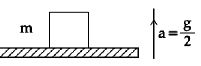
A block of mass $m$ is kept on a platform which starts from rest with constant acceleration $g/2$ upward, as shown in figure. Work done by normal reaction on block in time $t$ is