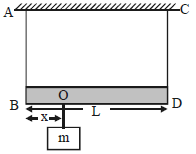
A massless rod of length $L$ is suspended by two identical strings $AB$ and $CD$ of equal length. A block of mass $m$ is suspended from point $O$ such that $BO$ is equal to $‘x’$. Further it is observed that the frequency of $1^{st}$ harmonic in $AB$ is equal to $2^{nd}$ harmonic frequency in $CD$. $‘x’$ is
Diffcult
Download our app for free and get started
Frequency of $1$ st harmonic of $AB$
$=\frac{1}{2 \ell} \sqrt{\frac{\mathrm{T}_{\mathrm{AB}}}{\mathrm{m}}}$
Frequency of $2$ nd harmonic of $\mathrm{CD}$
$=\frac{1}{\ell} \sqrt{\frac{\mathrm{T}_{\mathrm{CD}}}{\mathrm{m}}}$
Given that the two frequencies are equal.
$\therefore \frac{1}{2 \ell} \sqrt{\frac{\mathrm{T}_{\mathrm{AB}}}{\mathrm{m}}}=\frac{1}{\ell} \sqrt{\frac{\mathrm{T}_{\mathrm{CD}}}{\mathrm{m}}}$
$\Rightarrow \frac{\mathrm{T}_{\mathrm{AB}}}{4}=\mathrm{T}_{\mathrm{CD}} \Rightarrow \mathrm{T}_{\mathrm{AB}}=4 \mathrm{T}_{\mathrm{CD}}$ $...(i)$
For rotational equilibrium of massless rod, taking torque about point $O.$
$\mathrm{T}_{\mathrm{AB}} \times \mathrm{x}=\mathrm{T}_{\mathrm{CD}}(\mathrm{L}-\mathrm{x})$ $...(ii)$
For translational equilibrium,
$\mathrm{T}_{\mathrm{AB}}+\mathrm{T}_{\mathrm{CD}}=\mathrm{mg}$ $..(iii)$
On solving, $(i)$ $\&(iii)$ we get, $\mathrm{T}_{\mathrm{CD}}-\frac{\mathrm{mg}}{5}$
$\therefore \mathrm{T}_{\mathrm{AB}}=\frac{4 \mathrm{mg}}{5}$
Substituting these values in $(ii)$ we get
$\frac{4 m g}{5} \times x=\frac{m g}{5}(L-x)$
$\Rightarrow 4 \mathrm{x}=\mathrm{L}-\mathrm{x} \Rightarrow \mathrm{x}=\frac{\mathrm{L}}{5}$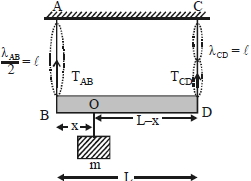

Download our appand get started for free
Experience the future of education. Simply download our apps or reach out to us for more information. Let's shape the future of learning together!No signup needed.*
Similar Questions
- 1A person blows into open-end of a long pipe. As a result, a high-pressure pulse of air travels down the pipe. When this pulse reaches the other end of the pipe then which of the following statements are true ?View Solution
$(I)$ a high-pressure pulse starts travelling up the pipe, if the other end of the pipe is open
$(II)$ a low -pressure pulse starts travelling up the pipe, if the other end of the pipe is open
$(III)$ a low pressure pulse starts travelling up the pipe, if the other end of the pipe is closed
$(IV)$ a high-pressure pulse starts travelling up the pipe, if the other end of the pipe is closed
- 2If $n _{1}, n_{2}$ and $n _{3}$ are the fundamental frequencies of three segments into which a string is divided, then the original fundamental frequency $n$ of the string is given byView Solution
- 3View SolutionWhich one of the following statements is true
- 4The linear density of a vibrating string is $1.3 \times 10^{-4}\, kg/m.$ A transverse wave is propagating on the string and is described by the equation $Y = 0.021\, \sin (x + 30t)$ where $x$ and $y$ are measured in meter and $t$ in second the tension in the string is ..... $N$View Solution
- 5View SolutionIn a stationary wave, all particles are
- 6If separation between screen and source is increased by $2\%$ what would be the effect on the intensityView Solution
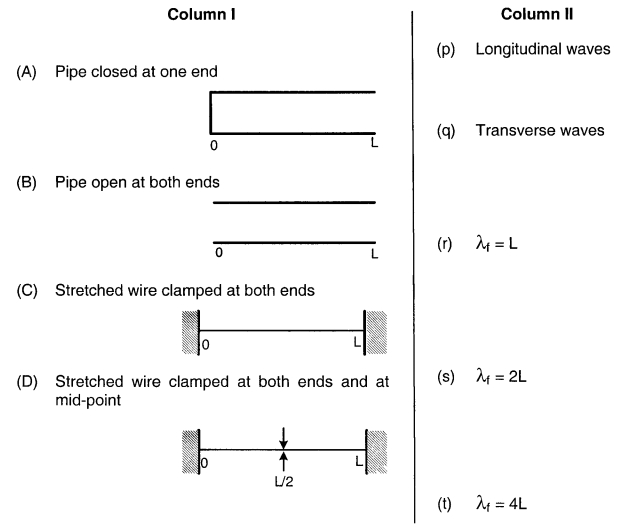
- 7Column $I$ shows four systems, each of the same length $L$, for producing standing waves. The lowest possible natural frequency of a system is called its fundamental frequency, whose wavelength is denoted as $\lambda_{ f }$. Match each system with statements given in Column $II$ describing the nature and wavelength of the standing waves.View Solution
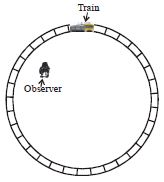
- 8An engine is moving with uniform speed along a circular track emitting a sound of frequency $400\, Hz$ as shown in the figure. Speed of engine is $30\, m/sec$ and speed of sound is $330\, m/sec$. An observer is standing inside the track. Maximum frequency observed by the observer isView Solution
- 9The equation of a stationary wave is $y = 0.8\cos \,\left( {\frac{{\pi x}}{{20}}} \right)\sin 200\,\pi t$, where $x$ is in $cm$ and $t$ is in sec. The separation between consecutive nodes will be..... $cm$View Solution
- 10View SolutionIn a harmonium the intermediate notes between a note and its octave form