Question
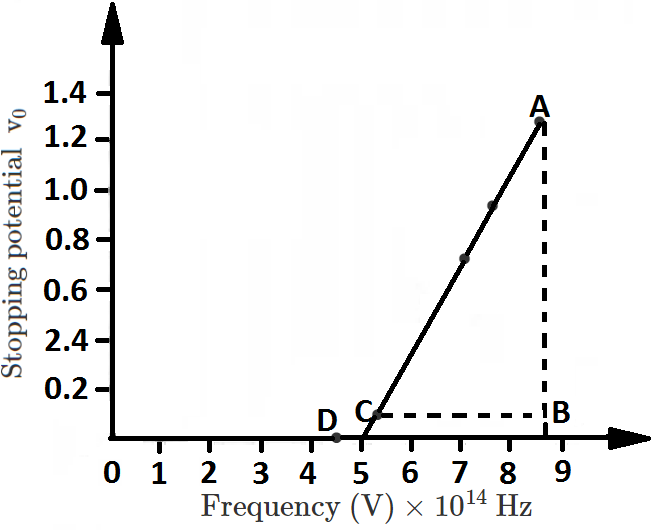
A mercury lamp is a convenient source for studying frequency dependence of photoelectric emission,
Since it gives a number of spectral lines ranging from the $UV$ to the red end of the visible spectrum. In our experiment with rubidium photo $-$ cell, the following lines from a mercury source were used:
$\lambda_1=3650\ \mathring{\text{A}},\ \lambda_2=4047\ \mathring{\text{A}},\ \lambda_3=4358\ \mathring{\text{A}},\ \lambda_4=5461\ \mathring{\text{A}},\ \lambda_5=6907\ \mathring{\text{A}},$
The stopping voltages, respectively, were measured to be:
$V_{01} = 1.28 V, V_{02} = 0.95 V, V_{03} = 0.74 V, V_{04} = 0.16 V, V_{05} = 0 V$
Determine the value of Planck’s constant h, the threshold frequency and work function for the material.
[Note: You will notice that to get h from the data, you will need to know $e \ ($which you can take to be $1.6 \times 10^{–19} C)$. Experiments of this kind on $\text{Na, Li, K,}$ etc. were performed by Millikan, who, using his own value of e $($from the oil $-$ drop experiment) confirmed Einstein’s photoelectric equation and at the same time gave an independent estimate of the value of $h.]$
Since it gives a number of spectral lines ranging from the $UV$ to the red end of the visible spectrum. In our experiment with rubidium photo $-$ cell, the following lines from a mercury source were used:
$\lambda_1=3650\ \mathring{\text{A}},\ \lambda_2=4047\ \mathring{\text{A}},\ \lambda_3=4358\ \mathring{\text{A}},\ \lambda_4=5461\ \mathring{\text{A}},\ \lambda_5=6907\ \mathring{\text{A}},$
The stopping voltages, respectively, were measured to be:
$V_{01} = 1.28 V, V_{02} = 0.95 V, V_{03} = 0.74 V, V_{04} = 0.16 V, V_{05} = 0 V$
Determine the value of Planck’s constant h, the threshold frequency and work function for the material.
[Note: You will notice that to get h from the data, you will need to know $e \ ($which you can take to be $1.6 \times 10^{–19} C)$. Experiments of this kind on $\text{Na, Li, K,}$ etc. were performed by Millikan, who, using his own value of e $($from the oil $-$ drop experiment) confirmed Einstein’s photoelectric equation and at the same time gave an independent estimate of the value of $h.]$