MCQ
$A$ metal have work function $4\, eV$ is exposed to photon of $\lambda = 1240\,\mathop A\limits^o $. If $a$ accelerating potential of $7.6\, volt$ is applied, then the electron with maximum kinetic energy will have speed equal to -
  • $2.18 × 10^6\, m/s$
  • B
    $3 × 10^8 \,m/s$
  • C
    $9.61 × 10^5\, m/s$
  • D
    $8.72 × 10^6\, m/s$

Answer

Correct option: A.
$2.18 × 10^6\, m/s$
a
$E = \left[ {\frac{{12400}}{{1240}}} \right]\,eV = 10\,eV$

$W = 4\, eV$

$KE_{max} = 6\, eV = KE_{initial}$

On applying accelerating potential of $7.6\,V$

$\Delta KE = charge × potential = 7.6\, eV$

$KE_f -KE_g = 7.6\, eV$

$KE_{final} = 7.6\, eV + 6\, eV = 13.6\, eV$

which is $KE$ of electron in $(n = 1)$ in hydrogen atom

$V = 2.188 \times 10^6\, m/s$

Need a full question paper?

Generate a complete, print-ready paper with questions like this in minutes — across 16+ boards, with answer keys.

Start Generating Free

Similar questions

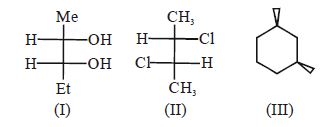
Which of the following are meso compounds
The treatment of an ester with $LiAlH_4$ followed by acid hydrolysis produces :
Optically active isomers but not mirror images are called
When methyl bromide is heated with $Zn$ it gives
Identify product $(P)$
For the alkali metals, which of the following increases with increasing atomic number?
The major product '$B$' is

$\begin{array}{*{20}{c}}
{\,\,\,\,\,\,\,\,\,\,\,C{H_3}}\\
{\,\,\,|\,\,}\\
{C{H_3} - C{H_2} - CH - C - N{H_2}}\\
{\,\,\,\,\,\,\,\,\,\,\,\,\,\,\,\,\,\,\,\,\,\,\,\,\,\,\,\,\,\,\,\,\,||}\\
{\,\,\,\,\,\,\,\,\,\,\,\,\,\,\,\,\,\,\,\,\,\,\,\,\,\,\,\,\,\,\,\,\,\,\,\,O\,\,\,}
\end{array}$ $\xrightarrow[\Delta ]{{B{r_2}/KOH}}\left( A \right)\xrightarrow{\begin{subarray}{l} 
  (1)\,\,C{H_3}I\,{\text{(excess)}} \\ 
  (2)\,AgOH/\Delta \, 
\end{subarray} }$ $(B)$

Among $Ca{H_2},N{H_3},NaH$ and ${B_2}{H_6}$, which are covalent hydride
The appropriate reagent for the transformation
Match the List-I with List-II

List-I edox Reaction)
List-II(Type of RedoxReaction)
A$\begin{array}{l} CH _{4(g)}+2 O _{2(g)}

\xrightarrow{\Delta} CO _{2(g)}+
2 H _2 O _{( l )}\end{array}$
(I)Disproportionation reaction
B$\begin{array}{l}2 NaH _{( s )} \xrightarrow{\Delta}
2 Na _{( s )}+ H _{2(g)}\end{array}$
(II)Combination reaction
C$\begin{array}{l} V _2 O _{5(s)}+5 Ca _{( s )}
\xrightarrow{\Delta} 2 V_{( s )}+
5 CaO _{( s )}\end{array}$
(III)Decomposition reaction
D$\begin{array}{l}2 H _2 O _{2( aq )}
\xrightarrow{\Delta} 2 H _2 O _{( l )}
+ O _{2(g)}\end{array}$
(IV)Displacement reaction
Choose the correct answer from the options given below :