A metal wire of length $L_1$ and area of cross section $A$ is attached to a rigid support. Another metal wire of length $L_2$ and of the same cross sectional area is attached to the free end of the first wire. A body of mass $M$ is then suspended from the free end of the second wire. If $Y_1$ and $Y_2$ are the Youngs moduli of the wires respectively, the effective force constant of the system of two wires is :
Diffcult


Download our appand get started for free
Experience the future of education. Simply download our apps or reach out to us for more information. Let's shape the future of learning together!No signup needed.*
Similar Questions
- 1Two wires of equal lengths are made of the same material. Wire $A$ has a diameter that is twice as that of wire $B$. If identical weights are suspended from the ends of these wires, the increase in length isView Solution
- 2A steel wire of length $3.2 m \left( Y _{ S }=2.0 \times 10^{11}\,Nm ^{-2}\right)$ and a copper wire of length $4.4\,M$ $\left( Y _{ C }=1.1 \times 10^{11}\,Nm ^{-2}\right)$, both of radius $1.4\,mm$ are connected end to end. When stretched by a load, the net elongation is found to be $1.4\,mm$. The load applied, in Newton, will be. (Given $\pi=\frac{22}{7}$)View Solution
- 3If Young's modulus of iron is $2 \times {10^{11}}\,N/{m^2}$ and the interatomic spacing between two molecules is $3 \times {10^{ - 10}}$metre, the interatomic force constant is ......... $N/m$View Solution
- 4A metal wire of length $0.5 m$ and cross-sectional area $10^{-4}\; m ^{2}$ has breaking stress $5 \times 10^{8}\; Nm ^{-2}$. A block of $10\; kg$ is attached at one end of the string and is rotating in a horizontal circle. The maximum linear velocity of block will be $ms ^{-1}$.View Solution
- 5When a load $W$ is hung from a wire of length $2\ L$ , it just breaks. Now this wire is completely melted and a new wire of length $L$ is formed. If the load $W$ is hung from this new wireView Solution
- 6The ratio of two specific heats of gas ${C_p}/{C_v}$ for argon is $1.6$ and for hydrogen is $1.4$. Adiabatic elasticity of argon at pressure $P$ is $E.$ Adiabatic elasticity of hydrogen will also be equal to $E$ at the pressureView Solution
- 7The following four wires of length $L$ and radius $r$ are made of the same material. Which of these will have the largest extension, when the same tension is applied?View Solution
- 8A uniform copper rod of length $50 \,cm$ and diameter $3.0 \,mm$ is kept on a frictionless horizontal surface at $20^{\circ} C$. The coefficient of linear expansion of copper is $2.0 \times 10^{-5} \,K ^{-1}$ and Young's modulus is $1.2 \times 10^{11} \,N / m ^2$. The copper rod is heated to $100^{\circ} C$, then the tension developed in the copper rod is .......... $\times 10^3 \,N$View Solution
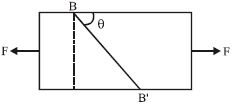
- 9A bar of cross-sectional area $A$ is subjected two equal and opposite tensile forces at its ends as shown in figure. Consider a plane $BB'$ making an angle $\theta $ with the length The ratio of tensile stress to the shearing stress on the plane $BB'$ isView Solution
- 10Auniform rod rotating in gravity free region with certain constant angular velocity. The variation of tensile stress with distance $x$ from axis of rotation is best represented by which of the following graphs.View Solution