Question
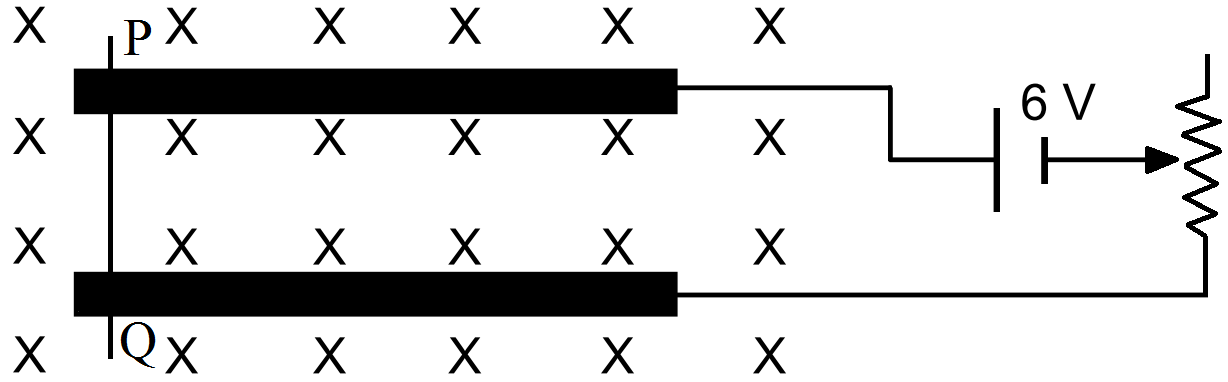
A metal wire PQ of mass 10g lies at rest on two horizontal metal rails separated by 4.90cm A vertically-downward magnetic field of magnitude 0.800T exists in the space. The resistance of the circuit is slowly decreased and it is found that when the resistance goes below 20.0Ω, the wire PQ starts sliding on the rails. Find the coefficient of friction.
Answer


$\mu\text{R}=\text{F}$
$\Rightarrow\mu\times\text{m}\times\text{g}=\text{ilB}$
$\Rightarrow\mu\times10\times10^{-3}\times9.8$
$=\frac{6}{20}\times4.9\times10^{-2}\times0.8$
$\Rightarrow\mu=\frac{0.3\times0.8\times10^{-2}}{2\times10^{-2}}=0.12$

Need a full question paper?

Generate a complete, print-ready paper with questions like this in minutes — across 16+ boards, with answer keys.

Start Generating Free

Similar questions

Which is greater; the angular velocity of the hour hand of a watch or angular velocity of earth around its own axis?
Find the magnitude and direction of the resultant of two forces $\vec{\text{P}}$ and $\vec{\text{Q}}$ in terms of their magnitudes and angle $\theta$ between them.
The horizontal range of cannon ball is $R$. If the greatest heights of two paths, for which this is possible, are $h$ and $h ^{\prime}$ then prove that
$4 \sqrt{h h^{\prime}}=R$
A ball moving with a momentum of $15kg ms^{-1}$ strikes against the wall at an angle of $30°$ and is reflected with the same momentum at the same angle. Calculate impulse.
A player throws a ball upwards with an initial speed of $29.4 \mathrm{~m} \mathrm{~s}^{-1}$. To what height does the ball rise and after how long does the ball return to the player's hands? (Take $\mathrm{g}=9.8 \mathrm{~m}^{\mathrm{s}-2}$ and neglect air resistance).
The acceleration experienced by a boat, after its engine is cut off, given by, $\frac{\text{dv}}{\text{dt}}=-\text{kv}^3,$ where k is a constant. If $v_0$ is the magnitude of velocity at cut off $(t = 0)$, find the magnitude of the velocity at a time t after the cut off.
Calculate the diameter of a molecule if $\mathrm{n}=2.79 \times 10^{25}$ molecules per $\mathrm{m}^3$ and mean free path $=2.2 \times 10^{-8}$.
One mole of an ideal gas is taken in a Carnot engine working between $27°C$ and $227°C$. The useful work done in one cycle is $600J$. Calculate the ratio of the volume of the gas at the end and beginning of the isothermal expansion. Given $R = 8.31J mole^{-1} K^{-1}$.
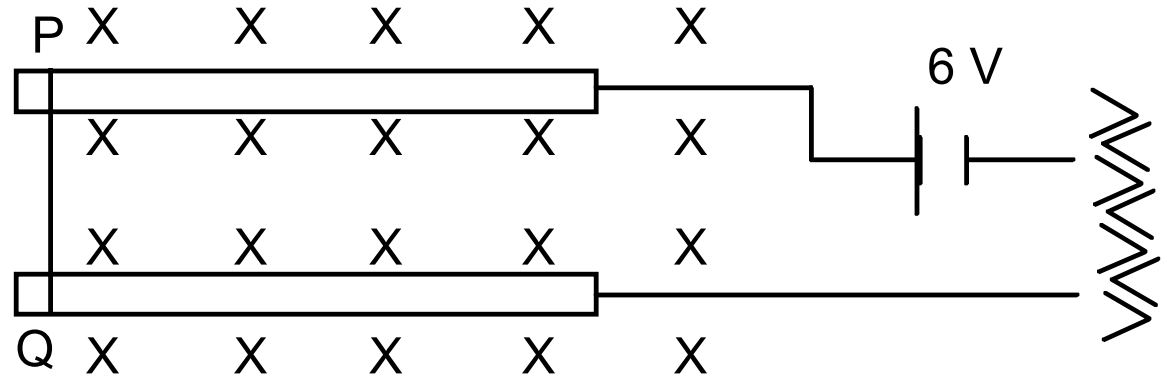
Consider the situation of the previous problem. A particle having charge q and mass m is projected from the point Q in a direction going into the plane of the diagram. It is found to describe a circle of radius r between the two plates. Find the speed of the charged particle.
Figure shows a particle sliding on a frictionless track which terminates in a straight horizontal section. If the particle starts slipping from the point A, how far away from the track will the particle hit the ground?