Question
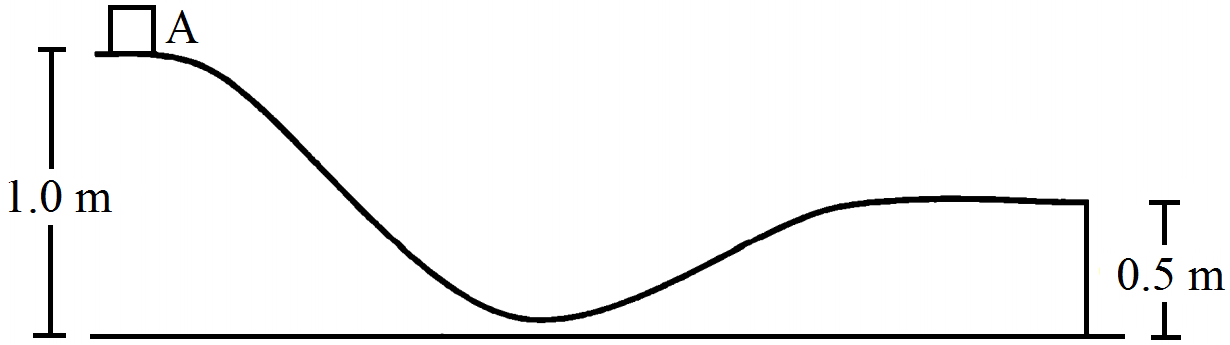
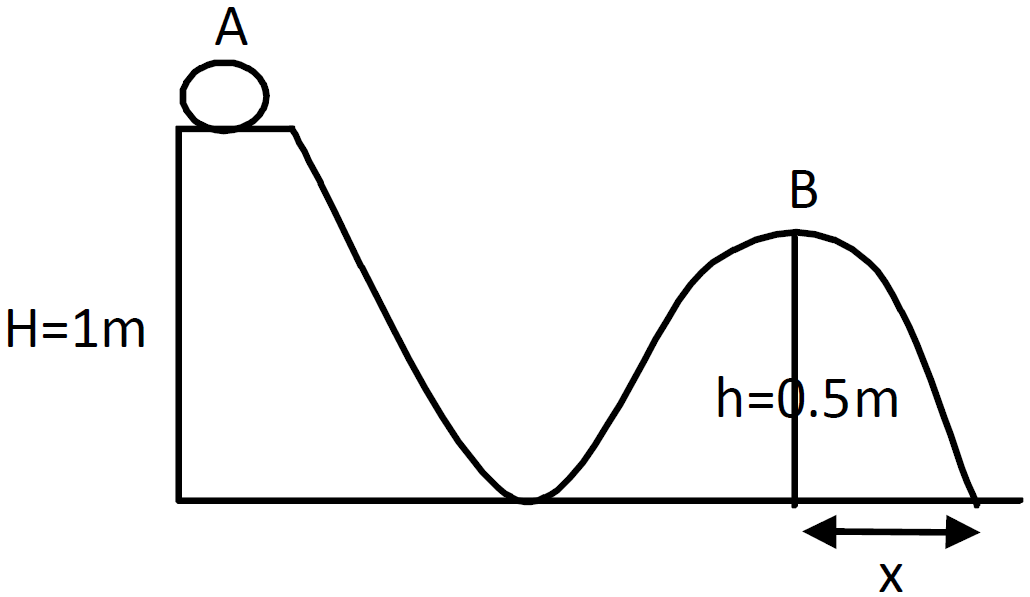
Figure shows a particle sliding on a frictionless track which terminates in a straight horizontal section. If the particle starts slipping from the point A, how far away from the track will the particle hit the ground?
Answer


H = 1m, h = 0.5mApplying law of conservation of Energy for point A & B
$\text{mgH}=\frac{1}{2}\text{mv}^2+\text{mgh}$
$\Rightarrow\text{g}=\frac{1}{2}\text{v}^2+0.5\text{g}$
$\Rightarrow\text{v}^22(\text{g}-0.59)=\text{g}$
$\Rightarrow\text{v}=\sqrt{\text{g}}=3.1\text{m}/\text{s}$
After point B the body exhibits projectile motion for which
$\theta=0^\circ,\text{v}=-0.5$
So, $-0.5=(\text{u}\sin\theta)\text{t}-\Big(\frac{1}{2}\Big)\text{gt}^2$
$\Rightarrow0.5=4.9\ \text{t}^2$
$\Rightarrow\text{t}=0.31\text{sec}$
So, $\text{x}=(\text{v}\cos\theta)\text{t}$
$=3.1\times3.1=1\text{m}$
So, the particle will hit the ground at a horizontal distance in from B.

Need a full question paper?

Generate a complete, print-ready paper with questions like this in minutes — across 16+ boards, with answer keys.
Start Generating Free

Similar questions

A cubical block of mass m and edge a slides down a rough inclined plane of inclination $\theta$ with a uniform speed. Find the torque of the normal force acting on the block about its centre.
A flywheel of moment of inertia $5.0kg-m^2$ is rotated at a speed of 60rad/s. Because of the friction at the axle, it comes to rest in $5.0$ minutes. Find:
  1. The average torque of the friction.
  2. The total work done by the friction.
  3. The angular momentum of the wheel $1$ minute before it stops rotating.
A circular hole of diameter $2.00 cm$ is made in an aluminium plate at $0^{\circ} \mathrm{C}$. What will be the diameter at $100^{\circ} \mathrm{C}$ ? $\alpha$ for aluminium $=2.3 \times 10^{-5}{ }^{\circ} \mathrm{C}^{-1}$.
The acceleration of a cart started at $t = 0$, varies with time as shown in figure. Find the distance travelled in $30$ seconds and draw the position-time graph.
The mass and diameter of a planet are twice of those of the earth. What will be the period of oscillation of a pendulum on this planet, if it is a second's pendulum on the earth?
A thin prism is made of a material having refractive indices 1.61 and 1.65 for red and violet light. The dispersive power of the material is 0.07. It is found that a beam of yellow light passing through the prism suffers a minimum deviation of 4.0° in favourable conditions. Calculate the angle of the prism.
A car travels first half of a length S with velocity $v_1$. The second half is covered with velocities $v_2$ and $v_3$ for equal time intervals. Find the average velocity of the motion.
The temperature and the relative humidity are $300K$ and $20\%$ in a room of volume $50m^3$. The floor is washed with water, $500g$ of water sticking on the floor. Assuming no communication with the surrounding, find the relative humidity when the floor dries. The changes in temperature and pressure may be neglected. Saturation vapour pressure at $300K = 3.3kPa$.
Plot the corresponding reference circle for each of the following simple harmonic motions. Indicate the initial (t = 0) position of the particle, the radius of the circle, and the angular speed of the rotating particle. For simplicity, the sense of rotation may be fixed to be anticlockwise in every case: (x is in cm and t is in s).$\text{x}=-2\sin\Big(3\text{t}+\frac{\pi}{3}\Big)$
A 0.2kg. of mass hangs at the end of a spring. When 0.02kg more mass is added to the end of the spring, it stretches 7cm more. If the 0.02kg mass is removed, what will be the period of vibration of the system?