A metallic body of material with density of $8000\ kg/m^3$ has a cavity inside. A spring balance shows its mass to be $10.0\ kg$ in air and $7.5\ kg$ when immersed in water. The ratio of the volume of the cavity to the volume of the material of the body must be
Diffcult
Download our app for free and get started
$\rho v_{2}=10(\text { in air })$
$\rho v_{2}-\rho_{\omega}\left(v_{1}+v_{2}\right)=7.5$ (in water)
$\rho_{\omega}\left(v_{1}+v_{2}\right)=2.5$
$\frac{\rho_{\omega}\left(\mathrm{v}_{1}+\mathrm{v}_{2}\right)}{\rho\left(\mathrm{v}_{2}\right)}=\frac{2.5}{10}=\frac{1}{4}$
$\frac{1000}{8000}\left(\frac{v_{1}}{v_{2}}+1\right)=\frac{1}{4}$
$\frac{v_{1}}{v_{2}}=1$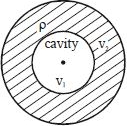

Download our appand get started for free
Experience the future of education. Simply download our apps or reach out to us for more information. Let's shape the future of learning together!No signup needed.*
Similar Questions
- 1Two water pipes $P$ and $Q$ having diameter $2 \times 10^{-2} \,m$ and $4 \times 10^{-2} \,m$ respectively are joined in series with the main supply line of water. The velocity of water flowing in pipe $P$ is ........View Solution
- 2View SolutionThe displacement of a ball falling from rest in a viscous medium is platted against time. Choose a possible option
- 3Suppose you have taken a dilute solution of oleic acid in such a way that its concentration becomes $0.01 \,cm ^{3}$ of oleic acid per $cm ^{3}$ of the solution. Then you make a thin film of this solution (monomolecular thickness) of area $4\, cm ^{2}$ by considering $100$ spherical drops of radius $\left(\frac{3}{40 \pi}\right)^{\frac{1}{3}} \times 10^{-3}\, cm .$ Then the thickness of oleic acid layer will be $x \times 10^{-14} \,m$. Where $x$ is ...... .View Solution
- 4There is a hole of area $A$ at the bottom of cylindrical vessel. Water is filled up to a height $ h$ and water flows out in $ t $ second. If water is filled to a height $4h,$ it will flow out in time equal toView Solution
- 5A table tennis ball has radius $(3 / 2) \times 10^{-2} m$ and mass $(22 / 7) \times 10^{-3} kg$. It is slowly pushed down into a swimming pool to a depth of $d=0.7 m$ below the water surface and then released from rest. It emerges from the water surface at speed $v$, without getting wet, and rises up to a height $H$. Which of the following option(s) is (are) correct?View Solution
[Given: $\pi=22 / 7, g=10 ms ^{-2}$, density of water $=1 \times 10^3 kg m ^{-3}$, viscosity of water $=1 \times 10^{-3} Pa$-s.]
$(A)$ The work done in pushing the ball to the depth $d$ is $0.077 J$.
$(B)$ If we neglect the viscous force in water, then the speed $v=7 m / s$.
$(C)$ If we neglect the viscous force in water, then the height $H=1.4 m$.
$(D)$ The ratio of the magnitudes of the net force excluding the viscous force to the maximum viscous force in water is $500 / 9$.
- 6Two bodies having volumes $V$ and $2V $ are suspended from the two arms of a common balance and they are found to balance each other. If larger body is immersed in oil (density $d_1 $ $=$ $ 0.9$ $ gm/cm^3$) and the smaller body is immersed in an unknown liquid, then the balance remain in equilibrium. The density of unknown liquid is given by ......... $gm/cm^3$View Solution
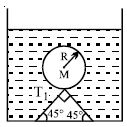
- 7A hollow sphere of mass $M$ and radius $r$ is immersed in a tank of water (density $\rho$$_w$ ). The sphere would float if it were set free. The sphere is tied to the bottom of the tank by two wires which makes angle $45^o$ with the horizontal as shown in the figure. The tension $T_1$ in the wire is :View Solution
- 8In an experiment to verify Stokes law, a small spherical ball of radius $r$ and density $\rho$ falls under gravity through a distance $h$ in air before entering a tank of water. If the terminal velocity of the ball inside water is same as its velocity just before entering the water surface, then the value of $h$ is proportional to :View Solution
(ignore viscosity of air)
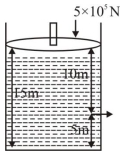
- 9Consider a cylindrical tank of radius $1 m$ is filled with water. The top surface of water is at $15\,m$ from the bottom of the cylinder. There is a hole on the wall of cylinder at a height of $5\,m$ from the bottom. A force of $5 \times 10^{5} N$ is applied an the top surface of water using a piston. The speed of efflux from the hole will be.View Solution
(given atmospheric pressure $P_{A}=1.01 \times 10^{5}\,Pa$, density of water $\rho_{ w }=1000\,kg / m ^{3}$ and gravitational acceleration $g=10\,m / s ^{2}$ )
- 10A cylindrical vessel of cross-section $A$ contains water to a height $h$ . There is a hole in the bottom of radius $'a'$ . The time in which it will be emptied isView Solution