Consider a cylindrical tank of radius $1 m$ is filled with water. The top surface of water is at $15\,m$ from the bottom of the cylinder. There is a hole on the wall of cylinder at a height of $5\,m$ from the bottom. A force of $5 \times 10^{5} N$ is applied an the top surface of water using a piston. The speed of efflux from the hole will be.
(given atmospheric pressure $P_{A}=1.01 \times 10^{5}\,Pa$, density of water $\rho_{ w }=1000\,kg / m ^{3}$ and gravitational acceleration $g=10\,m / s ^{2}$ )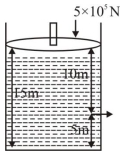
JEE MAIN 2022, Diffcult


Download our appand get started for free
Experience the future of education. Simply download our apps or reach out to us for more information. Let's shape the future of learning together!No signup needed.*
Similar Questions
- 1View SolutionA boy carries a fish in one hand and a bucket(not full) of water in the other hand . If he places the fish in the bucket , the weight now carried by him (assume that water does not spill) :
- 2If pressure at half the depth of a lake is equal to $2/3$ pressure at the bottom of the lake then what is the depth of the lake ........ $m$View Solution
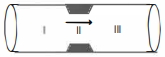
- 3The platelets are drifting with the blood flowing in a streamline flow through a horizontal artery as shown below Artery is contracted in region $II$. Choose the correct statement.View Solution
- 4A heavy hollow cone of radius $R$ and height $h$ is placed on a horizontal table surface, with its flat base on the table. The whole volume inside the cone is filled with water of density $\rho$ . The circular rim of the cone’s base has a watertight seal with the table’s surface and the top apex of the cone has a small hole. Neglecting atmospheric pressure find the total upward force exerted by water on the cone isView Solution
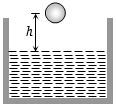
- 5A ball of radius $r $ and density $\rho$ falls freely under gravity through a distance $h$ before entering water. Velocity of ball does not change even on entering water. If viscosity of water is $\eta$, the value of $h$ is given byView Solution
- 6The weight of a body in water is one third of its weight in air. The density of the body is ....... $g / cm ^3$View Solution
- 7If two liquids of same masses but densities ${\rho _1}$ and ${\rho _2}$ respectively are mixed, then density of mixture is given byView Solution
- 8The water is filled upto height of $12\, {m}$ in a tank having vertical sidewalls. A hole is made in one of the walls at a depth $'{h}'$ below the water level. The value of $'h'$ for which the emerging stream of water strikes the ground at the maximum range is $.....\,{m}$.View Solution
- 9View SolutionSelect wrong statement about pressure ..........
- 10If the terminal speed of a sphere of gold ( density $= 19.5 kg/m^3$) is $0.2\ m/s$ in a viscous liquid (density $= 1.5\ kg/m^3$ ), find the terminal speed (in $m/s$) of a sphere of silver (density $= 10.5\ kg/m^3$) of the same size in the same liquid ...... $m/s$View Solution