Question
A metallic loop is placed in a nonuniform magnetic field. Will an emf be induced in the loop?

Answer

As the magnetic field is non uniform thus it will induce only small electric field in different directions so there would be no net current in the loop.

Need a full question paper?

Generate a complete, print-ready paper with questions like this in minutes — across 16+ boards, with answer keys.

Start Generating Free

Similar questions

Read the passage given below and answer the following questions from 1 to 5.
The gravitational potential energy of an object at a point above the ground is defined as the work done in raising it from the ground by height h to that point against gravity. Let the work done on the object against gravity be W. That is, work done,
W = force × displacement
= mg × h
Therefore potential energy (PE) = mg*h. The dimensions of potential energy are [ML2T-2] and the unit is joule (J), the same as kinetic energy or work. To reiterate, the change in potential energy, for a conservative force, $\triangle\text{V}$ is equal to the negative of the work done by the force $\triangle\text{v}=−\text{F}(\text{x})\triangle\text{x}.$
Conservation of mechanical energy: Suppose that a body undergoes displacement $\triangle\text{x}$ under the action of a conservative force F. Then from the WE theorem we have, $ \triangle\text{K}=\text{F}(\text{x})\triangle\text{x}$
If the force is conservative, the potential energy function V(x) can be defined such that
$-\triangle\text{V}=\text{F}(\text{x})\triangle\text{x}$
The above equations imply that $\triangle\text{K}+\triangle\text{V}=0$  or $\triangle(\text{K}+\text{V})=0.$
Which means that K + V, the sum of the kinetic and potential energies of the body is a constant? Over the whole path, xi to xf, this means that Ki + V(xi ) = Kf + V(xf ). The quantity K +V(x), is called the total mechanical energy of the system. Individually the kinetic energy K and the potential energy V(x) may vary from point to point, but the sum is a constant. The aptness of the term ‘conservative force’ is now clear.
Let us consider some of the definitions of a conservative force.
  • A force F(x) is conservative if it can be derived from a scalar quantity V(x).
  • The work done by the conservative force depends only on the end points. This can be seen from the relation, W = Kf – Ki = V (xi ) – V(xf ) which depends on the end points.
  • A third definition states that the work done by this force in a closed path is zero. This is once again apparent since xi = xf .
Thus, the principle of conservation of total mechanical energy can be stated as the total mechanical energy of a system is conserved if the forces, doing work on it, are conservative.
  1. Dimensions of potential energy is given by:
  1. [ML2T-2]
  2. [M2 L2T-2]
  3. [ML3T-3]
  4. None of the above
  1. SI unit of potential energy is:
  1. Joule(J)
  2. Newton meter(N-m)
  3. Both a and b
  4. None of these
  1. Define the gravitational potential energy.
  1. Define conservative force.
  1. State conservation of mechanical energy.
A body of mass 2 kg initially at rest moves under the action of an applied horizontal force of 7N on a table with coefficient of kinetic friction = 0.1. Compute the
(a) work done by the applied force in 10 s,
(b) work done by friction in 10 s,
(c) work done by the net force on the body in 10 s,
(d) change in kinetic energy of the body in 10 s, and interpret your results.
Read the case study given below and answer any four subparts:
Potential energy is the energy stored within an object, due to the object's position, arrangement or state. Potential energy is one of the two main forms of energy, along with kinetic energy. Potential energy depends on the force acting on the two objects.

  1. A body is falling freely under the action of gravity alone in vacuum. Which of the following quantities remain constant during the fall?
    1. kinetic energy
    2. potential energy
    3. mechanical energy
    4. none of these
  2. Work done by a conservative force is positive, if
    1. potential energy decreases
    2. potential energy increases
    3. kinetic energy decreases
    4. kinetic energy increases
  3. When does the potential energy of a spring increases?
    1. only when spring is stretched
    2. only when spring is compressed 
    3. both a and b
    4. none of these
  4. Dimension of k/m is, here k is force constant
    1. T2
    2. T-2
    3. T1
    4. T-1
  5. A vehicle of mass 5000kg climbs up a hill of 10 m. The potential energy gained by it
    1. 5J
    2. 500J
    3. 5 × 104J
    4. 5 × 105J
A spring balance has a scale that reads from 0 to 50 kg . The length of the scale is 20 cm . A body suspended from this balance, when displaced and released, oscillates with a period of 0.6 s . What is the weight of the body ?
The saturation current from a thoriated-tungsten cathode at 2000K is 100mA. What will be the saturation current for a pure-tungsten cathode of the same surface area operating at the same temperature? The constant A in the Richardson-Dushman equation is 60 × 104Am-2K-2 for pure tungsten and 3.0 × 10⁴Am-2k-2 for thoriated tungsten. The work function of pure tungsten is 4.5eV and that of thoriated tungsten is 2.6eV.
Cathode rays are passing through a discharge tube. In the tube, there is:
  1. An electric field but no magnetic field.
  2. A magnetic field but no electric field.
  3. An electric as well as a magnetic field.
  4. Neither an electric nor a magnetic field.
Read the passage given below and answer the following questions from (i) to (v).
When an object follows a circular path at a constant speed, the motion of the object is called uniform circular motion. The word
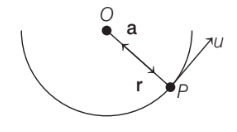
uniform refers to the speed which is uniform (constant) throughout the motion. Although the speed does not vary, the particle is accelerating because the velocity changes its direction at every point on the circular track. The figure shows a particle P which moves along a circular track of radius r with a uniform speedu.

  1. A circular motion:
  1. Is one-dimensional motion.
  2. Is two-dimensional motion.
  3. It is represented by combination of two variable vectors.
  4. Both (b) and (c)
  1. For a particle performing uniform circular motion, choose the incorrect statement from the following.
  1. Magnitude of particle velocity (speed) remains constant.
  2. Particle velocity remains directed perpendicular to radius vector.
  3. Direction of acceleration keeps changing as particle moves.
  4. Angular momentum is constant in magnitude but direction keeps changing.
  1. Two cars A and B move along a concentric circular path of radius rA and rB with velocities vA and vB maintaining constant distance, then $\frac{\text{v}_{\text{A}}}{\text{v}_\text{B}}$ is equal to:
  1. $\frac{\text{r}_{\text{B}}}{\text{r}_\text{A}}$
  2. $\frac{\text{r}_{\text{A}}}{\text{r}_\text{B}}$
  3. $\frac{\text{r}_{\text{A}}^2}{\text{r}_\text{B}^2}$
  4. $\frac{\text{r}_{\text{B}}^2}{\text{r}_\text{A}^2}$
  1. A car runs at a constant speed on a circular track of radius 100m, taking 62.8s for every circular lap. The average velocity and average speed for each circular lap, respectively is:
  1. 0,0
  2. 0,10ms-1
  3. 10ms-1, 10ms-1
  4. 10ms-1, 0
  1. A particle is revolving at 1200 rpm in acircle of radius 30cm. Then, its acceleration is:
  1. 1600ms-2
  2. 4740ms-2
  3. 2370ms-2
  4. 5055ms-2
Read the passage given below and answer the following questions from 1 to 5.

PE of Spring

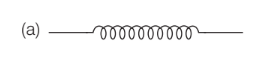
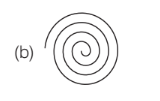
There are many types of spring. Important among these are helical and spiral springs as shown in figure.

Usually, we assume that the springs are massless. Therefore, work done is stored in the spring in the form of elastic potential energy of the spring. Thus, potential energy of a spring is the energy associated with the state of compression or expansion of an elastic spring.
 

  1. The potential energy of a body is increases in which of the following cases?
  1. If work is done by conservative force
  2. If work is done against conservative force
  3. If work is done by non-conservative force
  4. If work is done against non- conservative force
  1. The potential energy, i.e. U (x) can be assumed zero when:
  1. x = 0
  2. gravitational force is constant
  3. infinite distance from the gravitational source
  4. All of the above
  1. The ratio of spring constants of two springs is 2 : 3. What is the ratio of their potential energy, if they are stretched by the same force?
  1. 2 : 3
  2. 3 : 2
  3. 4 : 9
  4. 9 : 4
  1. The potential energy of a spring increases by 15 J when stretched by 3cm. If it is stretched by 4cm, the increase in potential energy is:
  1. 27 J
  2. 30 J
  3. 33 J
  4. 36 J
  1. The potential energy of a spring when stretched through a distance x is 10 J. What is the amount of work done on the same spring to stretch it through an additional distance x?
  1. 10 J
  2. 20 J
  3. 30 J
  4. 40 J
The half-life of 226Ra is 1602y. Calculate the activity of 0.1g of RaCl2 in which all the radium is in the form of 226Ra. Taken atomic weight of Ra to be 226g/mol-1 and that of Cl to be 35.5g/mol-1.
A person is standing on a weighing machine placed on the floor of an elevator. The elevator starts going up with some acceleration, moves with uniform velocity for a while and finally decelerates to stop. The maximum and the minimum weights recorded are 72kg and 60kg. Assuming that the magnitudes of the acceleration and the deceleration are the same, find:
  1. The true weight of the person.
  2. The magnitude of the acceleration. Take g = 9.9m/s2.
​​​​​​​