Question
The saturation current from a thoriated-tungsten cathode at 2000K is 100mA. What will be the saturation current for a pure-tungsten cathode of the same surface area operating at the same temperature? The constant A in the Richardson-Dushman equation is 60 × 104Am-2K-2 for pure tungsten and 3.0 × 10⁴Am-2k-2 for thoriated tungsten. The work function of pure tungsten is 4.5eV and that of thoriated tungsten is 2.6eV.

Answer

$\text{i}=\text{AST}^2\text{ e}^{\frac{-\phi}{\text{KT}}}$

$\text{i}_1=\text{i},\ \text{i}_2=100\text{mA}$

$\text{A}_1=60\times10^4,\ \text{A}_2=3\times10^4$

$\text{S}_1=\text{S},\ \text{S}_2=\text{S}$

$\text{T}_1=2000,\ \text{T}_2=2000$

$\phi_1=4.5\text{eV},\ \phi_2 =2.6\text{eV}$

$\text{i}=(60\times10^{4})(\text{S})\times(2000)^2\frac{-45\times1.6\times10^{-19}}{\text{e}^{1.38\times10^{-23}\times2000}}$

$100=(3\times10^{4})(\text{S})\times(2000)^2\frac{-2.6\times1.6\times10^{-19}}{\text{e}^{1.38\times10^{-23}\times2000}}$

Dividing the equation,

$\Rightarrow\frac{\text{i}}{100}=\text{e}^{\big[\frac{-4.5\times1.6\times10}{1.38\times2}\big(\frac{-2.6\times1.6\times10}{1.38\times20}\big)\big]}$

$\Rightarrow\frac{\text{i}}{100}=20\times\text{e}^{-11.014}$

$\Rightarrow\frac{\text{i}}{100}=20\times0.000016$

$\Rightarrow\text{i}=20\times0.0016=0.0329\text{mA}=33\mu\text{A}$

Need a full question paper?

Generate a complete, print-ready paper with questions like this in minutes — across 16+ boards, with answer keys.

Start Generating Free

Similar questions

Two heavy spheres each of mass 100 kg and radius 0.10 m are placed 1.0m apart on a horizontal table. What is the gravitational force and potential at the mid point of the line joining the centres of the spheres? Is an object placed at that point in equilibrium? If so, is the equilibrium stable or unstable?
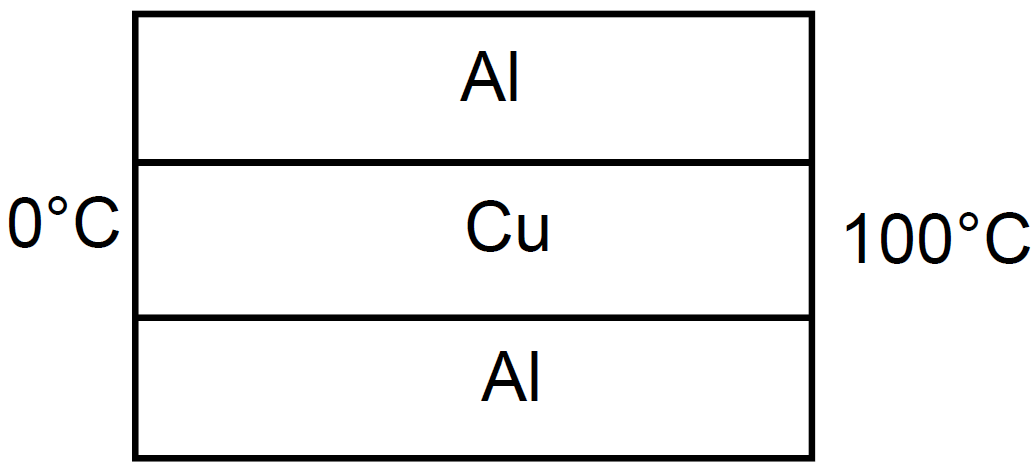
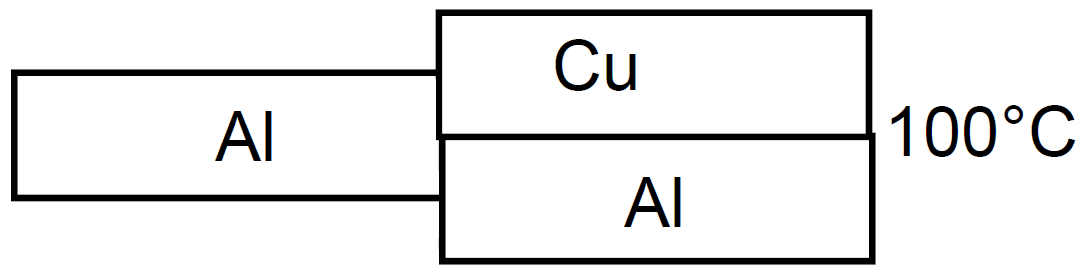
The three rods shown in figure, have identical geometrical dimensions. Heat flows from the hot end at a rate of 40 Win the arrangement (a) Find the rates of heat flow when the rods are joined as in arrangement (b) and in (c) Thermal conductivities of aluminium and copper are 200Wm-1°C-1 and 400Wm-1°C-1 respectively.

  1.  

  1.  

  1.  

Read the passage given below and answer the following questions from 1 to 5. First Law of Thermodynamics The first law of thermodynamics is the general law of conservation of energy applied to any system in which energy transfer from or to the surroundings (through heat and work) is taken into account. It states that the energy supplied to the system goes in partly to increase the internal energy of the system and the rest in work on the environment. Mathematically, $\triangle\text{Q}=\triangle\text{U}+\triangle\text{W}$ where $\triangle\text{Q}$ is the heat supplied to the system, $\triangle\text{W}$ is the work done by the system and $\triangle\text{U}$ is the change in internal energy of the system. $\triangle\text{Q}$ and $\triangle\text{W}$ depend on the path taken to go from initial to final states, but the combination $\triangle\text{Q}​​-​​\triangle\text{W}$ is path independent.

  1. The first law of thermodynamics is concerned with conservation of:
  1. Number of molecules
  2. Number of moles
  3. Energy
  4. Temperature
  1. Which of the following is not a path function?
  1. $\triangle\text{Q}$

  2. $\triangle\text{Q}​​+\triangle\text{W}$

  3. $\triangle\text{W}$

  4. $\triangle\text{Q}​​-​​\triangle\text{W}$

  1. An electric heater supplies heat to a system at a rate of 120W. If system performs work at a rate of 80 J s-1, the rate of increase in internal energy is:
  1. 30 J s-1
  2. 40 J s-1
  3. 50 J s-1
  4. 60 J s-1
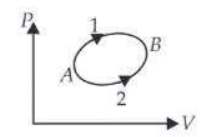
  1. Asystem goes from A to B by two different paths in the P - V diagram as shown in figure. Heat given to the system in path 1 is 1100 J, the work done by the system along path 1 is more than path 2 by 150 J. The heat exchanged by the system in path 2 is:

  1. 800 J
  2. 750 J
  3. 1050 J
  4. 950 J
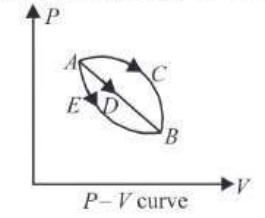
  1. A certain mass of gas is carried from A to B, along three paths via ACB, ADB and AEB. Which one of the following is correct?

  1. Work done via path ACB is minimum.
  2. Work done via path ADB is maximum.
  3. Work done via path ACB is maximum.
  4. Work done via path AEB is maximum.
Cathode rays are passing through a discharge tube. In the tube, there is:
  1. An electric field but no magnetic field.
  2. A magnetic field but no electric field.
  3. An electric as well as a magnetic field.
  4. Neither an electric nor a magnetic field.
Read the case study given below and answer any four subparts:
Potential energy is the energy stored within an object, due to the object's position, arrangement or state. Potential energy is one of the two main forms of energy, along with kinetic energy. Potential energy depends on the force acting on the two objects.

  1. A body is falling freely under the action of gravity alone in vacuum. Which of the following quantities remain constant during the fall?
    1. kinetic energy
    2. potential energy
    3. mechanical energy
    4. none of these
  2. Work done by a conservative force is positive, if
    1. potential energy decreases
    2. potential energy increases
    3. kinetic energy decreases
    4. kinetic energy increases
  3. When does the potential energy of a spring increases?
    1. only when spring is stretched
    2. only when spring is compressed 
    3. both a and b
    4. none of these
  4. Dimension of k/m is, here k is force constant
    1. T2
    2. T-2
    3. T1
    4. T-1
  5. A vehicle of mass 5000kg climbs up a hill of 10 m. The potential energy gained by it
    1. 5J
    2. 500J
    3. 5 × 104J
    4. 5 × 105J
Explain why
(a) a horse cannot pull a cart and run in empty space.
(b) passengers are thrown forward from their seats when a speeding bus stops suddenly.
(c) it is easier to pull a lawn mower than to push it.
(d) a cricketer moves his hands backward while holding a catch.
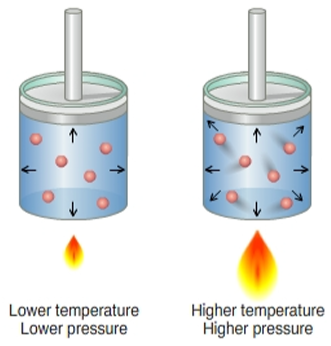
In a gas the particles are always in a state of random motion, all the particles move at different speed constantly colliding and changing their speed and direction, as speed increases it will result in an increase in its kinetic energy.
Image
1. If the temperature of the gas increases from 300 K to 600 K then the average kinetic energy becomes:
(a) same    (b) becomes double    (c) becomes half    (d) become triple
2. What is the average velocity of the molecules of an ideal gas?
(a) Infinite    (b) Same    (c) Increase    (d) Zero
3. Cooking gas containers are kept in a lorry moving with uniform speed. The temperature of the gas molecules inside will ___________.
(a) decrease    (b) Rises    (c) increase    (d) remains same
4. Find the ratio of average kinetic energy per molecule of Oxygen and Hydrogen:
(a) $1: 1$    (b) $4: 1$    (c) $1: 2$    (d) $1: 4$
OR
The velocities of the three molecules are $3 v , 4 v$, and 5 v . calculate their root mean square velocity?
(a) 4.0 v   (b) 4.02 v    (c) 4.08 v    (d) 4.04 v
The magnetometer of the previous problem is used with the same magnet in $\tan-\text{B}$ position. Where should the magnet be placed to produce a 37° deflection of the needle?
When you push your bicycle up on an incline the potential energy of the bicyle and yourself increases. Where does this energy come from?