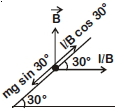
A metallic rod of mass per unit length $0.5\; kg\; m^{-1}$ is lying horizontally on a smooth inclined plane which makes an angle of $30^o$ with the horizontal. The rod is not allowed to slide down by flowing a current through it when a magnetic field of induction $0.25\; T$ is acting on it in the vertical direction. The current flowing in the rod to keep it stationary is.....$A$
NEET 2018, Medium


Download our appand get started for free
Experience the future of education. Simply download our apps or reach out to us for more information. Let's shape the future of learning together!No signup needed.*
Similar Questions
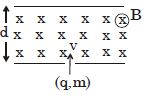
- 1View SolutionA charged particle projected in a limited magnetic field according to figure. The charged particle does not strike to the opposite plate provided
- 2A beam of electrons is moving with constant velocity in a region having electric and magnetic fields of strength $20\;V{m^{ - 1}}$ and $0.5 T$ at right angles to the direction of motion of the electrons. What is the velocity of the electrons............ $m{s^{ - 1}}$View Solution
- 3$20$ $ampere$ current is flowing in a long straight wire. The intensity of magnetic field at a distance $20\, cm$ from the wire will beView Solution
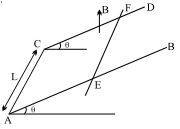
- 4$AB$ and $CD$ are smooth parallel rails, separated by a distance $l$, and inclined to the horizontal at an angle $\theta$ . $A$ uniform magnetic field of magnitude $B$, directed vertically upwards, exists in the region. $EF$ is a conductor of mass $m$, carrying a current $i$, if $B$ is normal to the plane of the railsView Solution
- 5View SolutionAssertion : Free electrons always keep on moving in a conductor even then no magnetic force act on them in magnetic field unless a current is passed through it.
Reason : The average velocity of free electron is zero.
- 6Given below are two statements: One is labelled as Assertion $A$ and the other is labelled as Reason $R$.View Solution
Assertion $A:$ For measuring the potential difference across a resistance of $600\,\Omega$, the voltmeter with resistance $1000\,\Omega$ will be preferred over voltmeter with resistance $4000\,\Omega$.
Reason $R:$ Voltmeter with higher resistance will draw smaller current than voltmeter with lower resistance.
In the light of the above statements, choose the most appropriate answer from the options given below.
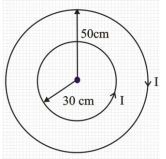
- 7Two concentric circular loops of radii $r _{1}=30\,cm$ and $r_{2}=50\,cm$ are placed in $X - Y$ plane as shown in the figure. $A$ current $I=7\,A$ is flowing through them in the direction as shown in figure. The net magnetic moment of this system of two circular loops is approximately.View Solution
- 8A moving coil galvanometer has $50$ turns and each turn has an area $2 \times 10^{-4} m ^2$. The magnetic field produced by the magnet inside the galvanometer is $0.02 T$. The torsional constant of the suspension wire is $10^{-4} N m rad ^{-1}$. When a current flows through the galvanometer, a full scale deflection occurs if the coil rotates by $0.2$ rad. The resistance of the coil of the galvanometer is $50 \Omega$. This galvanometer is to be converted into an ammeter capable of measuring current in the range $0-1.0 A$. For this purpose, a shunt resistance is to be added in parallel to the galvanometer. The value of this shunt resistance, in ohms, is. . . . . .View Solution
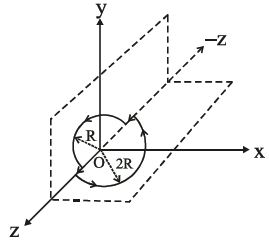
- 9In given diagram, two current carrying circular loop of radius $R$ and $2R$ are arranged in $YZ-$ plane and $XZ-$ plane respectively. Common centre of both are at origin $O$. Then what will be angle of resultant magnetic field from $X-$ axis.View Solution
- 10A proton moving with a constant velocity, passes through a region of space without change in its velocity. If $E$ $\& B$ represent the electric and magnetic fields respectively, this region may haveView Solution